Whooper Swan
Cygnus cygnus
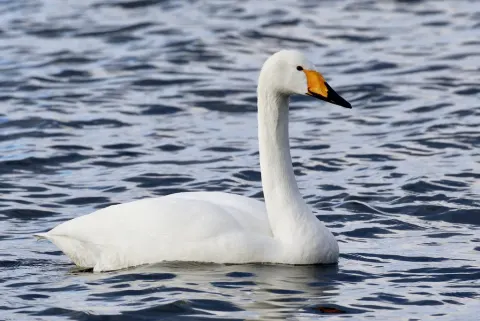
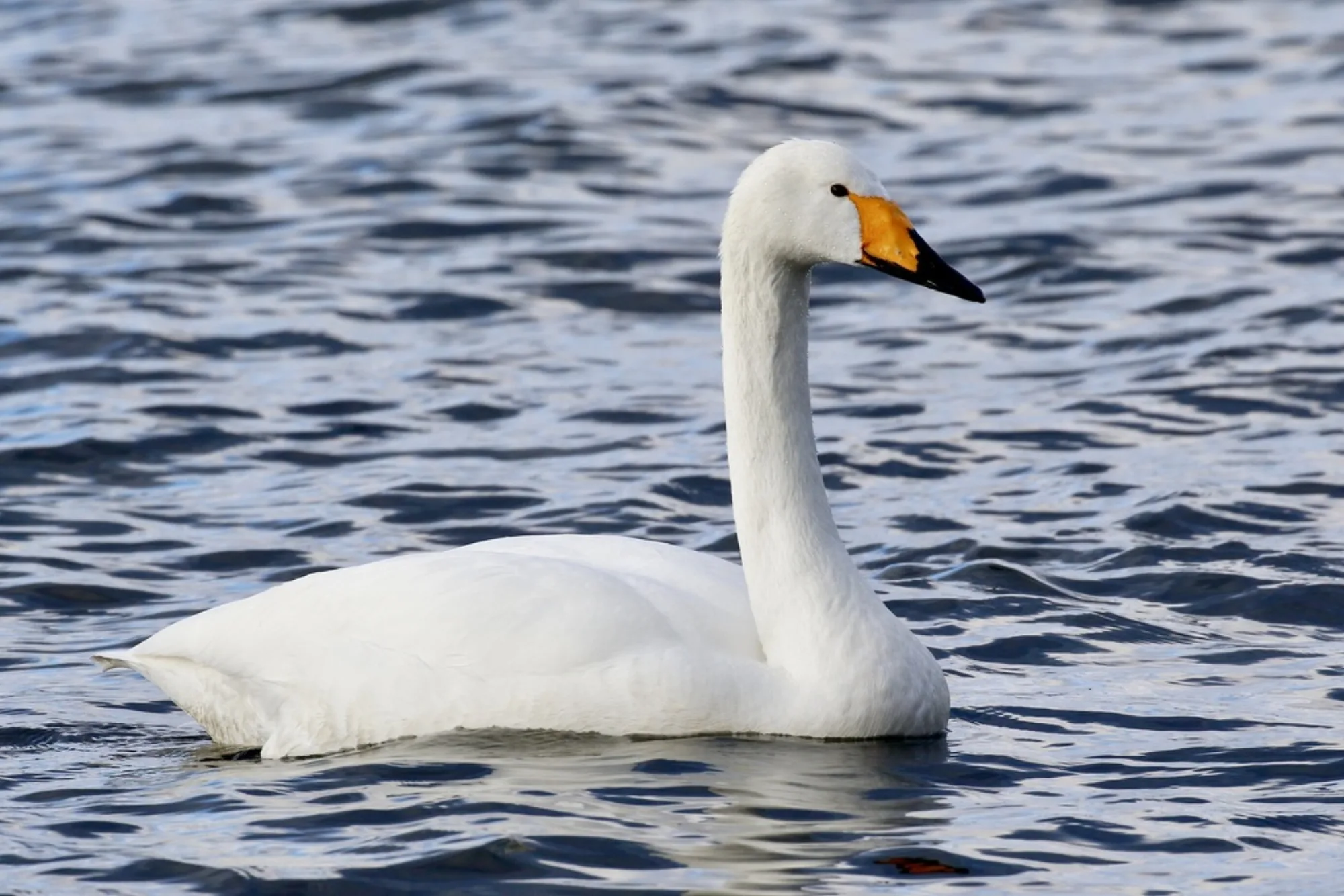
A deep, goose-like honk can announce a Whooper Swan before its powerful flight comes into view. This large northern hemisphere swan measures 140 to 165 centimetres in length, with a wingspan of 205 to 275 cm. Adults are pure white, although their heads and necks can become rusty-yellow while feeding where the water contains tannins or iron compounds. The bill shows more yellow than black, while young birds are pale grey to greyish-brown, with pink in place of the adult yellow. A shorter, rounded tail helps distinguish Whooper Swans of any age from mute swans, even when their heads are underwater.
Whooper Swans breed in subarctic Eurosiberia, including the taiga zone, and migrate south to spend winter in Europe and east to Asia. Birds breeding in Iceland spend the winter in the United Kingdom and Ireland, particularly at wildfowl nature reserves. They sometimes stop along their migration routes, and flocks use head bobs, head shakes and wing flaps to communicate before taking flight. Pairs stay together for life and build their nests in dense cover in or near water. The female mostly builds the nest from nearby vegetation and usually lays 2 to 7 eggs. She incubates them while the male normally guards the nest and surrounding territory.
Collisions with power lines and poisoning from lead are significant causes of death. Outbreaks of avian influenza can kill many birds: in England, 200 died during an outbreak at the Ouse Washes in 2025. In northern Russia, red foxes, white-tailed eagles and golden eagles are the main natural predators.
Written from the English Wikipedia article Whooper swan (CC BY-SA 4.0).
- Records
- 288,287
- Countries
- 15
No atlas park has a record of the Whooper Swan in or around it yet.
These are open occurrence records, so they show where people looked for and recorded the Whooper Swan as much as where it lives. Cells are up to 25 km across, and every location is generalised to its cell.
Generalised encounter areas, not exact locations. Each shape is a grid cell coloured by how likely the species is there.
- Very likelyNorway25 km zone · high confidence · 190058 records · updated 80 days ago
- Very likelyFinland25 km zone · high confidence · 35560 records · updated 80 days ago
- Very likelyIceland25 km zone · high confidence · 24226 records · updated 80 days ago
- Very likelyUnited Kingdom25 km zone · high confidence · 18214 records · updated 80 days ago
- Very likelySweden25 km zone · high confidence · 10983 records · updated 80 days ago
- Very likelyBelgium25 km zone · high confidence · 2813 records · updated 80 days ago
- Very likelyRussia25 km zone · high confidence · 1498 records · updated 80 days ago
- Very likelyIreland25 km zone · high confidence · 1162 records · updated 80 days ago
- Very likelyTaiwan25 km zone · high confidence · 738 records · updated 80 days ago
- Very likelySwitzerland25 km zone · high confidence · 663 records · updated 80 days ago
Conservation status not assessed here yet, so every location is generalised to its grid cell.