Tundra Swan
Cygnus columbianus
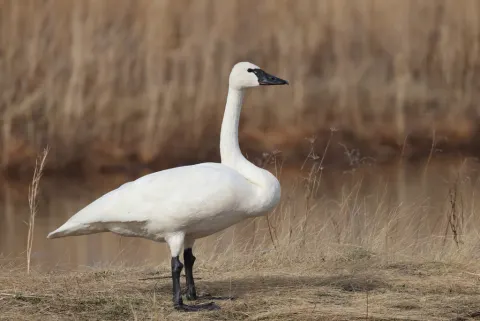
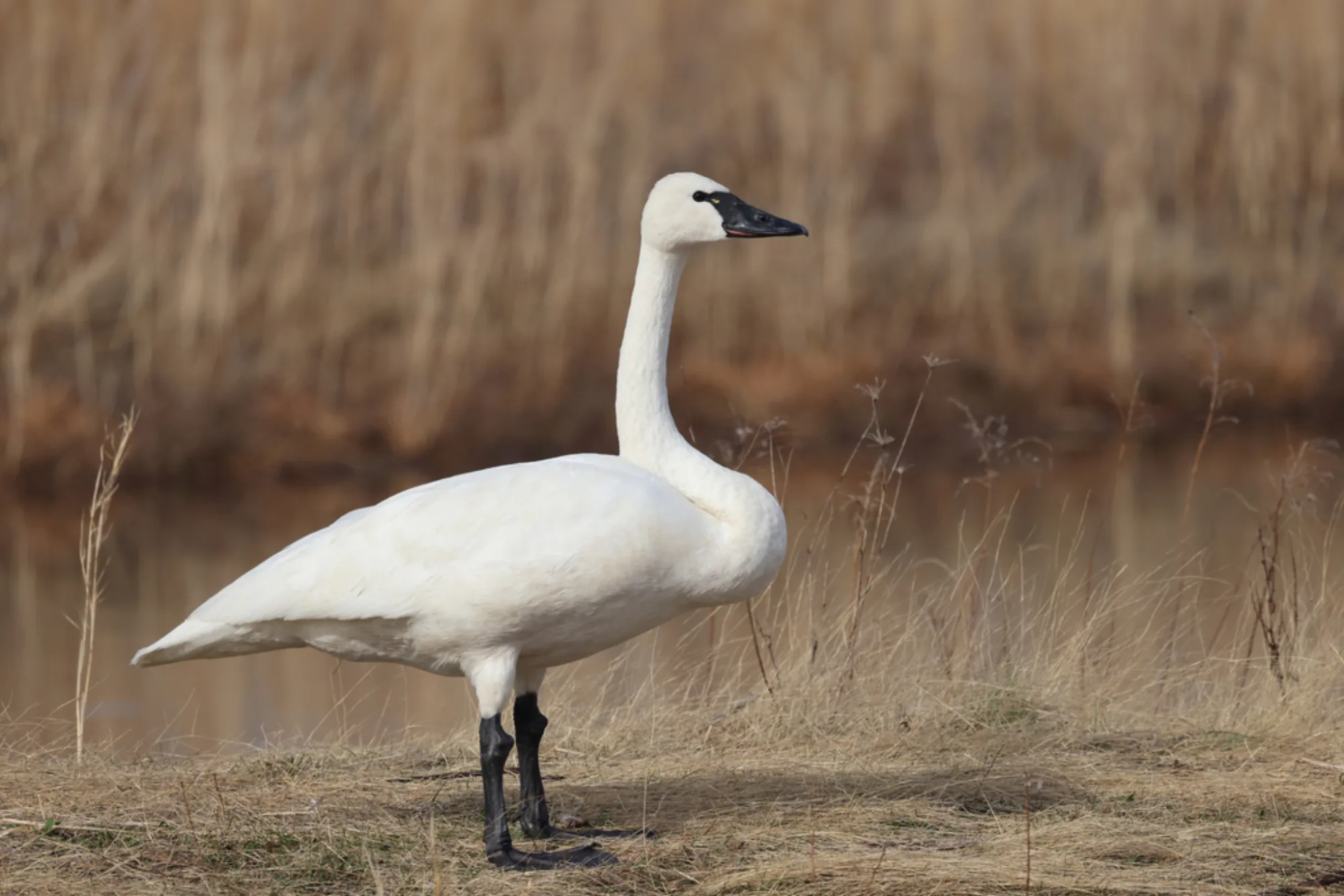
Across Arctic and subarctic tundra, the Tundra Swan breeds beside shallow pools, lakes and rivers. Measuring 115 to 150 cm long, it is the smallest swan in the Holarctic. Adults are usually white, with black feet and a mostly black bill marked with varying amounts of yellow. Young birds have some dull grey feathers, especially on the head and upper neck. A relatively short neck can give the bird the appearance of a large white goose, while its call is a high-pitched honk.
These migratory swans winter across North America, Europe and Asia, favouring marshes and grassy habitats that are often coastal. They also visit harvested fields and may pause on mountain lakes during migration. In summer they feed mainly on aquatic plants, reaching them by dipping their heads underwater or upending as they swim. At other times, they eat crops left in fields, including grain and potatoes. They forage mostly during the day. Outside the breeding season they gather in groups, but nesting birds defend territories and can be aggressive towards passing animals.
Pairs build a mound of plant material on raised ground near open water, and the female lays 2 to 7 eggs. Young swans travel with their parents on their first winter migration, and older offspring sometimes join the family on the wintering grounds. Eggs and hatchlings can be taken by Arctic foxes, parasitic jaegers and glaucous gulls, while brown bears can also raid nests. Hunting and poaching kill adults, and swallowed lead shot is another significant cause of death. Habitat destruction and water pollution reduce the aquatic vegetation available in winter, leaving the birds increasingly dependent on crops.
Written from the English Wikipedia article Tundra swan (CC BY-SA 4.0).
- Records
- 403,601
- Countries
- 4
No atlas park has a record of the Tundra Swan in or around it yet.
These are open occurrence records, so they show where people looked for and recorded the Tundra Swan as much as where it lives. Cells are up to 25 km across, and every location is generalised to its cell.
Generalised encounter areas, not exact locations. Each shape is a grid cell coloured by how likely the species is there.
- Very likelyUnited States25 km zone · high confidence · 351534 records · updated 80 days ago
- Very likelyCanada25 km zone · high confidence · 47451 records · updated 80 days ago
- Very likelyUnited Kingdom25 km zone · high confidence · 3683 records · updated 80 days ago
- Very likelyFrance25 km zone · high confidence · 933 records · updated 80 days ago
Conservation status not assessed here yet, so every location is generalised to its grid cell.