Grand Cayman Blue Iguana
Cyclura lewisi
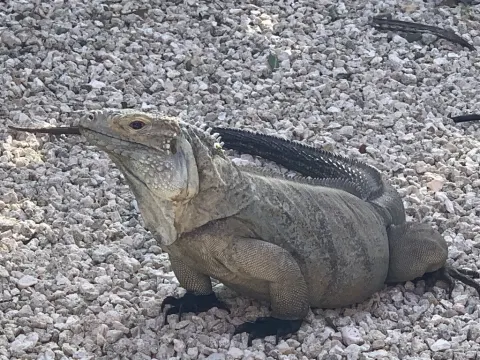
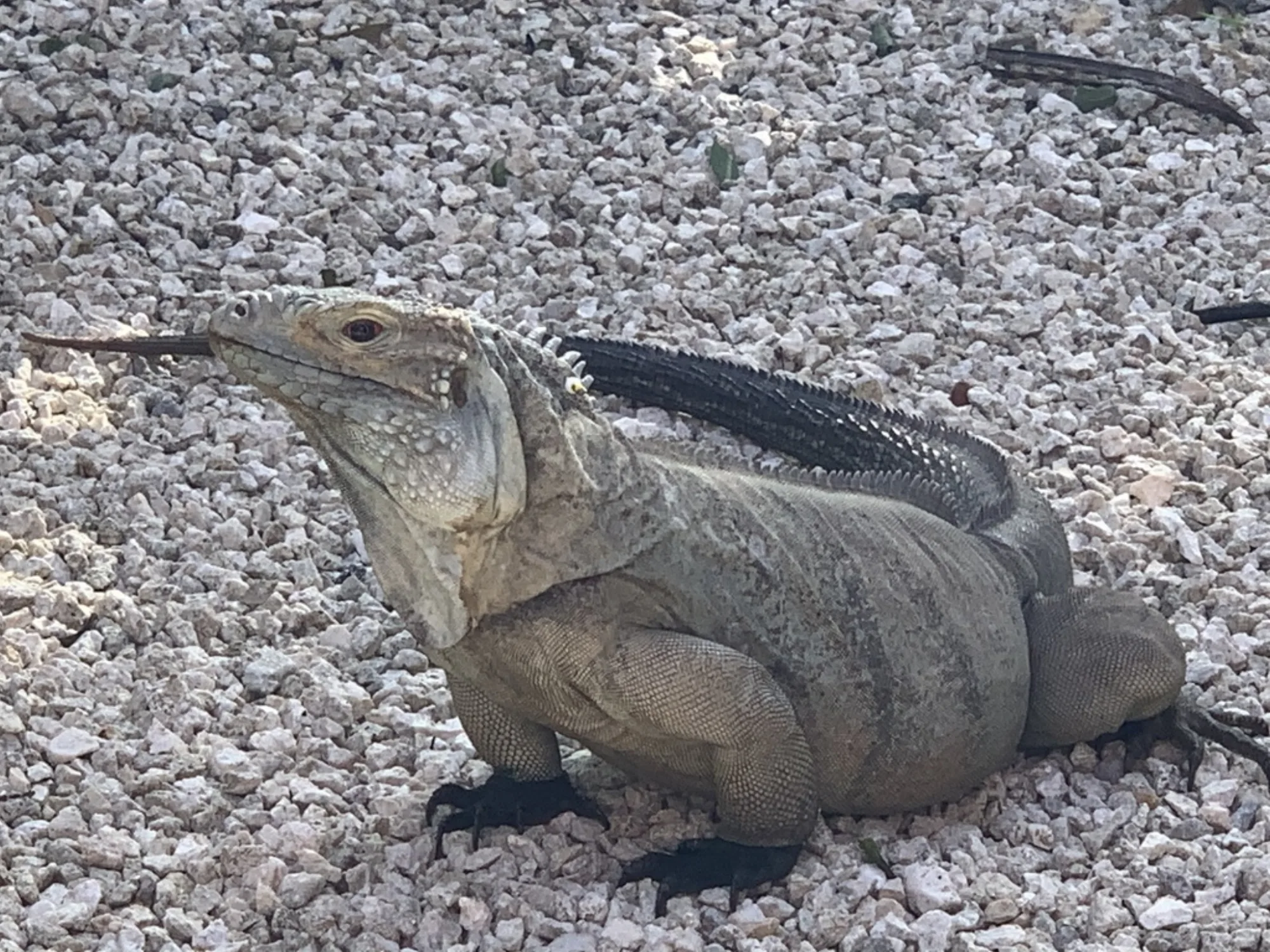
Found only on Grand Cayman, the Grand Cayman Blue Iguana (Cyclura lewisi) is a large, heavy-bodied lizard with a line of short spines running down its back and tail. It can reach 1.5 m from nose to tail and weigh as much as 14 kg. Adults are often dark grey, blending with the island's karst rock, but turn blue in the presence of other iguanas when signalling and establishing territory. Males show a stronger blue, while young animals tend to be dark brown or green with faint bands.
Look for these iguanas in rocky, sunny openings in dry forest or near the shore. Inland, they live in dry shrubland and at the edges of farm clearings, roads and gardens where these meet dry forest or shrubland. Adults spend most of their time on the ground, sheltering in rock holes and tree cavities, though they can climb trees. Their food is mostly plant material, including leaves, stems, flowers, nuts and fruit, with insects and other small animals eaten only rarely. Females often travel towards the coast to nest, usually laying 1 to 21 eggs in sunny pockets of earth in June or July. The eggs take 65 to 90 days to hatch.
Land clearance for farming, roads and development removes habitat, while the conversion of cropland to cattle pasture takes away further places where iguanas live. Rats prey on hatchlings, feral cats attack young iguanas, and pet dogs can kill adults. Road collisions also kill iguanas, which rarely survive being hit. Captive-bred animals have been released into protected areas on Grand Cayman, where restored populations have bred.
Written from the English Wikipedia article Blue iguana (CC BY-SA 4.0).
- Records
- 36
- Countries
- 1
No atlas park has a record of the Grand Cayman Blue Iguana in or around it yet.
These are open occurrence records, so they show where people looked for and recorded the Grand Cayman Blue Iguana as much as where it lives. Cells are up to 25 km across, and every location is generalised to its cell.
Generalised encounter areas, not exact locations. Each shape is a grid cell coloured by how likely the species is there.
- Very likelyCayman Islands25 km zone · medium confidence · 36 records · updated 80 days ago
Conservation status not assessed here yet, so every location is generalised to its grid cell.