Jamaican Iguana
Cyclura collei
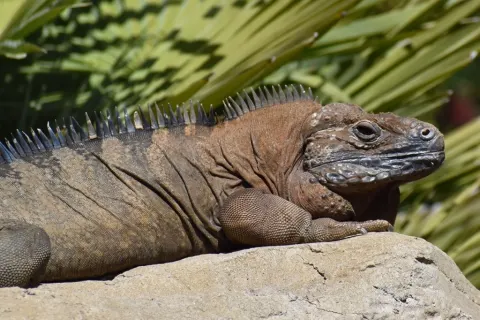
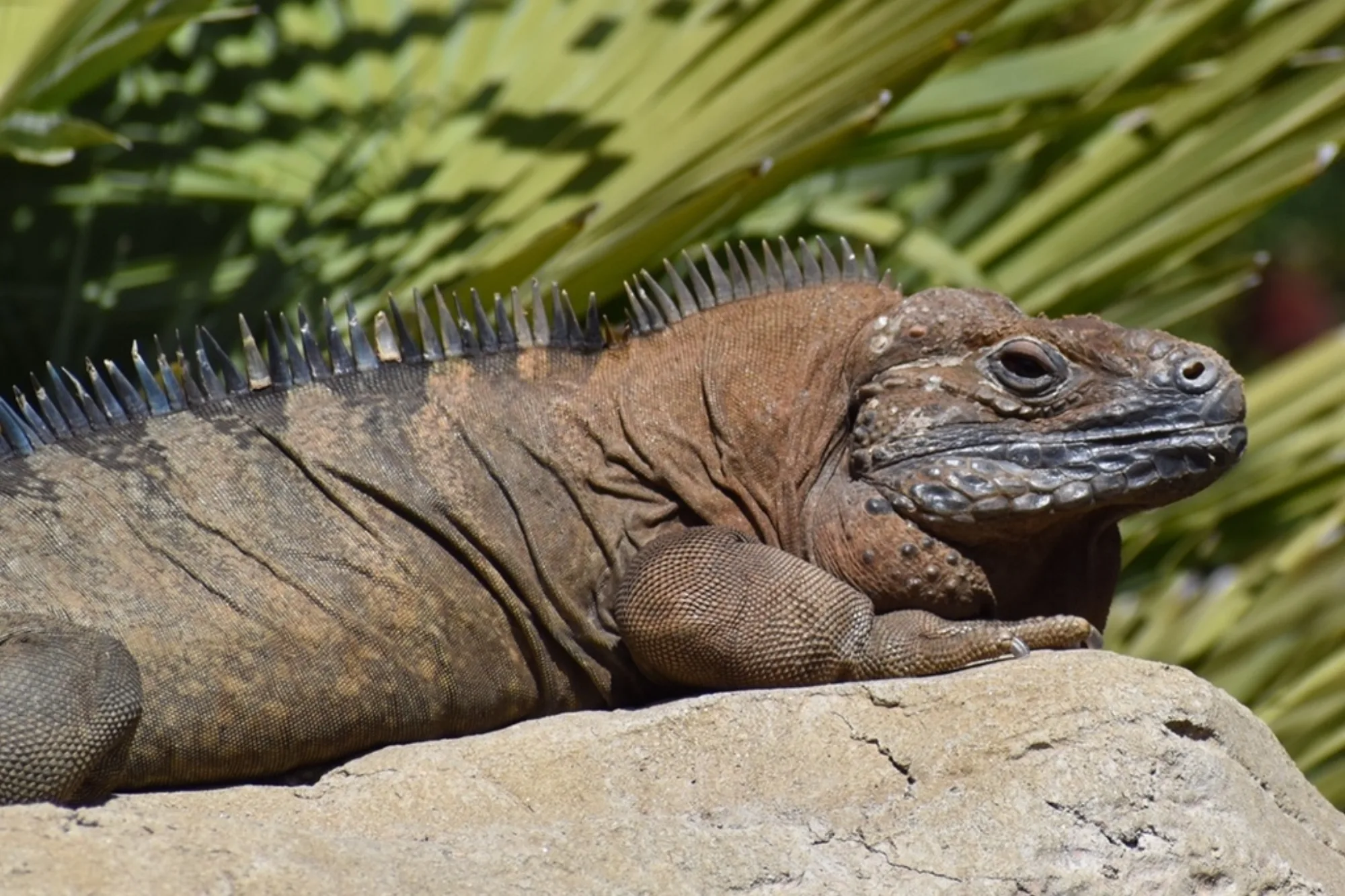
This heavy-bodied lizard is the largest land animal original to Jamaica after the island's boa. Identifying the Jamaican Iguana is easiest by its green or salty blue scales, marked with dark olive-green shoulders and three dark chevrons running from the neck to the tail. Yellowish blotches and spots cover its skin, though nesting females often look deep reddish-brown because they dig in the local soil. Males are the larger sex, reaching over 2 kilograms and 428 millimetres in length.
While these reptiles once lived across the mainland and several offshore islets, they are now restricted to the rocky limestone forests of the Hellshire Hills. This dry, dense habitat provides the leaves, flowers, and fruits of more than 100 plant species that form their primary diet. Occasionally, they might also ingest insects or snails while eating foliage. Though they were thought to be extinct for decades, a remnant population was found in 1990, and today there are between 500 and 600 mature individuals.
Survival in the wild is difficult due to invasive species and habitat loss. The introduction of the small Asian mongoose caused a massive decline because the predators eat young hatchlings. To help, researchers raise eggs and young in a protected facility until they are big enough to fend for themselves. Currently, the charcoal industry poses the greatest danger, as workers cut down the hardwood trees that provide the iguanas with their final refuge.
Written from the English Wikipedia article Jamaican iguana (CC BY-SA 4.0).
- Atlas places
- 0
These are open occurrence records, so they show where people looked for and recorded the Jamaican Iguana as much as where it lives. Cells are up to 25 km across, and every location is generalised to its cell.
No encounter zones yet
Where and when you can expect to see Jamaican Iguana is calculated from observation density. No zones have been computed for this species yet.