Blue Jay
Cyanocitta cristata
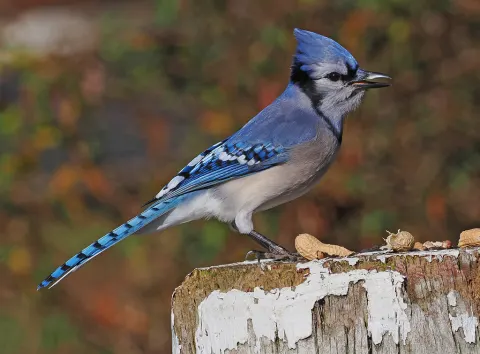
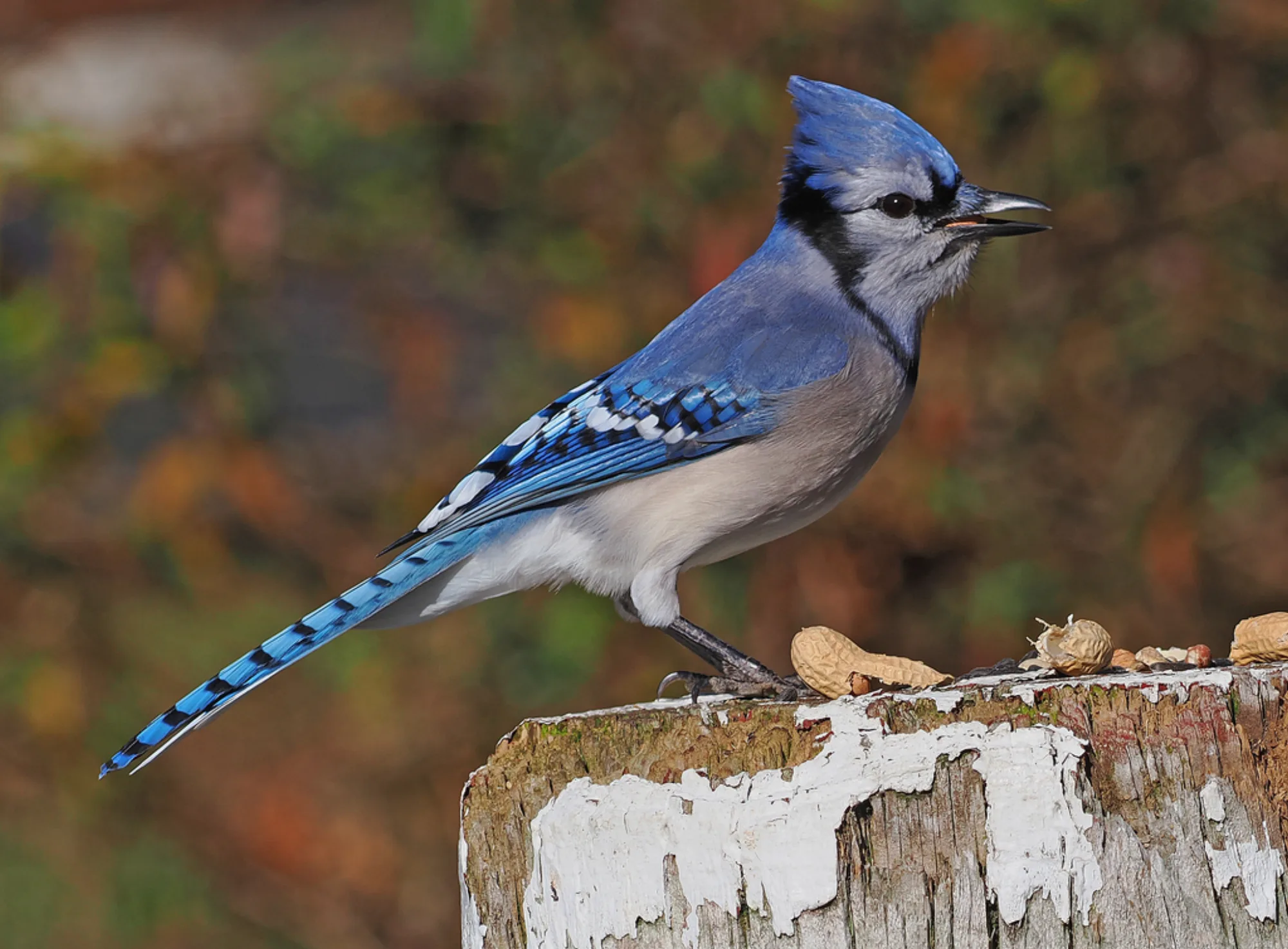
With its blue crest and black neck collar, the Blue Jay is a striking bird of eastern North America. Its face is white, its underside off-white, and its wings and tail are barred in black, blue and white. The crest changes with its mood, standing fully raised when the bird is excited or aggressive and lying flat when it rests. Males and females look much alike, and their plumage stays the same throughout the year.
Blue Jays occur across the eastern and central United States and southern Canada, reaching south to Florida and northeastern Texas. They favour mixed woodland with oaks and beeches, but also live in coniferous forests, parks and residential areas. Some migrate by day in loose flocks, while others remain through winter in every part of the range. Noisy and bold, they give a loud alarm call when danger approaches and can imitate the calls of hawks. They may chase predators away, but also defend feeders against other birds and sometimes raid nests.
Their varied diet includes acorns, seeds, fruit and small invertebrates, gathered from the ground and vegetation; they sometimes store food for later. Both parents build a cup-shaped nest, usually in a tree or large bush, and both rear the young. The fledglings travel and forage with their family until early autumn. Hawks and owls can catch adults in flight, while squirrels, snakes and other animals take eggs and young. Collisions with human-made objects and West Nile virus also cause deaths, although the disease has not appeared to reduce the overall population despite major local declines.
Written from the English Wikipedia article Blue jay (CC BY-SA 4.0).
- Records
- 7,984,979
- Countries
- 4
- Atlas places
- 2
These are open occurrence records, so they show where people looked for and recorded the Blue Jay as much as where it lives. Cells are up to 25 km across, and every location is generalised to its cell.
Generalised encounter areas, not exact locations. Each shape is a grid cell coloured by how likely the species is there.
- Very likelyUnited States25 km zone · high confidence · 6993681 records · updated 86 days ago
- Very likelyCanada25 km zone · high confidence · 990331 records · updated 86 days ago
- LikelySt. Pierre & Miquelon25 km zone · high confidence · 965 records · updated today
- RareUnited Kingdom25 km zone · medium confidence · 2 records · updated today
Conservation status not assessed here yet, so every location is generalised to its grid cell.