Eurasian Blue Tit
Cyanistes caeruleus
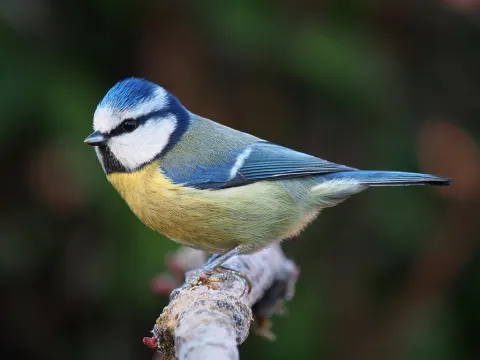
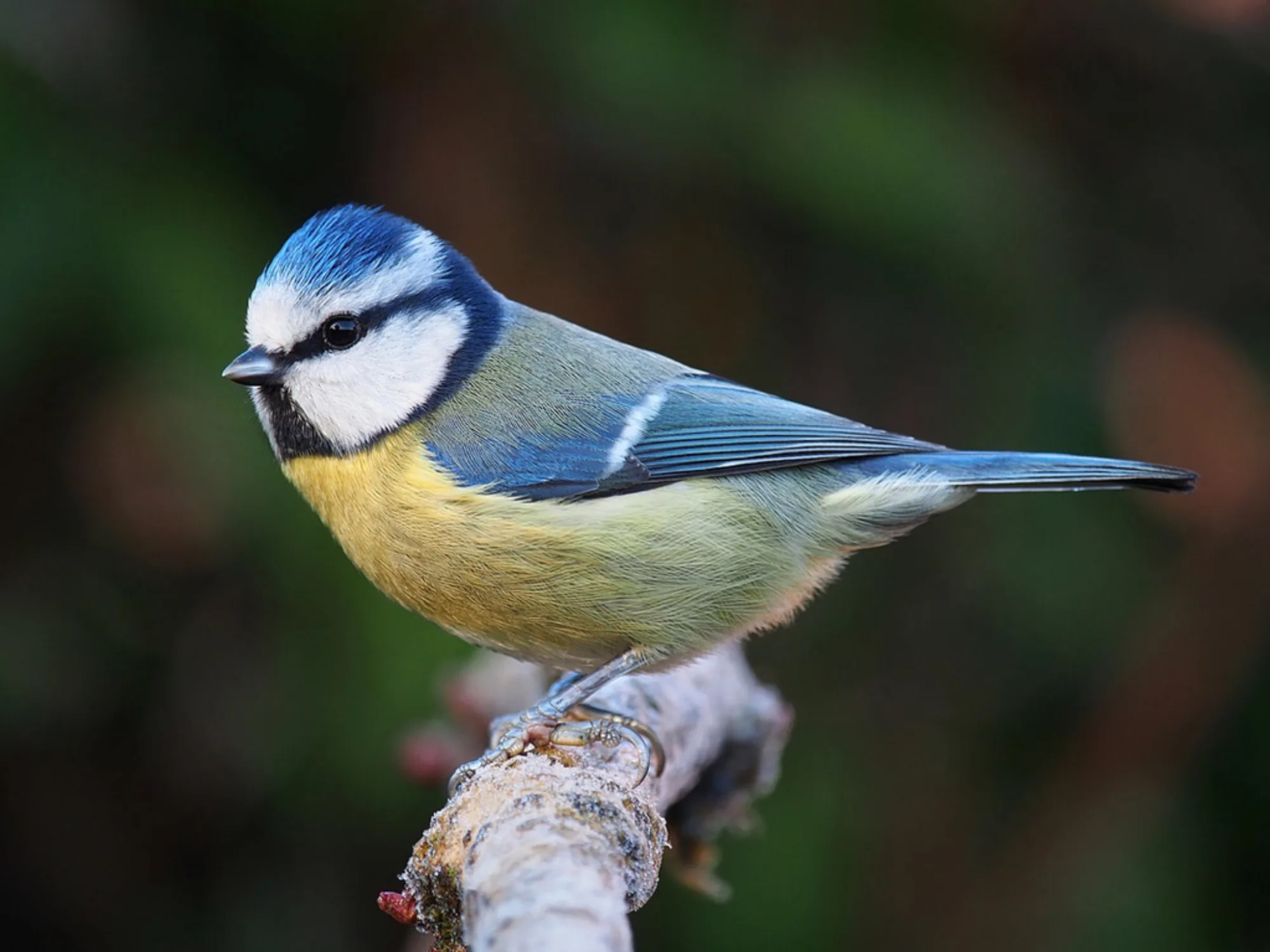
A flash of blue and yellow on a slender branch may reveal a Eurasian Blue Tit (Cyanistes caeruleus), a small member of the tit family. Its blue crown, white cheeks outlined in dark blue, yellow underparts and yellowish-green back make it distinctive. The forehead and a wing bar are white, while the wings and tail are blue. Adults are usually 10.5 to 12 cm long, and the sexes look much alike to the human eye. Young birds are more yellow and less sharply coloured.
A widespread resident breeder, it occurs across Europe's temperate and subarctic regions and reaches into western Asia; it usually stays in its range year-round. It favours deciduous or mixed woodland, often rich in oak; in Great Britain, it also visits parks, gardens and town centres. Watch for its acrobatic feeding: it grips the outer branches of trees and shrubs and hangs upside down as it searches. It eats mainly insects, spiders and other small invertebrates, adding fruit and seeds outside the breeding season. In winter, blue tits join flocks with other tit species, including great tits.
Pairs nest in holes in trees, walls or stumps, and readily use nest boxes. They line the nest with materials such as moss, wool, hair and feathers, and usually lay seven or eight eggs in April or May. The female incubates while the male feeds her. Predators include Eurasian sparrowhawks and domestic cats, while jays can catch fledglings as they leave the nest. Weasels and squirrels may raid nests, and cold, wet weather during the breeding season can be especially damaging when it coincides with the emergence of caterpillars needed by chicks.
Written from the English Wikipedia article Eurasian blue tit (CC BY-SA 4.0).
- Records
- 2,787,807
- Countries
- 55
No atlas park has a record of the Eurasian Blue Tit in or around it yet.
These are open occurrence records, so they show where people looked for and recorded the Eurasian Blue Tit as much as where it lives. Cells are up to 25 km across, and every location is generalised to its cell.
Generalised encounter areas, not exact locations. Each shape is a grid cell coloured by how likely the species is there.
- Very likelyFinland25 km zone · high confidence · 739487 records · updated 86 days ago
- Very likelyUnited Kingdom25 km zone · high confidence · 566948 records · updated 86 days ago
- Very likelySweden25 km zone · high confidence · 432781 records · updated 86 days ago
- Very likelyNorway25 km zone · high confidence · 294428 records · updated 86 days ago
- Very likelyFrance25 km zone · high confidence · 175017 records · updated 86 days ago
- Very likelyBelgium25 km zone · high confidence · 148719 records · updated 86 days ago
- Very likelySpain25 km zone · high confidence · 71440 records · updated 86 days ago
- Very likelyLuxembourg25 km zone · high confidence · 50993 records · updated 86 days ago
- Very likelyGermany25 km zone · high confidence · 49067 records · updated 86 days ago
- Very likelyPortugal25 km zone · high confidence · 35503 records · updated 86 days ago
Conservation status not assessed here yet, so every location is generalised to its grid cell.