Common Cuckoo
Cuculus canorus
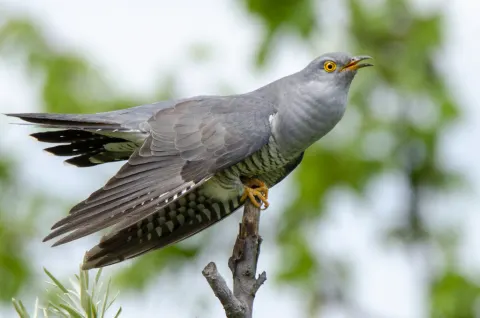
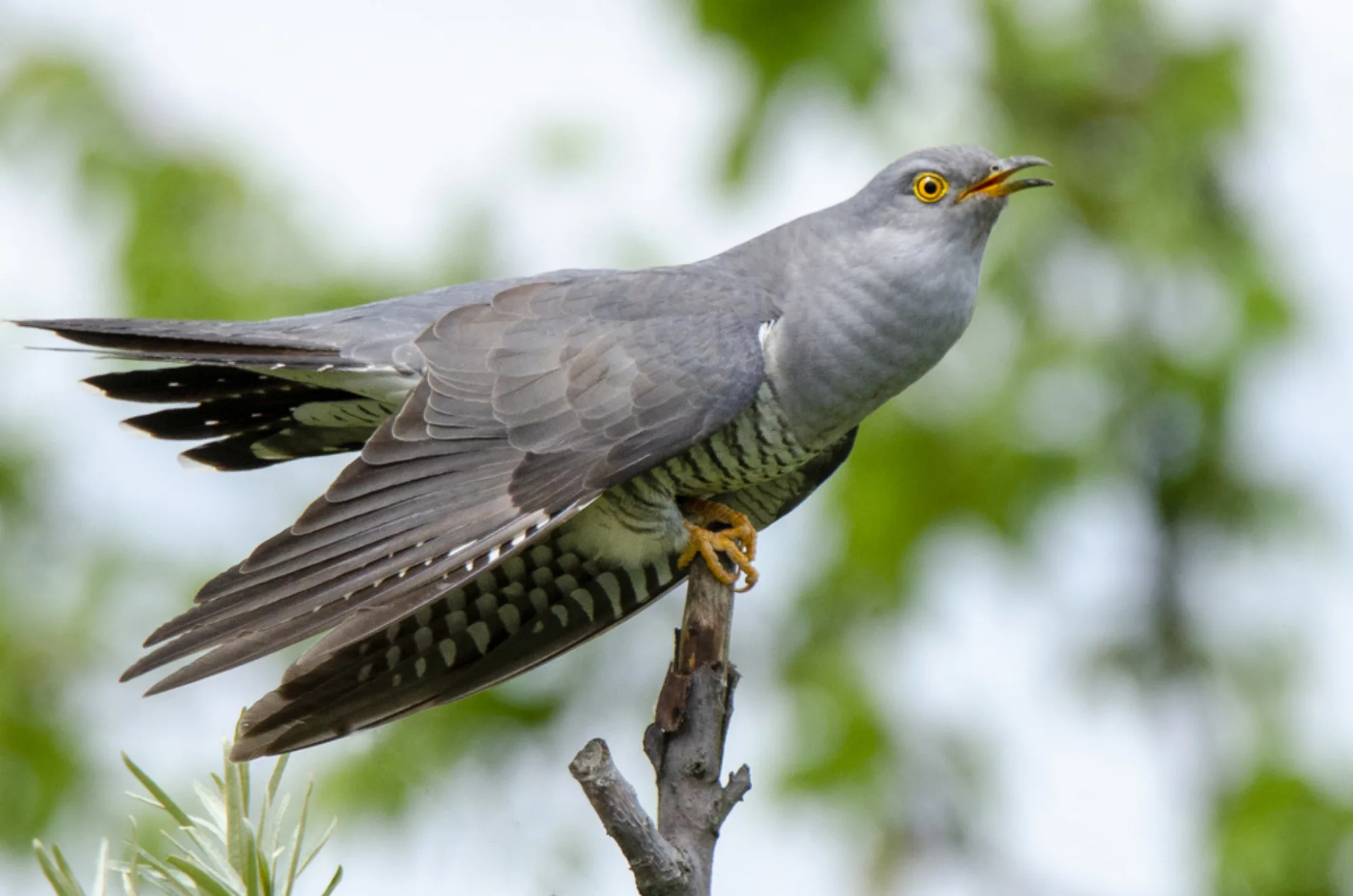
A slender grey bird with a long tail, the Common Cuckoo can resemble a sparrowhawk in flight, where its wingbeats are regular. Adult males are slate-grey, with a grey throat and breast set off sharply against barred underparts. Some adult females and many juveniles have reddish-brown colouring, while young birds can also be grey. A white patch on the back of the neck and white feather edges are useful signs of a juvenile. During the breeding season, look for cuckoos on exposed perches, sometimes with wings drooped and tail raised. The male usually sings its goo-ko song from an open perch; the female gives a loud bubbling call.
A bird of open land, the cuckoo spends summer across much of Europe and Asia and winters in Africa. In Europe, birds arrive in April and leave in September. Its range extends from Ireland and Scandinavia across northern Russia and Siberia to Japan, and includes parts of North Africa and Central Asia. Insects make up its diet, with hairy caterpillars a particular favourite, although it occasionally eats eggs and chicks. Rather than rear its own young, the female lays eggs in other birds' nests, including those of dunnocks, meadow pipits and reed warblers. Some cuckoo eggs resemble the host's eggs in colour and pattern, though eggs laid in dunnock nests differ markedly from the host's blue eggs. Once hatched, the cuckoo chick pushes the host's eggs or chicks out and is fed by the host parents. The global population appears to be declining, and in England numbers fell by 69% between 1995 and 2015, although they rose in Scotland over the same period. Sparrowhawks prey on adult cuckoos, while host birds may attack cuckoos and reject their eggs.
Written from the English Wikipedia article Common cuckoo (CC BY-SA 4.0).
- Records
- 221,198
- Countries
- 29
- Atlas places
- 1
These are open occurrence records, so they show where people looked for and recorded the Common Cuckoo as much as where it lives. Cells are up to 25 km across, and every location is generalised to its cell.
Generalised encounter areas, not exact locations. Each shape is a grid cell coloured by how likely the species is there.
- Very likelyBelgium25 km zone · high confidence · 52298 records · updated 80 days ago
- Very likelyFrance25 km zone · high confidence · 42393 records · updated 80 days ago
- Very likelyUnited Kingdom25 km zone · high confidence · 33653 records · updated 80 days ago
- Very likelyNorway25 km zone · high confidence · 18567 records · updated 80 days ago
- Very likelySpain25 km zone · high confidence · 16932 records · updated 80 days ago
- Very likelyNetherlands25 km zone · high confidence · 9989 records · updated 80 days ago
- Very likelyFinland25 km zone · high confidence · 9965 records · updated 80 days ago
- Very likelyPortugal25 km zone · high confidence · 7375 records · updated 80 days ago
- Very likelyGermany25 km zone · high confidence · 5167 records · updated 80 days ago
- Very likelyCzechia25 km zone · high confidence · 4232 records · updated 80 days ago
Conservation status not assessed here yet, so every location is generalised to its grid cell.