Grass Carp
Ctenopharyngodon idella
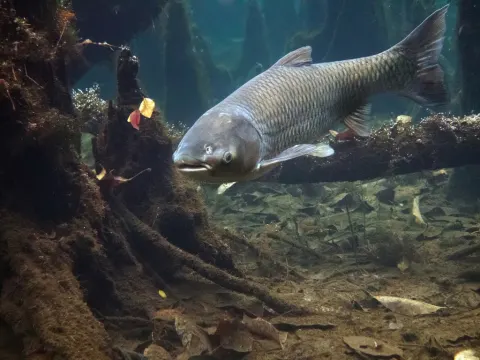
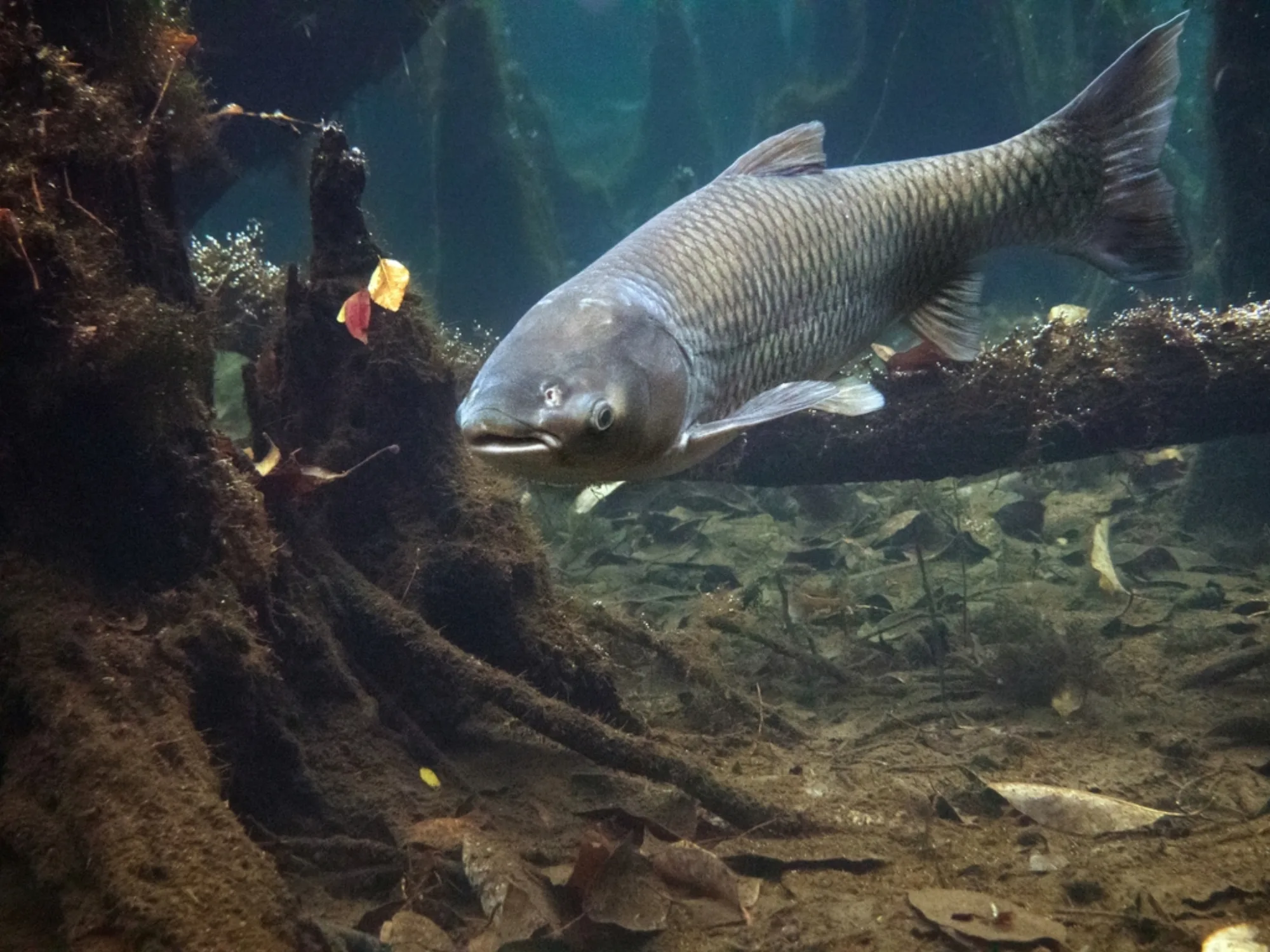
Long and rounded, with a torpedo-shaped body, the Grass Carp (Ctenopharyngodon idella) is a large freshwater fish that eats mainly plants. Its back is dark olive, fading to brownish-yellow along the sides, while its belly is white and its large scales are lightly outlined. A typical fish measures about 60 to 100 cm, though it can reach 2.0 m and weigh 45 kg. Young fish grow quickly: those stocked at 20 cm in spring can exceed 45 cm by autumn.
Native to the Pacific Far East, the species ranges between northern Vietnam and the Amur River, which lies on the Sino-Russian border. It lives in large, cloudy rivers and their floodplain lakes and wetlands, as well as ponds, pools and river backwaters. It favours spacious, slow-flowing or still water with plenty of vegetation. Grass carp have also been introduced to many countries, including the United Kingdom, New Zealand and South Africa, sometimes to control aquatic weeds. Adults feed chiefly on water plants, including submerged land vegetation, but also take insects, other invertebrates and detritus. They can eat up to three times their own weight in a day.
In the wild, Grass Carp breed in fast-flowing rivers at water temperatures of 20 to 30 °C. Their eggs drift downstream while they develop, held in suspension by turbulent water. Eggs and very young fish need long rivers to survive, and eggs that settle on the riverbed are thought to perish. Grass Carp are wary and can be difficult to catch on a fishing line, although they are also sought as sport fish.
Written from the English Wikipedia article Grass carp (CC BY-SA 4.0).
- Records
- 4,603
- Countries
- 16
- Atlas places
- 1
These are open occurrence records, so they show where people looked for and recorded the Grass Carp as much as where it lives. Cells are up to 25 km across, and every location is generalised to its cell.
Generalised encounter areas, not exact locations. Each shape is a grid cell coloured by how likely the species is there.
- Very likelyUnited States25 km zone · medium confidence · 4037 records · updated 80 days ago
- Very likelyNetherlands25 km zone · medium confidence · 296 records · updated 80 days ago
- Very likelySweden25 km zone · medium confidence · 63 records · updated 80 days ago
- Very likelyUnited Kingdom25 km zone · medium confidence · 52 records · updated 80 days ago
- LikelySwitzerland25 km zone · medium confidence · 34 records · updated 80 days ago
- LikelyBelgium25 km zone · medium confidence · 21 records · updated 80 days ago
- LikelyGermany25 km zone · medium confidence · 20 records · updated 80 days ago
- LikelyMexico25 km zone · medium confidence · 18 records · updated 80 days ago
- LikelyFrance25 km zone · medium confidence · 13 records · updated 80 days ago
- LikelyIndia25 km zone · medium confidence · 12 records · updated 80 days ago
Conservation status not assessed here yet, so every location is generalised to its grid cell.