Fossa
Cryptoprocta ferox
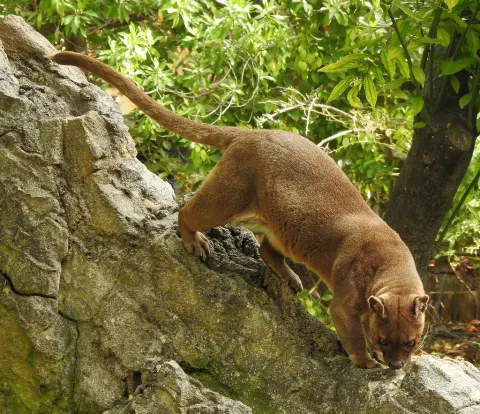
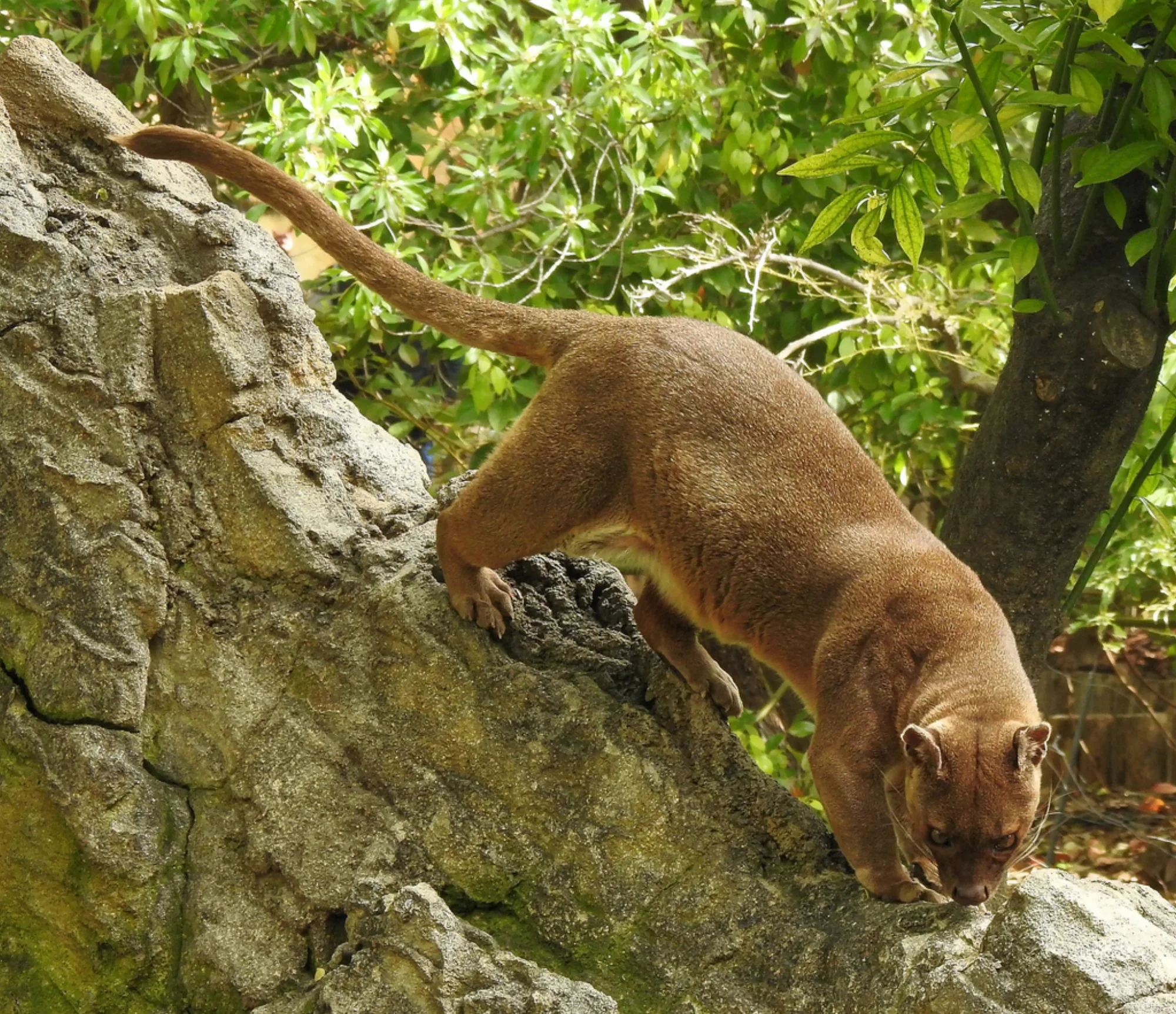
Madagascar's largest mammalian carnivore, the Fossa has a slender body, strong legs and a long tail that almost matches its body length. Its cat-like outline is paired with a broad, short muzzle and large, rounded ears. Adults have short, dense fur, generally reddish-brown above and cream underneath, with a lighter tail. Their head and body measure 70 to 80 cm, and males are larger than females. Flexible ankles help a Fossa climb down a tree head-first or leap to another, while its tail helps it balance.
Found only in Madagascar's forests, the Fossa ranges widely but generally occurs in low numbers. It favours undisturbed forest, though it also lives in degraded forest at lower densities. Its habitats include western dry deciduous forests, eastern rainforests and southern spiny forests, and it is seen more often in humid forest than dry forest. Active by day and night, it may be busiest around dawn, towards the end of the afternoon and at a late hour of the night. Fossas are usually solitary, apart from mothers with young and occasional pairs of males. They hunt on the ground and in trees, taking lemurs, tenrecs, rodents, lizards, birds and other animals. Lemurs make up over 50% of their diet.
Mating usually takes place in trees, and females give birth in concealed sites such as tree hollows, rock crevices or underground dens. Litters contain one to six pups, born blind and toothless; the young become independent after their first year. The greatest threat is the destruction of forest, compounded by fragmentation and declining lemur populations. Fossas are also hunted for meat and may be killed in retaliation for taking domestic fowl.
Written from the English Wikipedia article Fossa (animal) (CC BY-SA 4.0).
- Records
- 15
- Countries
- 1
No atlas park has a record of the Fossa in or around it yet.
These are open occurrence records, so they show where people looked for and recorded the Fossa as much as where it lives. Cells are up to 25 km across, and every location is generalised to its cell.
Generalised encounter areas, not exact locations. Each shape is a grid cell coloured by how likely the species is there.
- Very likelyMadagascar25 km zone · medium confidence · 15 records · updated 80 days ago
Conservation status not assessed here yet, so every location is generalised to its grid cell.