Christmas Island Blue-tailed Shinning-skink
Cryptoblepharus egeriae
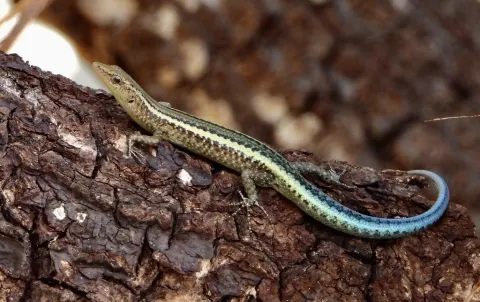
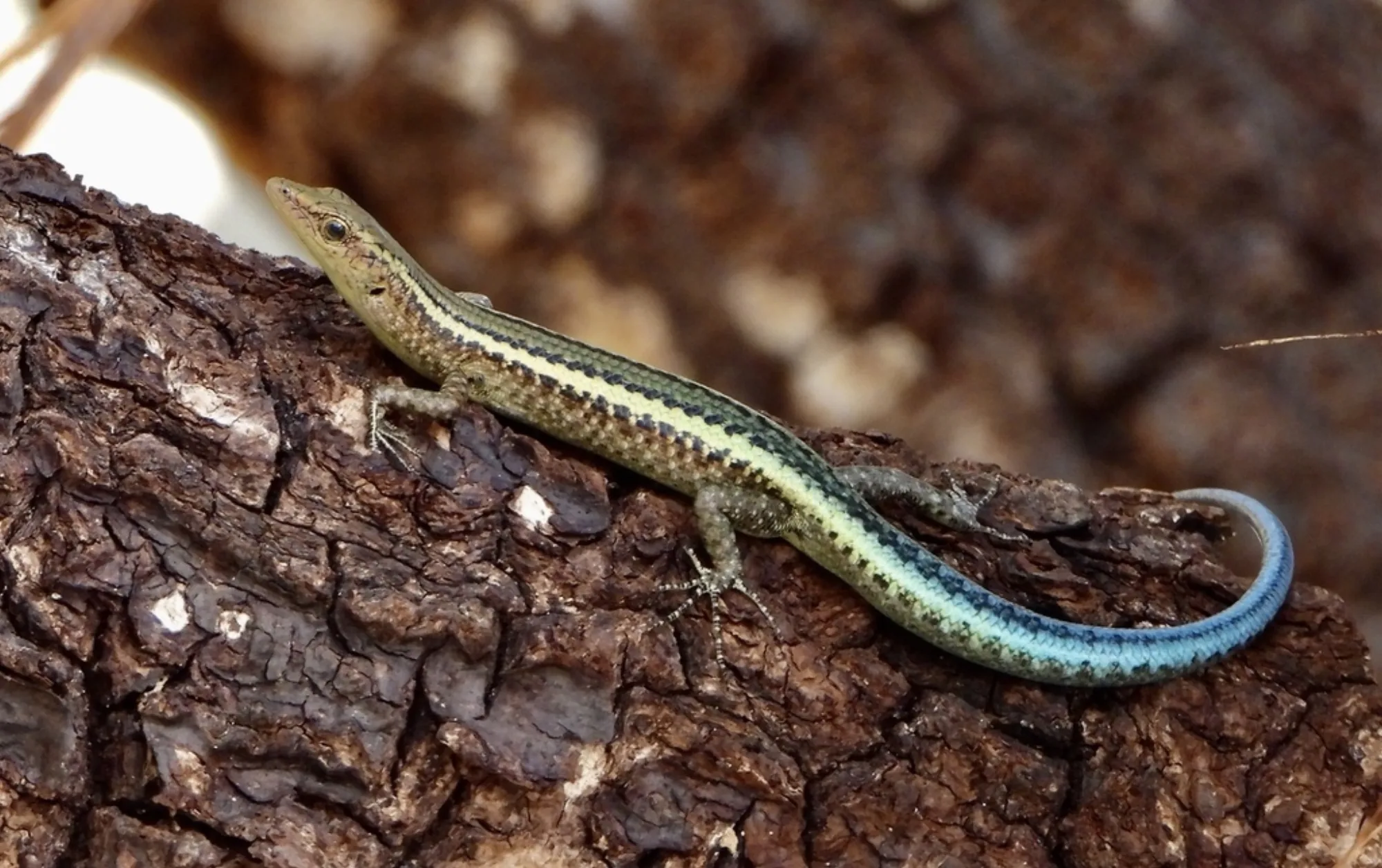
A small black lizard with two yellow stripes and a blue tail, the Christmas Island Blue-tailed Shinning-skink was once a common sight across its home island. Its stripes run along its back and onto the tail, while its body typically measures 4 to 5 cm from snout to vent. When threatened, it can shed the conspicuous tail, drawing a predator's attention away from its body. It was formerly the island's most abundant reptile, especially around the human settlement, but its numbers began falling sharply in the early 1990s.
The skink forages on the ground, over exposed rocks and among low vegetation, generally taking slower-moving prey. Crickets, beetles, flies, grasshoppers, spiders and earthworms make up much of its diet, although it occasionally eats vegetation. Males may fight one another during the breeding season, and females generally lay two eggs at a time. The eggs incubate for 75 days, and skinks begin breeding at approximately one year old. In the wild, they typically lived for seven years, including six active breeding years.
Invasive species are considered a major cause of its disappearance from the wild, with the wolf snake and yellow crazy ant among the introductions. The skink now survives in captive populations on Christmas Island and at Taronga Zoo, and has also been released on Pulu Blan in the Cocos (Keeling) Islands as part of a trial. A breeding programme begun by Parks Australia and Taronga Zoo prevented the species from disappearing altogether. The programme aims to return some skinks to their native habitat.
Written from the English Wikipedia article Cryptoblepharus egeriae (CC BY-SA 4.0).
- Records
- 73
- Countries
- 2
No atlas park has a record of the Christmas Island Blue-tailed Shinning-skink in or around it yet.
These are open occurrence records, so they show where people looked for and recorded the Christmas Island Blue-tailed Shinning-skink as much as where it lives. Cells are up to 25 km across, and every location is generalised to its cell.
Generalised encounter areas, not exact locations. Each shape is a grid cell coloured by how likely the species is there.
- Very likelyChristmas Island25 km zone · high confidence · 72 records · updated 80 days ago
- LikelyCocos (Keeling) Islands25 km zone · medium confidence · 1 record · updated 80 days ago
Conservation status not assessed here yet, so every location is generalised to its grid cell.