Collared Lizard
Crotaphytus collaris
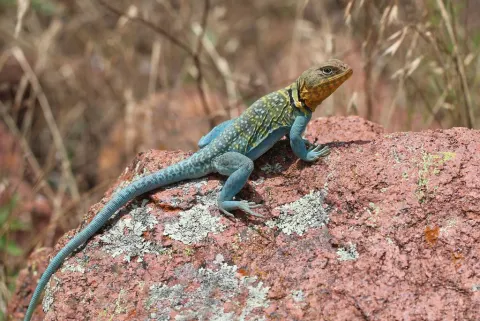
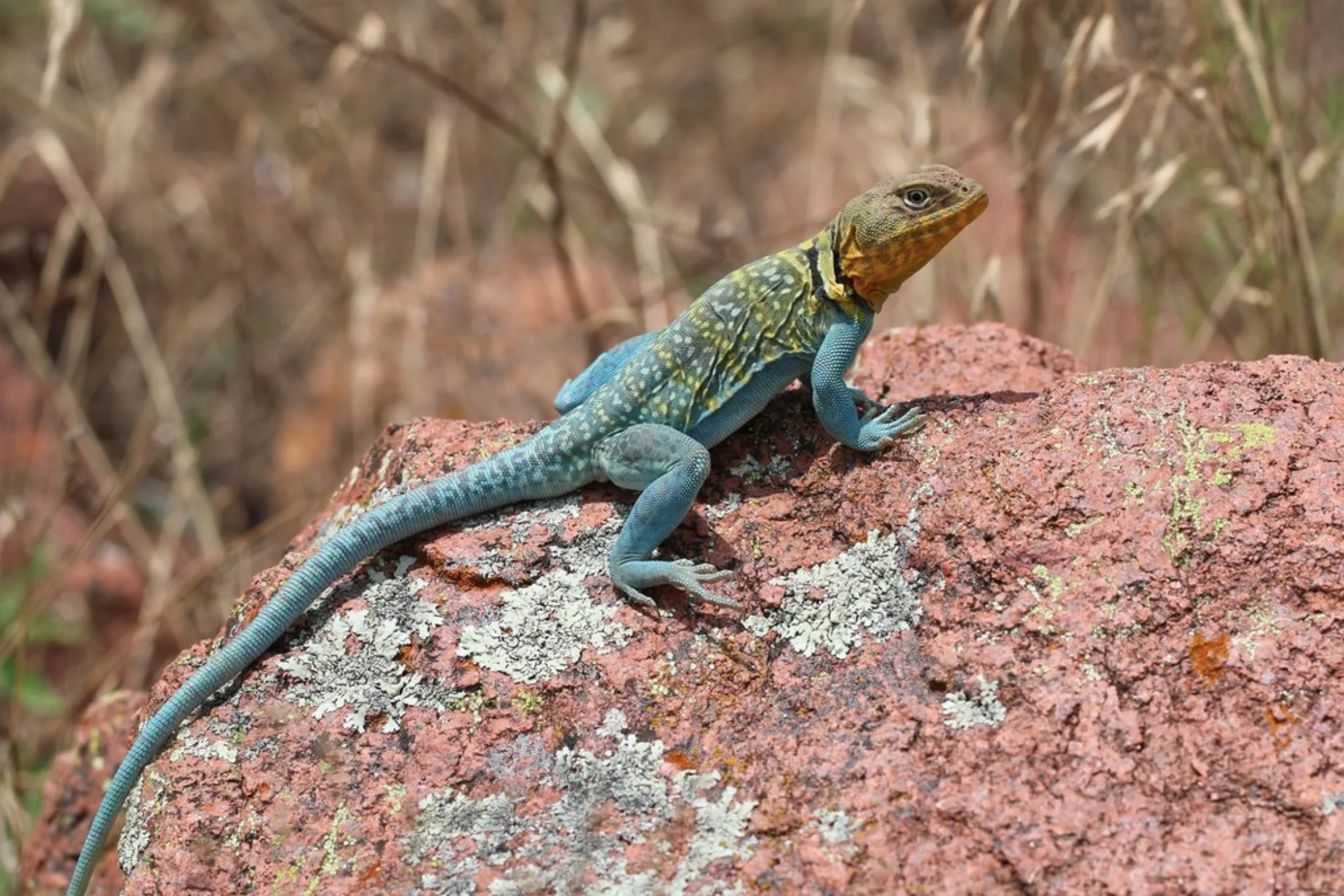
A pair of black bands around the neck gives the Collared Lizard its name. This North American lizard can grow to 20 to 38 cm from head to tail, and has a large head and powerful jaws. Males can have blue-green bodies, yellow stripes and yellow-orange throats, while females are generally more muted, ranging from brown to grey. Young lizards also have subdued colours, with dark brown markings that fade as they mature.
The species lives mainly in dry, open country in northern Mexico and the southwestern United States, from the Ozark Mountains to western Arizona. Its habitats range from rocky desert to grassland, and it often favours hot, mountainous areas. Rocks offer places to hide and elevated lookout points from which to watch for predators and territorial intruders. Active by day, it spends much of its time basking on rocks or boulders. When escaping a predator, it can sprint on its hind legs. Its prey includes crickets, grasshoppers, spiders, beetles, other small lizards and even snakes; diet can vary with age, sex and season.
Males defend territories and use displays to confront rivals, with encounters rarely escalating into violent fights. The breeding season runs from mid-March to early April until mid-July. Females lay their eggs in burrows or beneath rocks, usually producing clutches of four to six eggs, though larger, older females can lay more. Eggs can take 50 to 100 days to hatch, and the young are independent from the start. Predators pose a threat, and fighting between rival males can also cause serious injury.
Written from the English Wikipedia article Common collared lizard (CC BY-SA 4.0).
- Records
- 1,191
- Countries
- 2
- Atlas places
- 2
These are open occurrence records, so they show where people looked for and recorded the Collared Lizard as much as where it lives. Cells are up to 25 km across, and every location is generalised to its cell.
Generalised encounter areas, not exact locations. Each shape is a grid cell coloured by how likely the species is there.
- Very likelyUnited States25 km zone · medium confidence · 942 records · updated 80 days ago
- Very likelyMexico25 km zone · medium confidence · 249 records · updated 80 days ago
Conservation status not assessed here yet, so every location is generalised to its grid cell.