Prairie Rattlesnake
Crotalus viridis
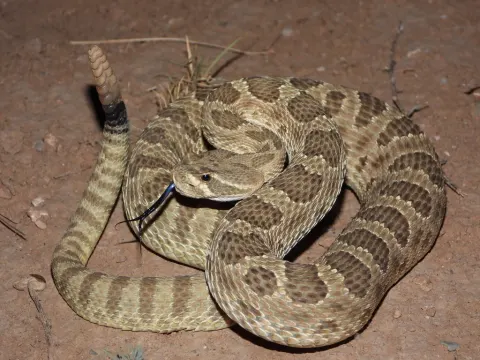
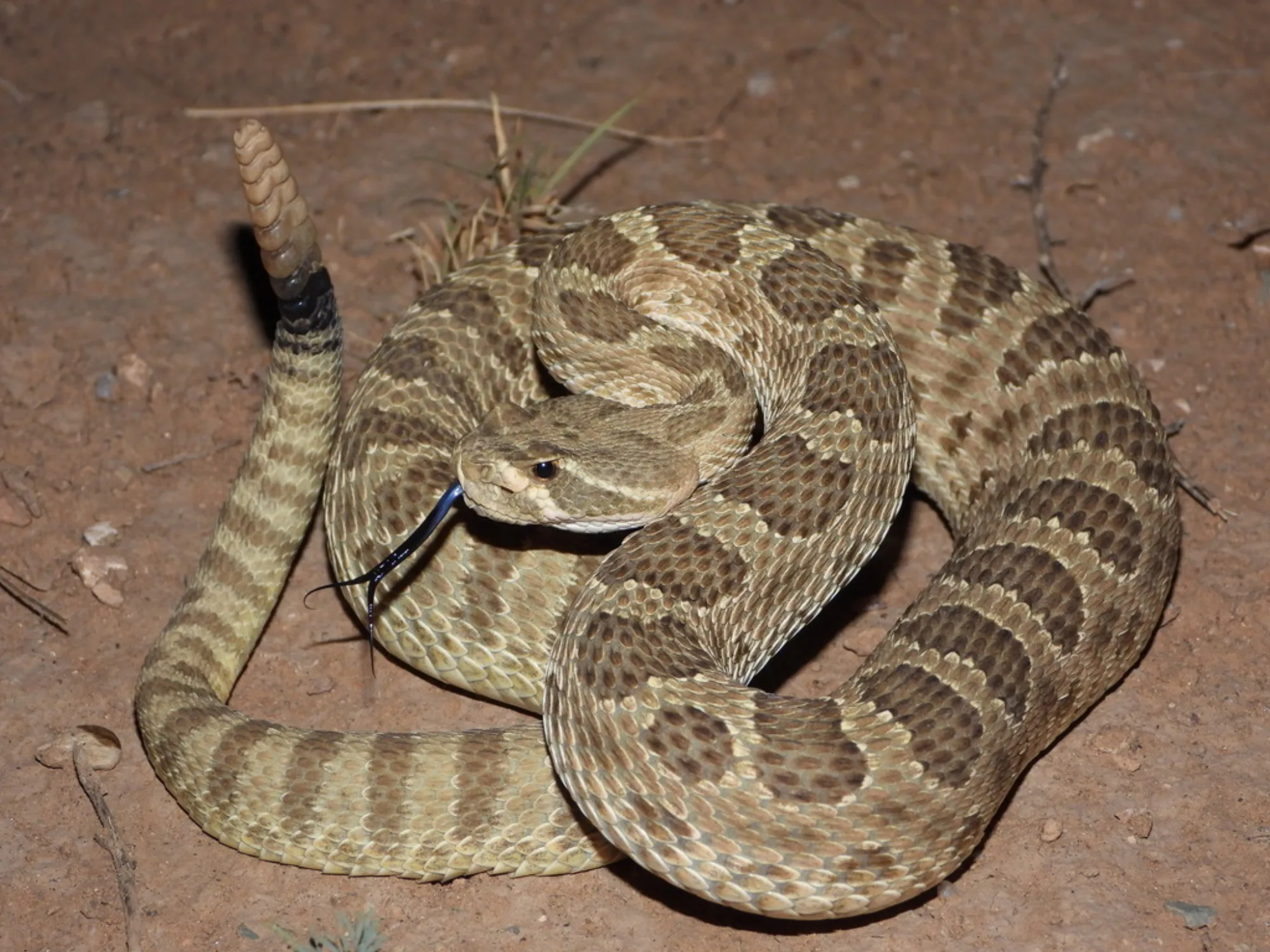
Across the Great Plains and into the Rocky Mountains, the Prairie Rattlesnake moves through a landscape of dry ground and rocky outcrops. This venomous pit viper lives in southwestern Canada, the western United States and northern Mexico, including foothills and some valleys between the mountains. It generally favours dry places with moderate vegetation, and may shelter in another animal's burrow. Rocky outcrops can provide den sites, while some snakes rest in caves or crevices. Usually light brown, it often has darker brown patches along its back, sometimes with a band of colour behind the eye. Its head is triangular, and adults commonly grow longer than 100 cm.
Mostly a ground-dweller, the snake occasionally climbs into trees or bushes. It tends to be active during the day when the weather is cooler, switching to night-time activity in hot weather. If threatened or injured, it can defend itself, rapidly vibrating its tail to make a rasping warning sound. Its prey includes small mammals such as ground squirrels, mice, rabbits and prairie dogs, as well as ground-nesting birds. It also occasionally eats amphibians and reptiles, including other snakes. Females give birth to live young in late summer or early autumn, sometimes gathering in communal dens where they care for them. A typical brood numbers four to 12, although food and environmental conditions can affect the number. Females have even been observed looking after unrelated youngsters while their mothers take a break. In Canada, large-scale habitat loss from cultivation and deaths on roads have contributed to steady declines since the 1930s.
Written from the English Wikipedia article Crotalus viridis (CC BY-SA 4.0).
- Records
- 756
- Countries
- 3
- Atlas places
- 4
These are open occurrence records, so they show where people looked for and recorded the Prairie Rattlesnake as much as where it lives. Cells are up to 25 km across, and every location is generalised to its cell.
Generalised encounter areas, not exact locations. Each shape is a grid cell coloured by how likely the species is there.
- Very likelyUnited States25 km zone · medium confidence · 579 records · updated 80 days ago
- Very likelyCanada25 km zone · medium confidence · 133 records · updated 80 days ago
- Very likelyMexico25 km zone · medium confidence · 44 records · updated 80 days ago
Conservation status not assessed here yet, so every location is generalised to its grid cell.