Mohave Rattlesnake
Crotalus scutulatus
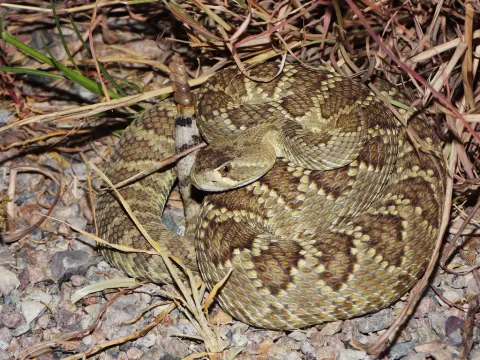
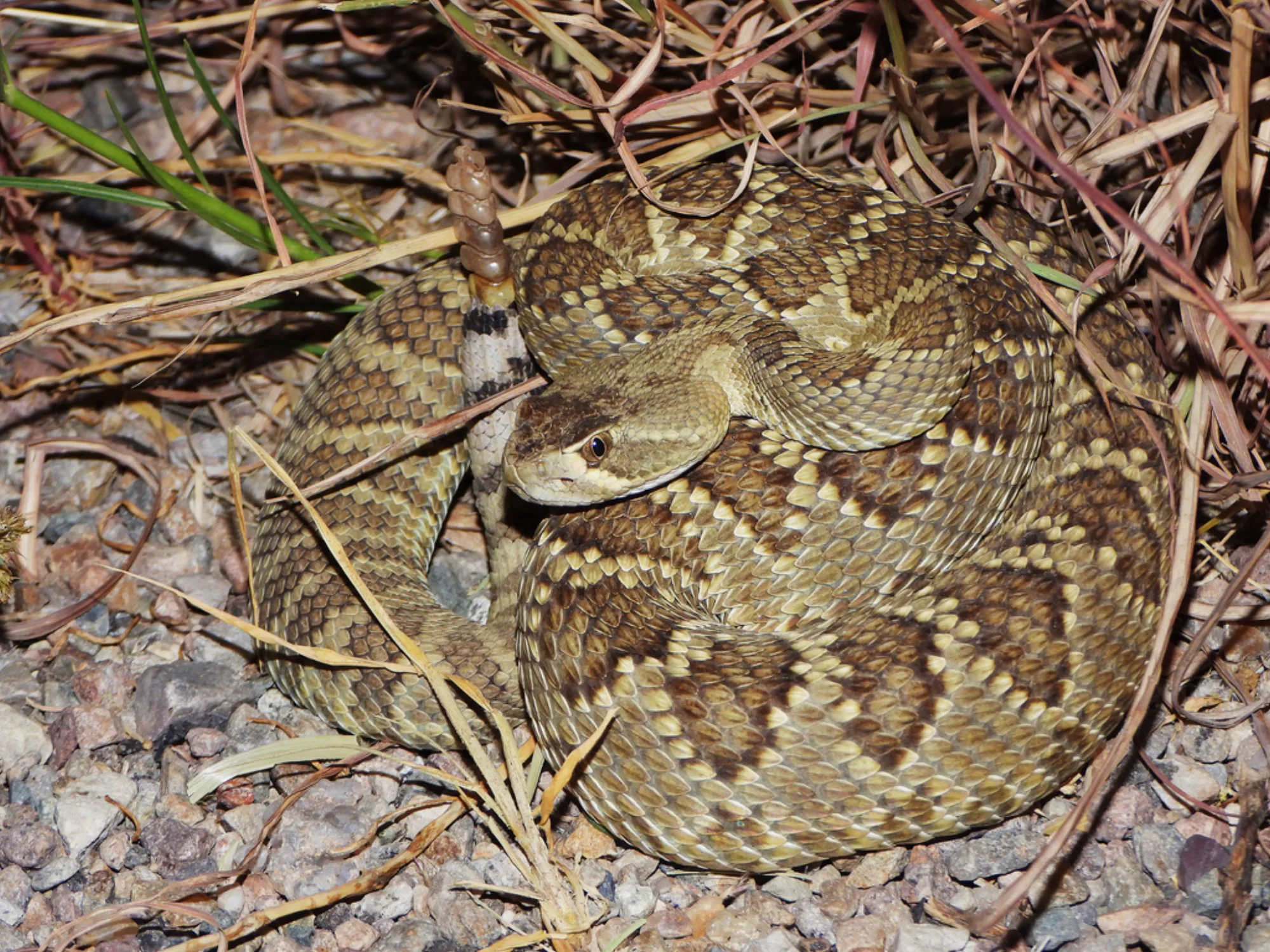
In desert country across the southwestern United States and mainland Mexico lives the Mohave Rattlesnake, a highly venomous pit viper. Its back can be green, brown, grey or yellowish, with a row of large diamond-shaped blotches. Its tail usually has alternating pale and dark rings, and the dark rings are often narrower. No single visual feature identifies it reliably, and it closely resembles the Western Diamond-backed Rattlesnake. Its average total length, including the tail, is less than 100 cm.
Its range extends from California, Nevada, Utah and Arizona to southern New Mexico and western Texas, and south through parts of Mexico. It favours open, relatively flat desert valleys and lower mountain slopes, at elevations ranging from close to sea level up to about 2,500 m. Look for sparsely vegetated places with creosote, sage, mesquite, cacti or Joshua trees, as well as some grasslands and juniper woodland. It generally avoids dense vegetation and extremely rocky ground.
Most active from April to September, it waits in ambush for prey, mainly small rodents and lizards. Individuals occupy a defined home range throughout the year, sheltering from winter and summer heat in burrows dug by other animals. Females give birth to two to 17 live young from July through September. Coyotes, bobcats and birds of prey hunt it, and the snake is shy and avoids confrontation with larger creatures, including people. When disturbed, particularly if surprised or unable to escape into vegetation or a burrow, it can strike and bite vigorously.
Written from the English Wikipedia article Crotalus scutulatus (CC BY-SA 4.0).
- Records
- 1,138
- Countries
- 2
- Atlas places
- 3
These are open occurrence records, so they show where people looked for and recorded the Mohave Rattlesnake as much as where it lives. Cells are up to 25 km across, and every location is generalised to its cell.
Generalised encounter areas, not exact locations. Each shape is a grid cell coloured by how likely the species is there.
- Very likelyUnited States25 km zone · medium confidence · 1012 records · updated 80 days ago
- Very likelyMexico25 km zone · medium confidence · 126 records · updated 80 days ago
Conservation status not assessed here yet, so every location is generalised to its grid cell.