Abyssus
Crotalus oreganus
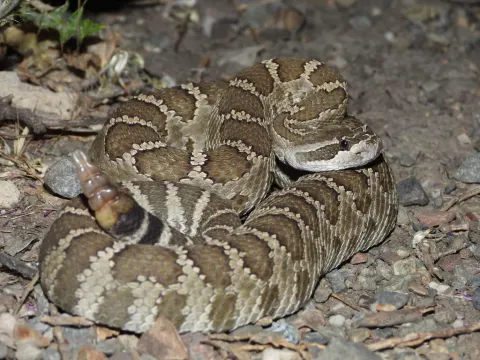
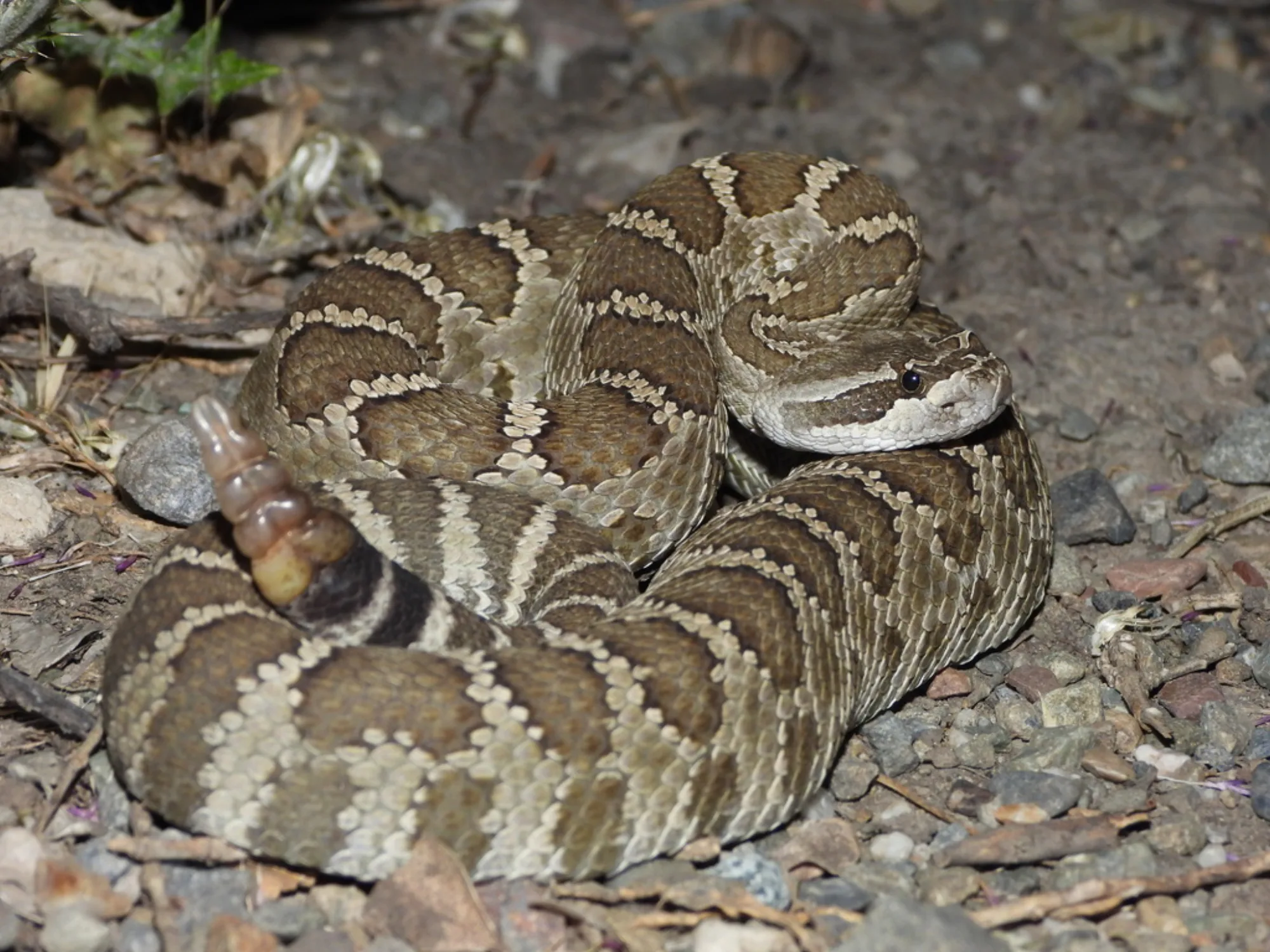
Across western North America, the Abyssus, or western rattlesnake, occurs in southern interior British Columbia and extends south into Mexico's Baja California Peninsula. This venomous snake varies greatly in size, although mainland individuals often reach 100 cm. Its colouring varies with its surroundings, and young snakes usually have clearer patterns that fade as they mature. In the typical form, large dark blotches with uneven white edges run along the back, over a ground colour ranging from dark brown or grey to olive-brown, black or pale yellowish. Darker blotches often mark the sides, while the pale yellow belly usually has brown spots.
The snake moves seasonally between winter dens and summer feeding grounds as prey availability changes. Its chosen winter sites tend to be on steep slopes surrounded by medium-sized rocks. It uses heat-sensing pits on its face to find prey, taking birds, eggs, small mammals, reptiles and amphibians. Young snakes also eat insects. Venom helps it hunt: even if an animal escapes initially, the snake can track it down after the venom causes paralysis. Females give birth to live young, usually in August or September, with litters of 1 to 15. Newborns range from 19 to 28 cm in total length. Females normally reproduce every other year, although some have litters in consecutive years. In British Columbia, rapid changes to the dry southern-interior valleys have reduced the population through human involvement. Researchers there have also found that greater human activity is associated with poorer body condition in the snakes.
Written from the English Wikipedia article Crotalus oreganus (CC BY-SA 4.0).
- Records
- 233
- Countries
- 3
- Atlas places
- 2
These are open occurrence records, so they show where people looked for and recorded the Abyssus as much as where it lives. Cells are up to 25 km across, and every location is generalised to its cell.
Generalised encounter areas, not exact locations. Each shape is a grid cell coloured by how likely the species is there.
- Very likelyUnited States25 km zone · high confidence · 230 records · updated 80 days ago
- LikelyCanada25 km zone · medium confidence · 3 records · updated 80 days ago
- RareMexico25 km zone · low confidence · 0 records · updated 80 days ago
Conservation status not assessed here yet, so every location is generalised to its grid cell.