Timber Rattlesnake
Crotalus horridus
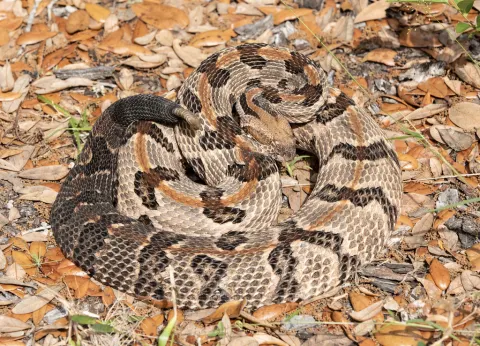
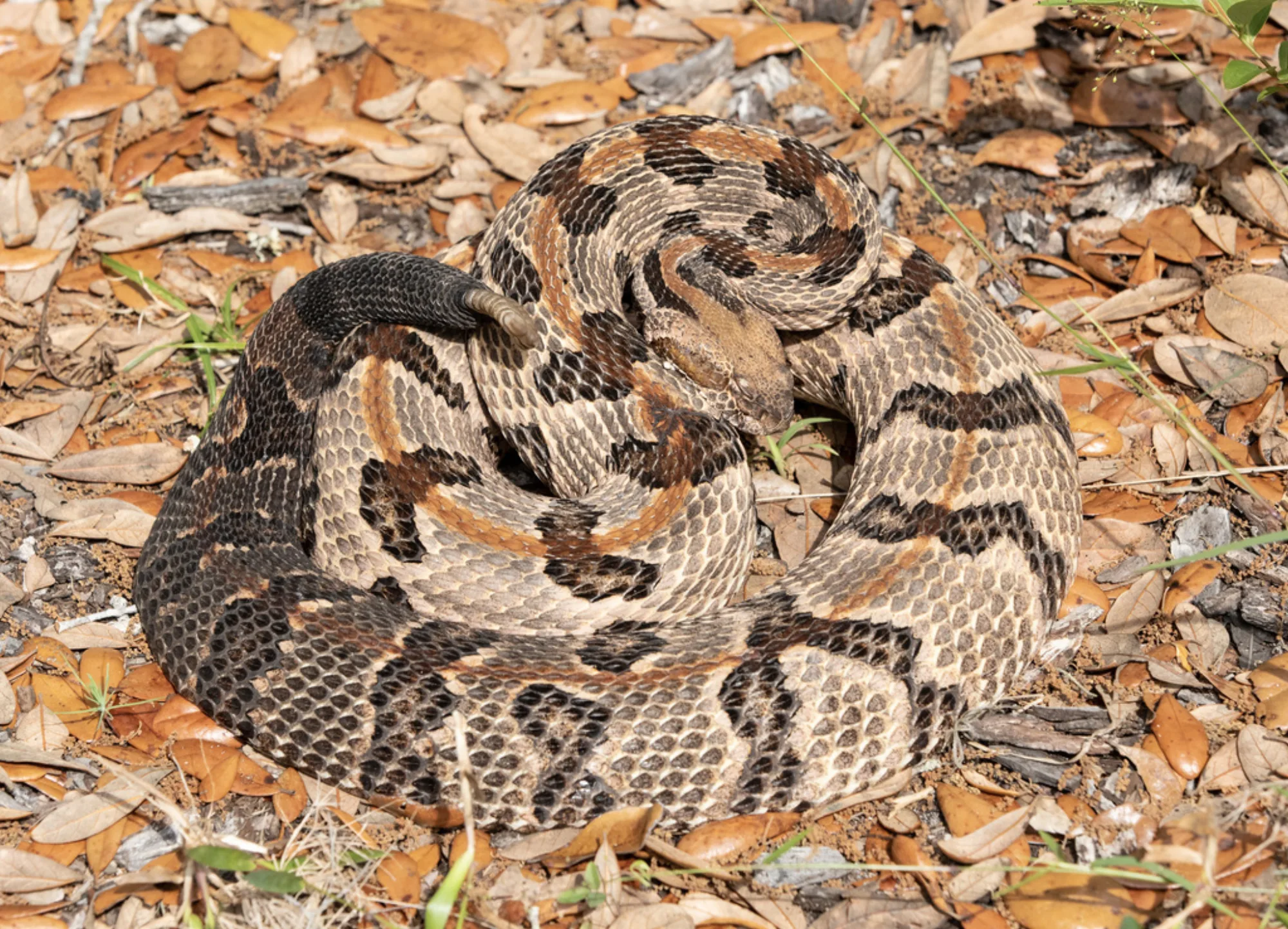
A venomous pit viper of the eastern United States, the Timber Rattlesnake usually reaches 91 to 152 cm in total length. Dark brown or black bands cross its yellowish-brown or greyish back, often with irregular zigzag edges and a V or M shape. Some have a rust-coloured stripe along the back, while others are so dark they appear almost entirely black. The tail is black, and the bite carries extremely potent venom.
Its range extends from southern Minnesota and southern New Hampshire to East Texas and North Florida. It generally favours deciduous forest in rugged country, but also inhabits cane thickets, hardwood and pine forests, mountainous areas, and higher ground around swamps and river floodplains. In summer, pregnant females often use warm, open rocky ledges, while males and other females spend more time in cooler, denser woodland. Females bask in sunny rocky areas before giving birth. In winter, the snakes shelter in dens and limestone crevices, often alongside copperheads and rat snakes, and may return to the same communal den each year.
Timber rattlesnakes mainly eat small mammals, including mice, rats, squirrels and rabbits, but also take birds, frogs and other small animals. They use chemical cues to find ambush sites and may wait on fallen logs, then strike prey and track it down. When faced with danger, a snake tries to retreat and may rattle and feint before striking. Populations have disappeared from many areas, particularly in the north, and continue to decline in Appalachian states. In New Hampshire, genetic isolation, inbreeding and unpredictable weather have left the remaining population susceptible to opportunistic pathogens.
Written from the English Wikipedia article Timber rattlesnake (CC BY-SA 4.0).
- Records
- 789
- Countries
- 1
- Atlas places
- 2
These are open occurrence records, so they show where people looked for and recorded the Timber Rattlesnake as much as where it lives. Cells are up to 25 km across, and every location is generalised to its cell.
Generalised encounter areas, not exact locations. Each shape is a grid cell coloured by how likely the species is there.
- Very likelyUnited States25 km zone · medium confidence · 789 records · updated 80 days ago
Conservation status not assessed here yet, so every location is generalised to its grid cell.