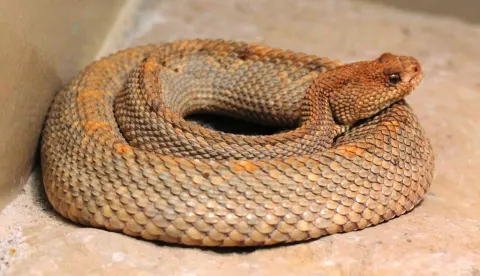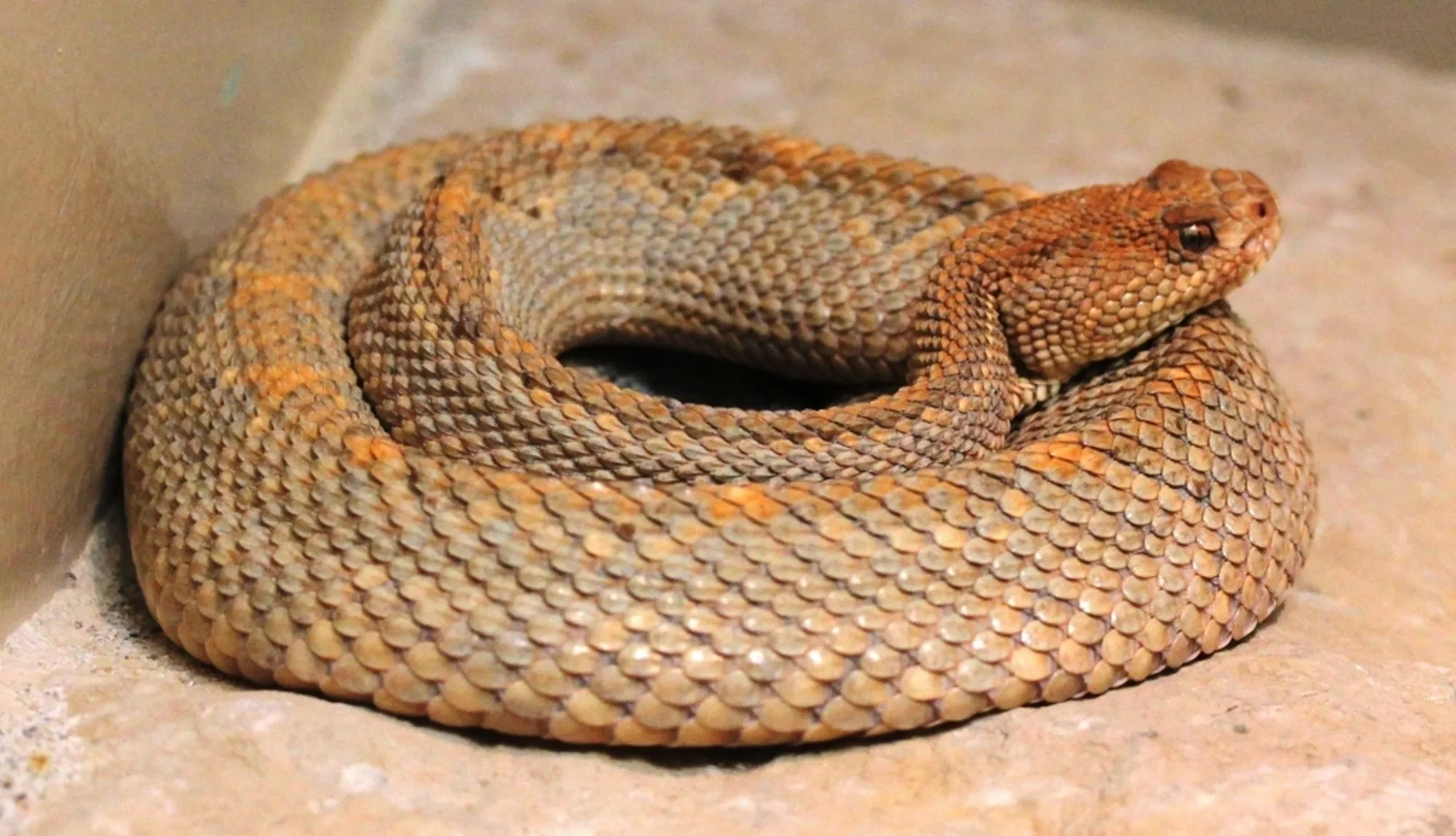
Cascabel Rattlesnake
Crotalus durissus
A large, highly venomous snake of South America, the Cascabel Rattlesnake usually grows to 1.5 m and only rarely reaches 1.9 m. Two distinct stripes begin at the base of its head, enclosing a lighter area. Its body colour and pattern vary considerably, but many individuals have darker diamond-shaped markings. The belly can be white or yellowish, with pale grey spots that darken towards the tail. The tail itself is usually grey, with indistinct dark bands running across it.
Its range is spread across South America outside the Andes, with many isolated populations in the north. It occurs in countries including Colombia, Bolivia, Paraguay and Uruguay, as well as eastern Brazil, southeastern Peru and northern Argentina; it also lives on some Caribbean islands, including Aruba. Savanna and semi-arid zones are favoured, though it has also been recorded in coastal grassland, thorny scrub and seasonal forest. In Paraguay's Chaco region, it occupies the drier, sandier areas.
Look for it around dusk or in the early morning, when it is more active. It is highly alert and may give little warning before striking, although it is seldom aggressive towards people. Rodents make up most of its diet, while lizards are also eaten in some regions. Its breeding cycle follows the seasons: males compete for access to females around the end of summer, and young are born the following spring or summer. A female gives birth to four to eight young, although up to 14 have been reported in Roraima, Brazil, where gestation has been reported to last five months.
Written from the English Wikipedia article Crotalus durissus (CC BY-SA 4.0).
- Records
- 52
- Countries
- 6
- Atlas places
- 6
These are open occurrence records, so they show where people looked for and recorded the Cascabel Rattlesnake as much as where it lives. Cells are up to 25 km across, and every location is generalised to its cell.
Generalised encounter areas, not exact locations. Each shape is a grid cell coloured by how likely the species is there.
- Very likelyBrazil25 km zone · medium confidence · 49 records · updated 80 days ago
- Very likelyColombia25 km zone · medium confidence · 3 records · updated 80 days ago
- LikelyMexico25 km zone · low confidence · 0 records · updated 80 days ago
- PossibleArgentina25 km zone · low confidence · 0 records · updated 80 days ago
- PossibleBolivia25 km zone · low confidence · 0 records · updated 80 days ago
- PossibleParaguay25 km zone · low confidence · 0 records · updated 80 days ago
Conservation status not assessed here yet, so every location is generalised to its grid cell.