Sidewinder
Crotalus cerastes
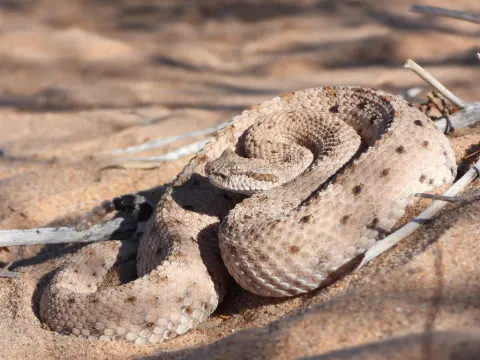
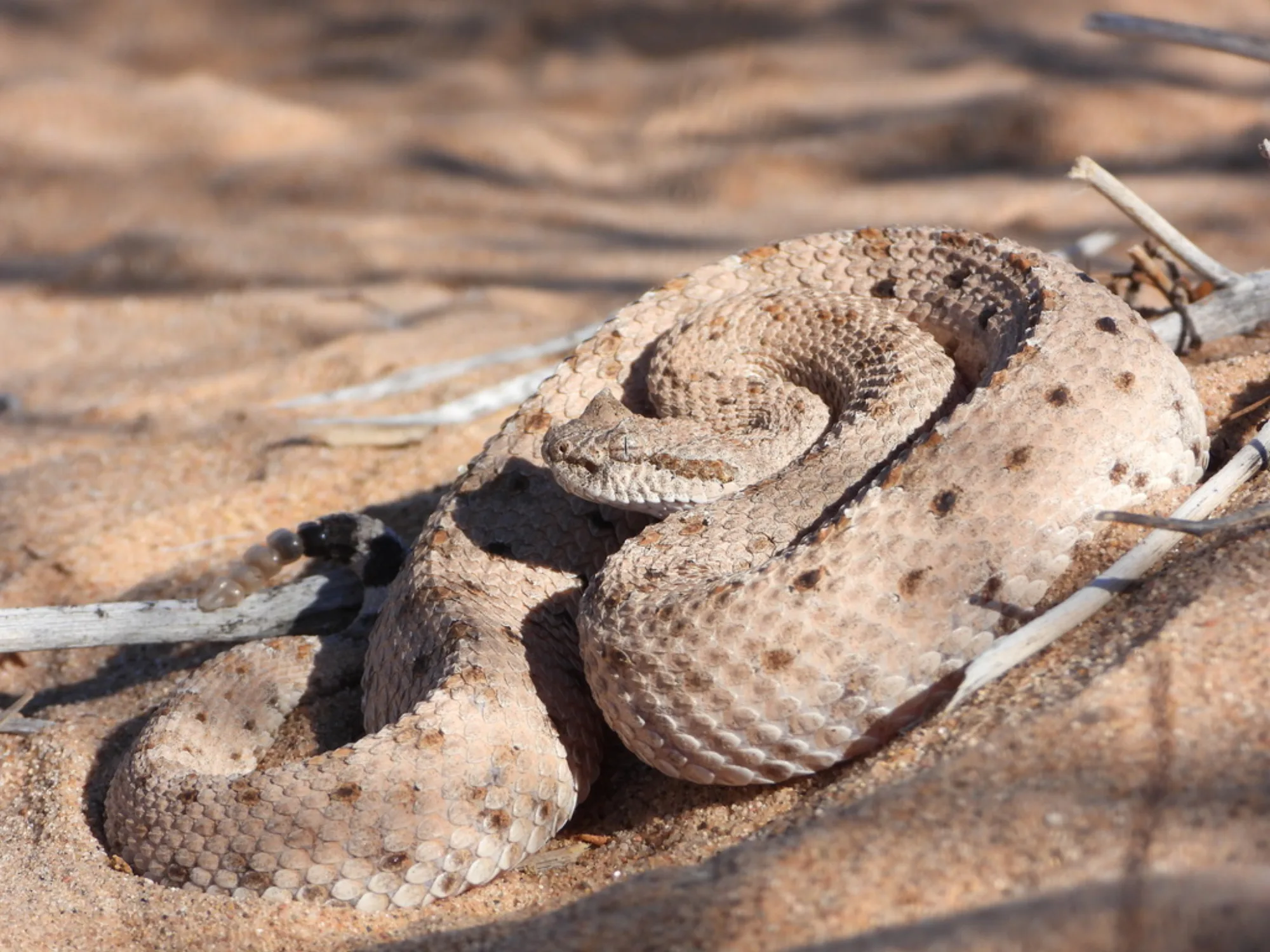
Raised scales above its eyes give the Sidewinder the look of a small horned rattlesnake. This venomous pit viper measures 43 to 80 cm as an adult, with females larger than males. Dark blotches mark its back, while its base colour ranges from pale cream and pink to yellowish-brown or ash grey. The raised scales may shade its eyes or help keep out drifting sand when the snake is almost buried.
Sidewinders live in deserts spanning the south-western United States and north-western Mexico, from southeastern California and southern Nevada to western Sonora and eastern Baja California. Their distinctive sideways movement is thought to give them traction on windblown sand, although they also use it on other surfaces. On loose sand, the body leaves a J-shaped impression whose hooked tip points in the direction of travel. They can also climb sandy slopes without slipping by adjusting how much of the body touches the sand. During hot months they are active at night, switching to daytime activity in cooler months.
Young Sidewinders move their tails to lure lizards, while adults mainly eat desert rodents, birds and other snakes. Females give birth to five to 18 live young in late summer to early autumn. For 7 to 10 days, the young remain in a burrow with their mother, shedding for the first time before they leave. During their first week or so, they gather at the burrow entrance in daylight, moving together in a mass that helps maintain their temperature. Predation, disease and encounters with vehicles can shorten Sidewinders' lives, while exhaustion following birth often kills females in the wild.
Written from the English Wikipedia article Crotalus cerastes (CC BY-SA 4.0).
- Records
- 534
- Countries
- 2
- Atlas places
- 2
These are open occurrence records, so they show where people looked for and recorded the Sidewinder as much as where it lives. Cells are up to 25 km across, and every location is generalised to its cell.
Generalised encounter areas, not exact locations. Each shape is a grid cell coloured by how likely the species is there.
- Very likelyUnited States25 km zone · medium confidence · 475 records · updated 80 days ago
- Very likelyMexico25 km zone · medium confidence · 59 records · updated 80 days ago
Conservation status not assessed here yet, so every location is generalised to its grid cell.