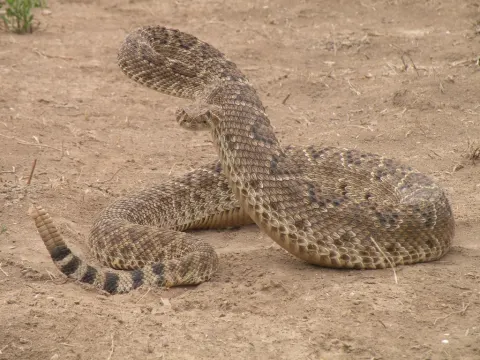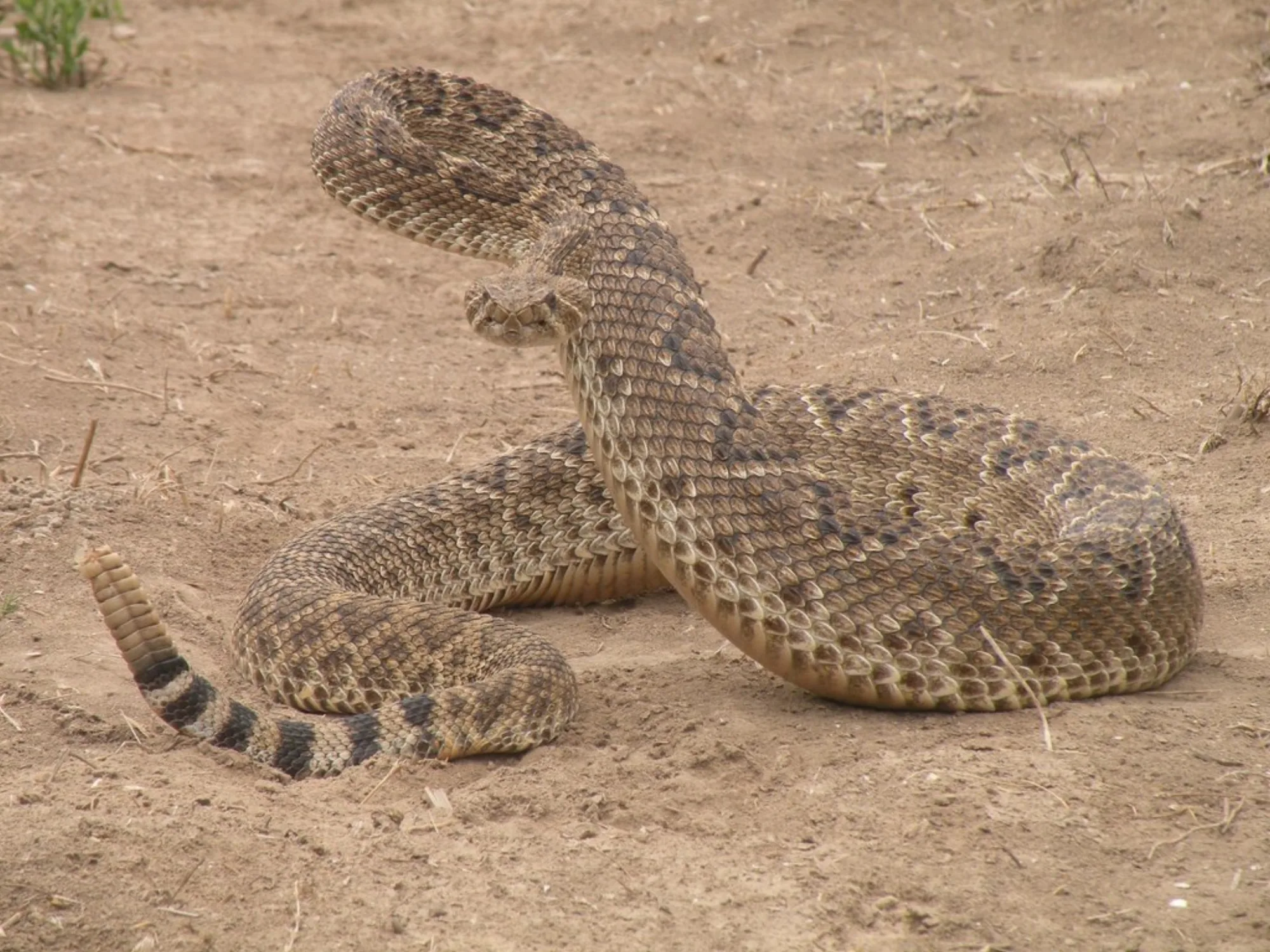
Western Diamond-backed Rattlesnake
Crotalus atrox
Across the southwestern United States and northern Mexico, the Western Diamond-backed Rattlesnake occupies habitats from coastal plains to rocky canyons and hillsides. It is a venomous viper found in desert scrub, mesquite grassland and pine-oak forest, as well as sandy creosote areas. It also lives in some developed areas, including the Phoenix and Tucson metropolitan areas in Arizona.
Adults commonly reach 120 cm in length, and males grow much larger than females after reaching maturity. The ground colour is generally khaki, though it can also be pinkish, brick red, yellowish blonde or white. Dark blotches along the back develop into diamond shapes, while black bands alternate with white or grey spaces on the tail. A grey or brown stripe slopes back from below the eye along the head. When threatened, the snake usually coils and rattles, standing its ground and striking in defence if the warning fails.
Mostly solitary outside the mating season, it can be active by day or night when conditions are favourable. In the heat of summer it is mainly active at night and around twilight, while in spring and autumn it favours daylight and twilight. It hunts or lies in ambush after dark or early in the morning, taking small mammals, birds and other animals; young snakes eat lizards. Females give birth to live young, which leave their mother after only a few hours to hunt and find shelter. Hawks, eagles, coyotes and other predators eat these snakes, while people take them from the wild for roundups, killing them for their skins, for food and for entertainment.
Written from the English Wikipedia article Western diamondback rattlesnake (CC BY-SA 4.0).
- Records
- 2,220
- Countries
- 2
- Atlas places
- 2
These are open occurrence records, so they show where people looked for and recorded the Western Diamond-backed Rattlesnake as much as where it lives. Cells are up to 25 km across, and every location is generalised to its cell.
Generalised encounter areas, not exact locations. Each shape is a grid cell coloured by how likely the species is there.
- Very likelyUnited States25 km zone · high confidence · 1953 records · updated 80 days ago
- Very likelyMexico25 km zone · medium confidence · 267 records · updated 80 days ago
Conservation status not assessed here yet, so every location is generalised to its grid cell.