Eastern Diamondback Rattlesnake
Crotalus adamanteus
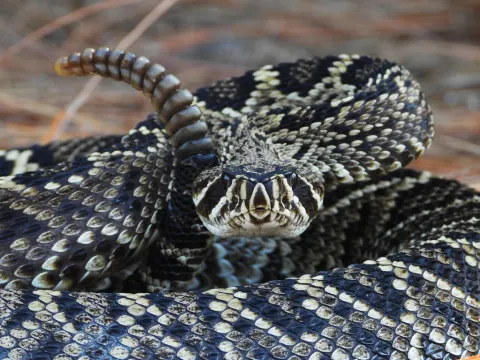
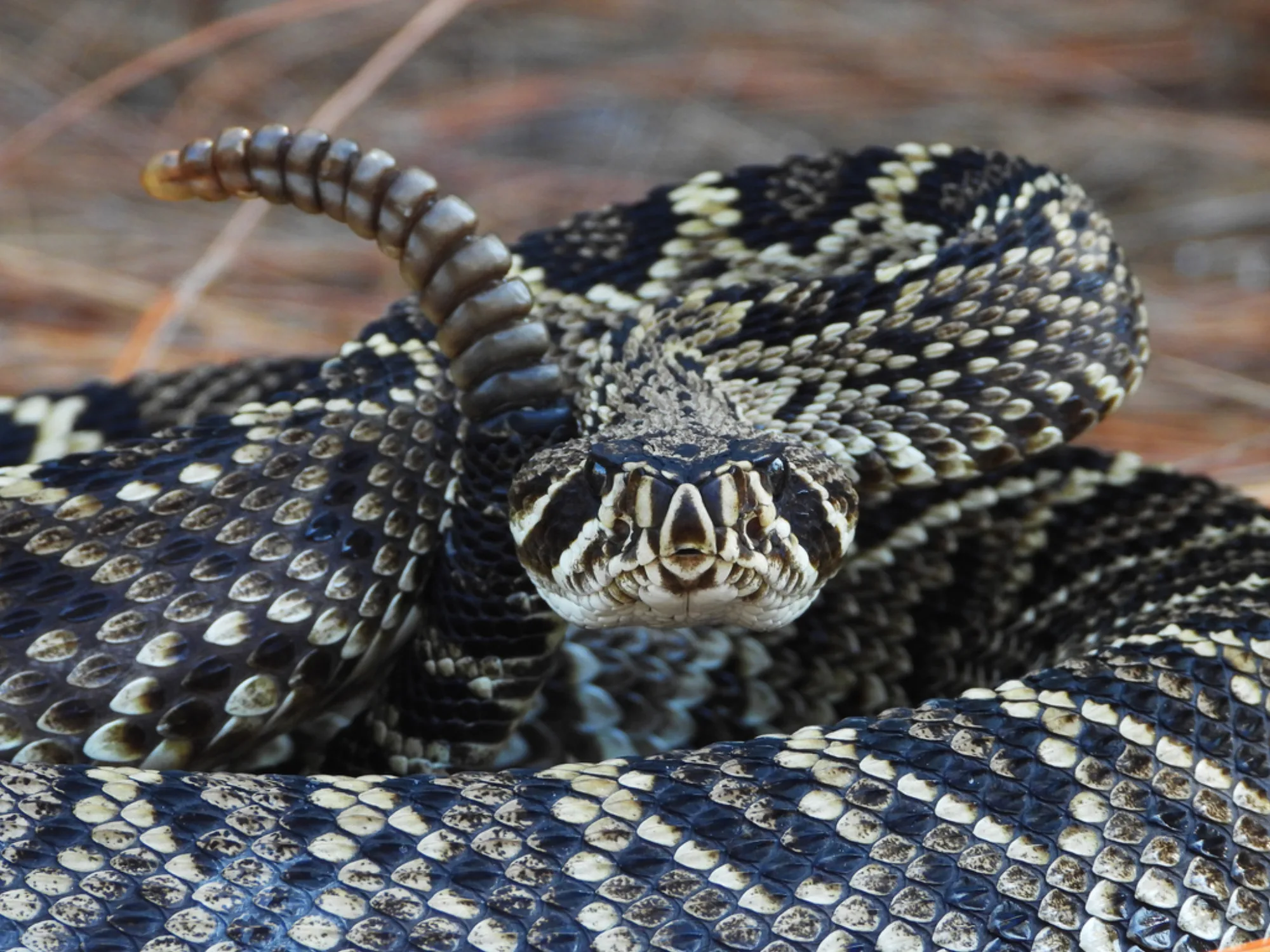
Across the southeastern United States, the Eastern Diamondback Rattlesnake is the largest rattlesnake species and among the heaviest venomous snakes in the Americas. Its brownish to olive colouring carries dark diamonds edged in cream or yellow, with bands towards the tail. A dark stripe runs from behind each eye towards the mouth, bordered by white or yellow. The tail ends in a rattle made of hard, loosely attached segments. Reported lengths range from 1.1 to 1.7 m, though specimens over 2.1 m are rare. Its range extends from southeastern North Carolina through Florida to the Keys, and west along the Gulf Coast to southeastern Louisiana. It occupies dry pine forests, pine and palmetto flatwoods, sandhills, marshes and swamp forests, among other habitats.
Often sheltering in burrows made by gophers and gopher tortoises, it comes out to bask during the early morning or afternoon. It is mostly ground-dwelling, but can swim well and has been seen crossing water between barrier islands and the mainland. Some snakes rattle as a person approaches, while others remain silent, and a diamondback can strike without rattling. It searches for food or lies in wait, eating small mammals such as rabbits and rice rats as well as birds. A female usually gives birth from July to early October, producing 4 to 28 young; they leave her after 10 to 20 days. Habitat loss and fragmentation threaten the snake, as do killing by people, highway deaths and rattlesnake roundups. Its limited dispersal and slow breeding make it less able to adapt to habitat loss.
Written from the English Wikipedia article Eastern diamondback rattlesnake (CC BY-SA 4.0).
- Records
- 190
- Countries
- 1
- Atlas places
- 1
These are open occurrence records, so they show where people looked for and recorded the Eastern Diamondback Rattlesnake as much as where it lives. Cells are up to 25 km across, and every location is generalised to its cell.
Generalised encounter areas, not exact locations. Each shape is a grid cell coloured by how likely the species is there.
- Very likelyUnited States25 km zone · medium confidence · 190 records · updated 80 days ago
Conservation status not assessed here yet, so every location is generalised to its grid cell.