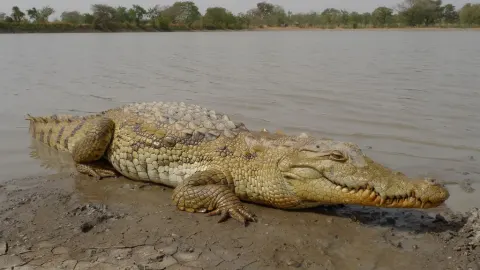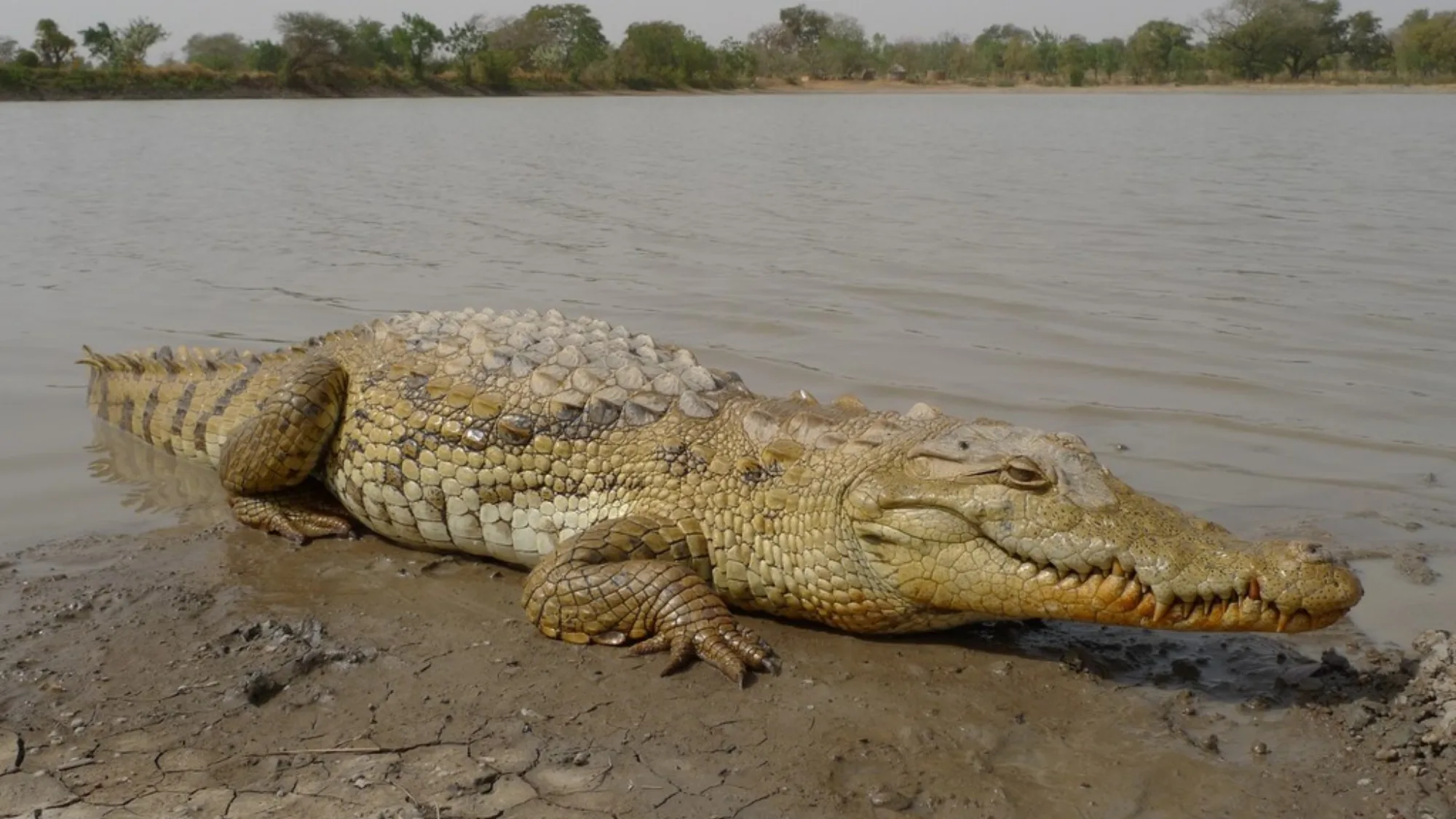
West African Crocodile
Crocodylus suchus
Across much of West and Central Africa, the West African Crocodile lives in waterways from Mauritania to Uganda and South Sudan, with its range extending south into the Democratic Republic of the Congo. Smaller than the Nile crocodile, with which it is often confused, it usually reaches 2 to 3 m in length. Its colour ranges from brown to olive, while younger crocodiles are paler, with black bands that are especially clear on the tail. Look for a short, thick muzzle, and eyes that reflect a flashlight's beam after dark.
Where its range overlaps with the Nile crocodile's, it generally favours lagoons and wetlands in forested areas, although the details of how the two share habitats remain uncertain. In Liberia, it has been found in larger, open waterways, including river basins and mangrove swamps, and tolerates brackish water. In Mauritania, crocodiles shelter in caves or burrows through the driest periods, entering a dormant state known as aestivation. Rain brings them together at gueltas. Active by day and night, they can remain underwater for more than 30 minutes and reach 30 km/h in short bursts. On land, they often bask without moving, sometimes with their mouths open.
Although less aggressive than the Nile crocodile, this species has been involved in attacks on people, some fatal. In Mauritania, local traditional communities protect crocodiles, believing that water would disappear without them. The species has vanished from the White Nile, where museums were still collecting specimens in the 1920s. Ancient Egyptians sometimes hunted crocodiles, though they also regarded them as protectors. Eggs of this species have been discovered in tombs in Egypt, and several European zoos keep breeding pairs.
Written from the English Wikipedia article West African crocodile (CC BY-SA 4.0).
- Records
- 75
- Countries
- 13
No atlas park has a record of the West African Crocodile in or around it yet.
These are open occurrence records, so they show where people looked for and recorded the West African Crocodile as much as where it lives. Cells are up to 25 km across, and every location is generalised to its cell.
Generalised encounter areas, not exact locations. Each shape is a grid cell coloured by how likely the species is there.
- Very likelyGambia25 km zone · medium confidence · 21 records · updated 80 days ago
- Very likelyGhana25 km zone · medium confidence · 19 records · updated 80 days ago
- Very likelyMauritania25 km zone · medium confidence · 11 records · updated 80 days ago
- Very likelySenegal25 km zone · medium confidence · 9 records · updated 80 days ago
- Very likelyBenin25 km zone · medium confidence · 6 records · updated 80 days ago
- LikelyBurkina Faso25 km zone · medium confidence · 3 records · updated 80 days ago
- LikelyNigeria25 km zone · medium confidence · 3 records · updated 80 days ago
- LikelyGuinea-Bissau25 km zone · medium confidence · 2 records · updated 80 days ago
- PossibleChad25 km zone · medium confidence · 1 record · updated 80 days ago
- UncommonCameroon25 km zone · low confidence · 0 records · updated 80 days ago
Conservation status not assessed here yet, so every location is generalised to its grid cell.