Cuban Crocodile
Crocodylus rhombifer
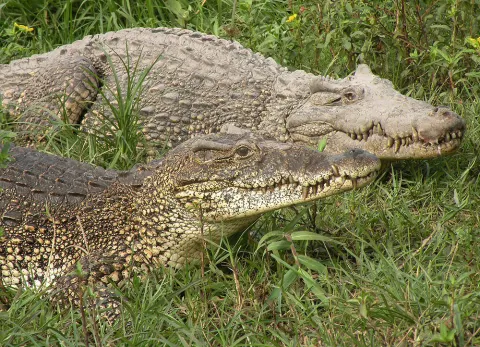
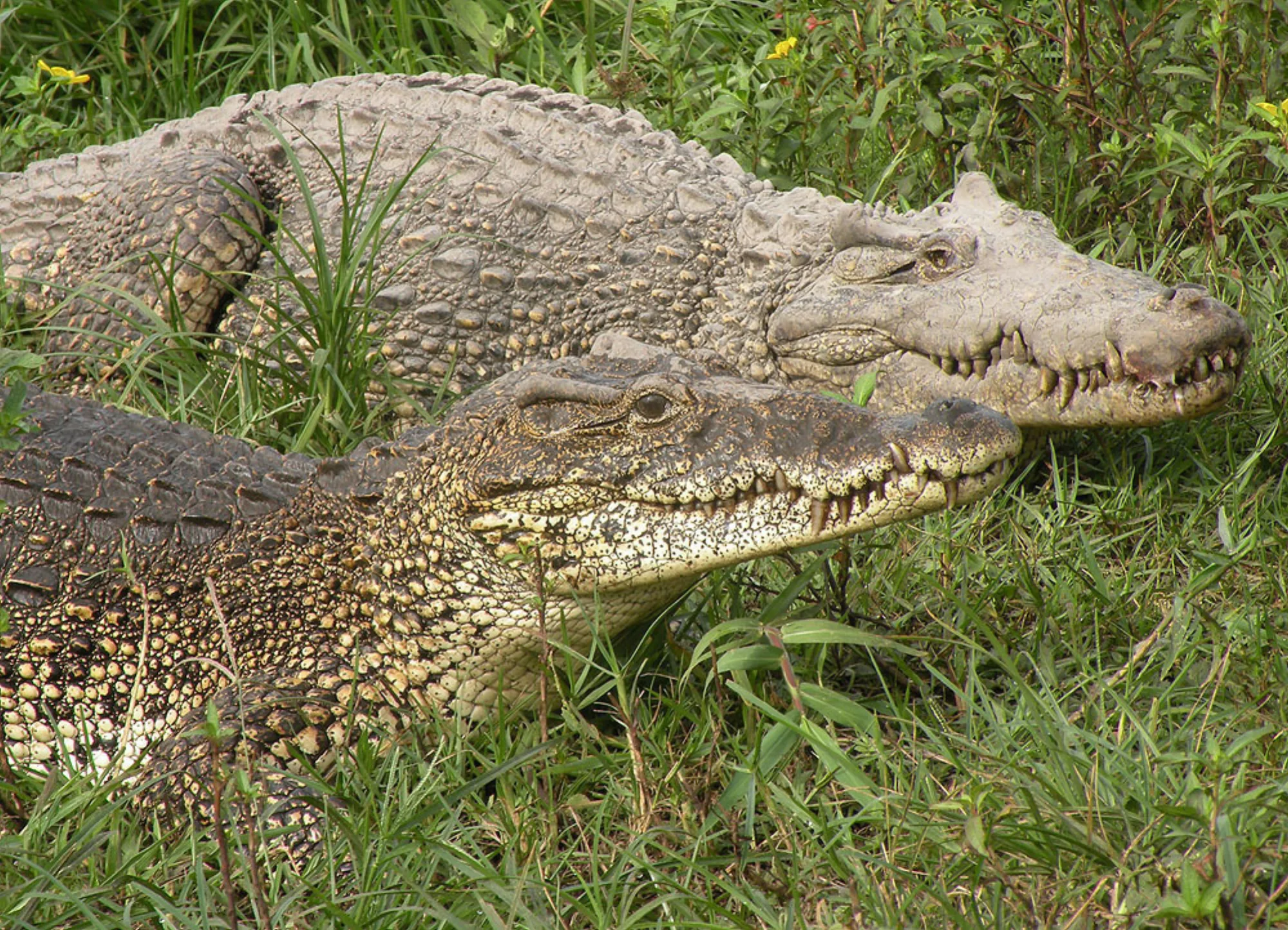
Long, strong legs and rough, pebbled scales help distinguish the Cuban Crocodile, a small to mid-sized crocodile found only in Cuba. Adults have brighter colours than other crocodilians, and typically measure 2.1 to 2.3 m long and weigh 70 to 80 kg. Large males can reach 3.5 m and weigh more than 215 kg. Today its range is confined to the Zapata Swamp, though fossils show that it once lived elsewhere in the Caribbean. It favours fresh water, including swamps, marshes and rivers, and rarely enters salt water. Other preferred habitats include mangrove swamps, coastal lagoons, estuaries, floodplains and river deltas.
This is the most terrestrial of living crocodiles, able to run with a gait resembling a gallop. It can also propel itself out of the water with its tail to snatch small animals from overhanging branches. Young crocodiles eat small fish, arthropods and crustaceans, while adults feed mostly on fish, turtles and small mammals. Captive animals have shown signs of cooperative hunting and can be taught tricks. The mating season runs from May to July. In wild marshes, females lay 30 to 40 eggs in trenches covered with organic material; incubation is estimated at 58 to 70 days. Hatching can take place from late August to early September, but humans, raccoons and other animals prey on many eggs.
Human hunting has reduced the species' range, and its remaining habitat is restricted. Hybridisation with the American crocodile is another significant threat, with genetic analysis finding hybrids among both wild and captive Cuban crocodiles. Captive breeding projects are helping the species recover.
Written from the English Wikipedia article Cuban crocodile (CC BY-SA 4.0).
- Records
- 2
- Countries
- 1
No atlas park has a record of the Cuban Crocodile in or around it yet.
These are open occurrence records, so they show where people looked for and recorded the Cuban Crocodile as much as where it lives. Cells are up to 25 km across, and every location is generalised to its cell.
Generalised encounter areas, not exact locations. Each shape is a grid cell coloured by how likely the species is there.
- Very likelyCuba25 km zone · medium confidence · 2 records · updated 80 days ago
Conservation status not assessed here yet, so every location is generalised to its grid cell.