Saltwater Crocodile
Crocodylus porosus
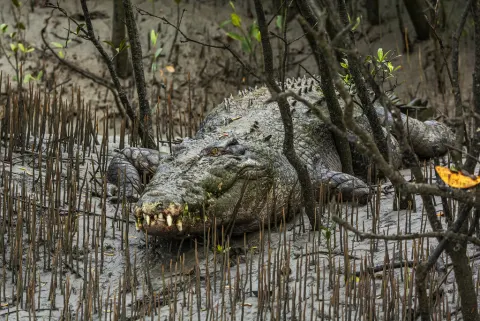
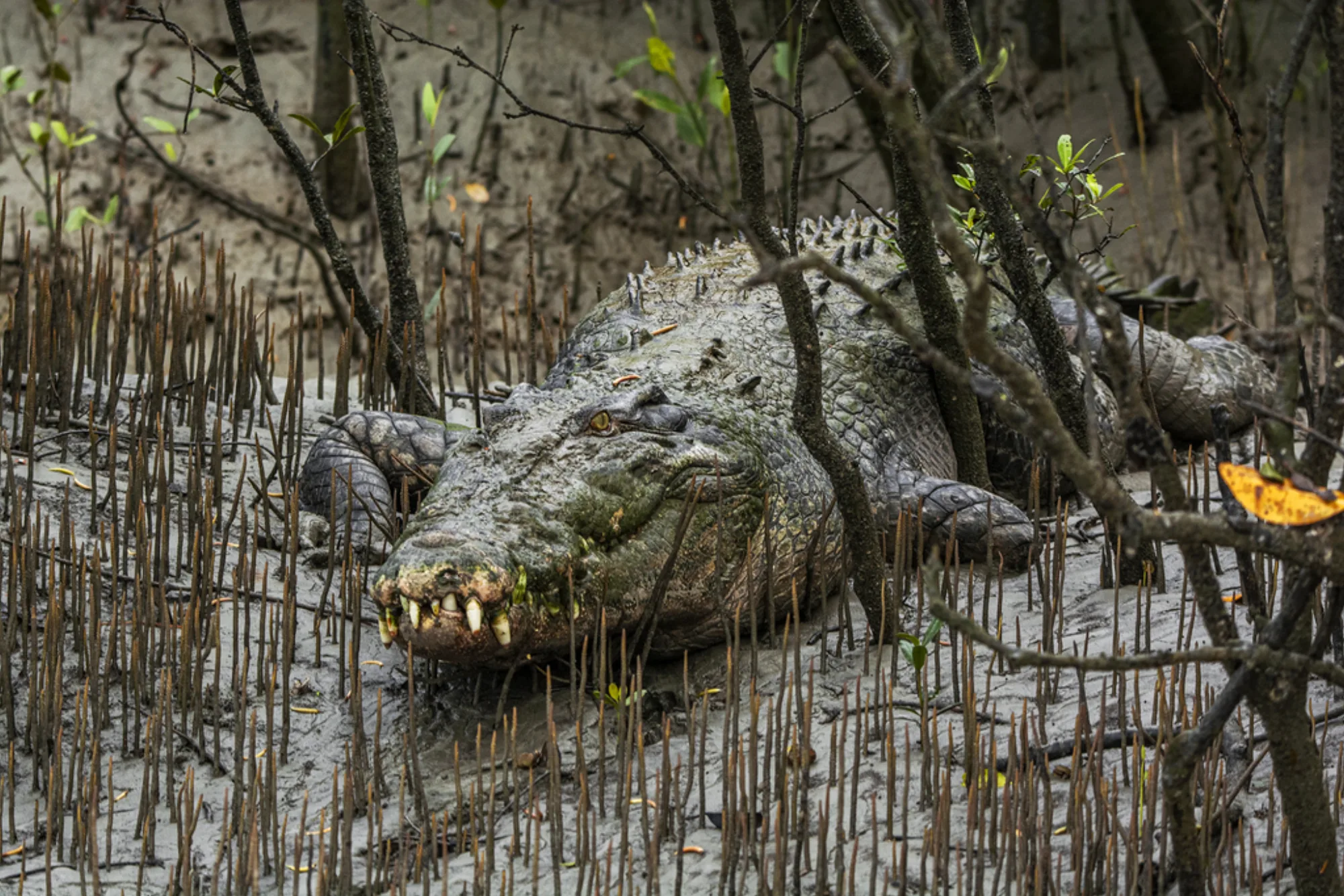
Broad-bodied and powerfully built, the Saltwater Crocodile (Crocodylus porosus) is the largest living reptile. Males can reach 6 m, while females are much smaller and rarely exceed 3 m. Young crocodiles are pale yellow with black stripes and spots, while adults are generally darker, with greenish-drab colouring. A broad snout and a pair of ridges running forward from the eyes are further features to look for.
Its range stretches from India's east coast through Southeast Asia to northern Australia and Micronesia. Despite its name, it uses fresh water as well as coastal mangrove swamps, river deltas and the sea. It generally spends the tropical wet season in freshwater rivers and swamps, then moves downstream to estuaries in the dry season. Dominant males compete for stretches of freshwater creeks, while younger crocodiles can be pushed into less favourable rivers or out to sea. Saltwater crocodiles can travel long distances on ocean currents, sometimes floating to conserve energy and waiting in sheltered bays for currents to change.
Much of the day is spent in the water or basking, with hunting usually taking place at night. An ambush hunter, it takes prey ranging from fish and crustaceans to birds, mammals and even sharks, drowning or swallowing its catch whole. Females build nests from mud and vegetation, typically lay 40 to 60 eggs and guard the nest; after hatching, the mother carries her young to water and stays with them for several months. Unregulated hunting for skins caused steep declines across the range, and illegal killing and habitat loss remain threats. Nesting areas can also be damaged by trampling buffalo or converted to agriculture.
Written from the English Wikipedia article Saltwater crocodile (CC BY-SA 4.0).
- Records
- 92,304
- Countries
- 8
- Atlas places
- 3
These are open occurrence records, so they show where people looked for and recorded the Saltwater Crocodile as much as where it lives. Cells are up to 25 km across, and every location is generalised to its cell.
Generalised encounter areas, not exact locations. Each shape is a grid cell coloured by how likely the species is there.
- Very likelyAustralia25 km zone · high confidence · 92017 records · updated 80 days ago
- LikelyMalaysia25 km zone · medium confidence · 98 records · updated 80 days ago
- LikelySingapore25 km zone · high confidence · 82 records · updated 80 days ago
- LikelyPalau25 km zone · medium confidence · 77 records · updated 80 days ago
- LikelyIndia25 km zone · medium confidence · 17 records · updated 80 days ago
- PossibleSri Lanka25 km zone · medium confidence · 7 records · updated 80 days ago
- PossibleTimor-Leste25 km zone · medium confidence · 6 records · updated 80 days ago
Conservation status not assessed here yet, so every location is generalised to its grid cell.