Marsh Crocodile
Crocodylus palustris
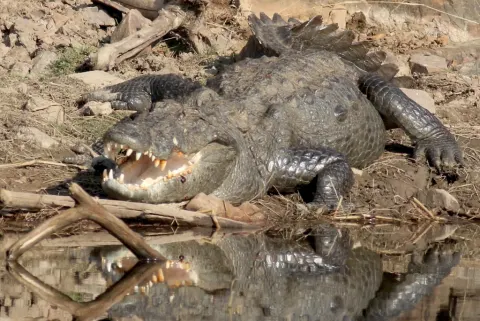
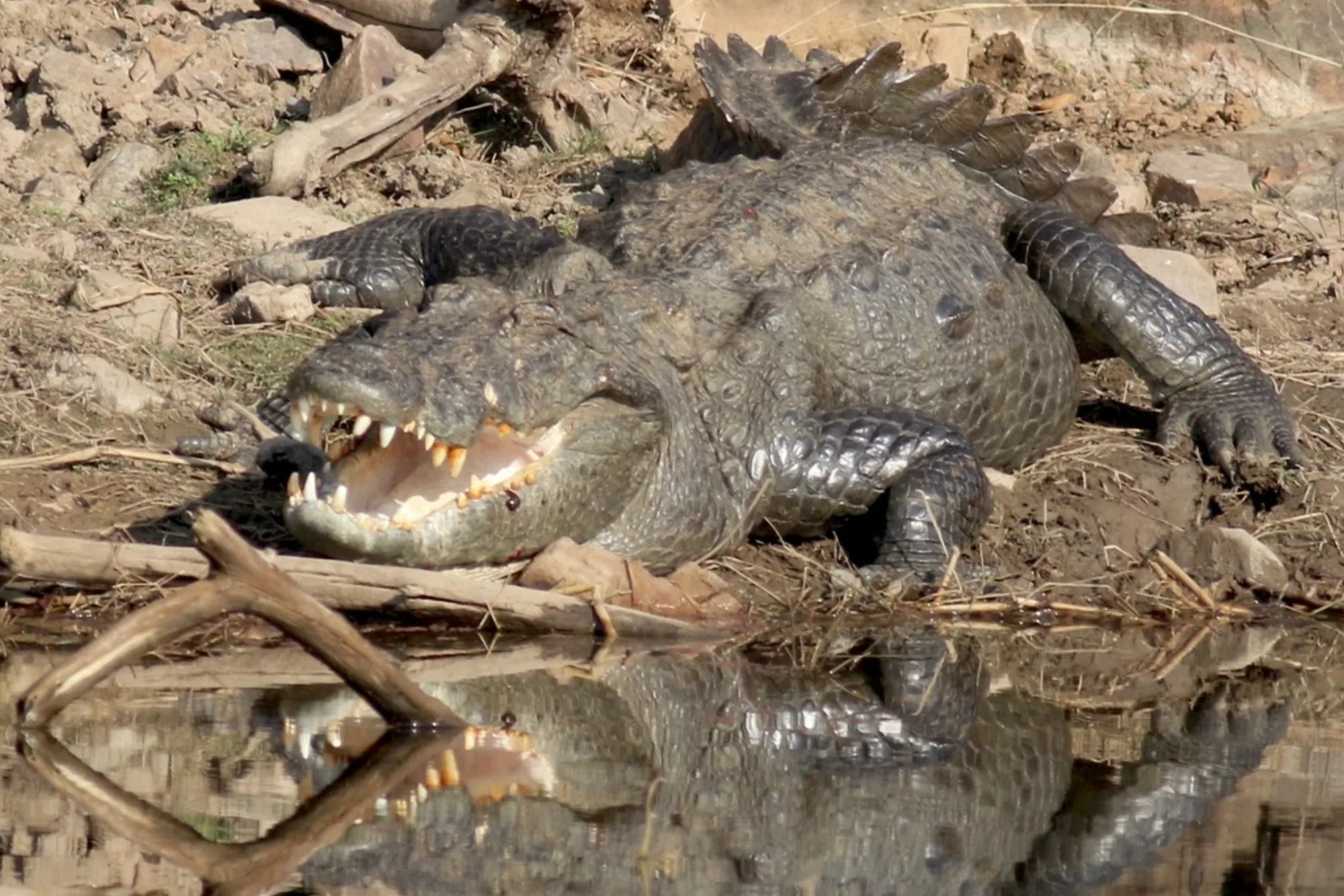
With a broad snout and a powerful tail, the Marsh Crocodile (Crocodylus palustris) is a medium-sized crocodile also known as the mugger. Adults range in colour from dark olive to grey or brown, while hatchlings are pale olive with black spots. Females average 2 to 2.5 m in length, while males typically reach 3 to 3.5 m. Its freshwater range extends from southern Iran through Pakistan to Nepal, India and Sri Lanka. It favours shallow, slow-moving water, including lakes, rivers and marshes, and also uses reservoirs and irrigation canals. In Nepal's Rapti River, it has often been seen basking on sandy banks.
A strong swimmer, the mugger uses its tail and hind feet to steer and submerge. During the hot dry season it spends much of the day underwater and travels overland at night to find wetlands. It also digs burrows for shelter from extreme temperatures and other harsh conditions. Young crocodiles eat mainly insects, along with crabs and shrimp, while larger animals favour fish and also hunt birds, reptiles and mammals. Muggers sometimes balance sticks and branches on their heads to lure birds seeking nesting material. Females dig nests in sand during the dry season and lay up to 46 eggs. Both parents protect their young for up to one year.
The crocodile faces habitat loss as natural areas are converted for agriculture and industry. It can drown after becoming tangled in fishing equipment, and is sometimes killed where fishers see it as competition. Encroachment brings more conflict with people, while roads and railway tracks have also claimed crocodiles.
Written from the English Wikipedia article Mugger crocodile (CC BY-SA 4.0).
- Records
- 479
- Countries
- 4
- Atlas places
- 16
- Yala National Park· Sri Lanka
- Chitwan National Park· Nepal
- Udawalawe National Park· Sri Lanka
- Kumana National Park· Sri Lanka
- Ranthambore National Park· India
- Wilpattu National Park· Sri Lanka
- Bardiya National Park· Nepal
- Jim Corbett National Park· India
- Wasgamuwa National Park· Sri Lanka
- Gir National Park· India
- Minneriya National Park· Sri Lanka
- Tadoba Andhari Tiger Reserve· India
- Bandipur National Park· India
- Gal Oya National Park· Sri Lanka
- Nagarhole National Park· India
- Pench National Park· India
These are open occurrence records, so they show where people looked for and recorded the Marsh Crocodile as much as where it lives. Cells are up to 25 km across, and every location is generalised to its cell.
Generalised encounter areas, not exact locations. Each shape is a grid cell coloured by how likely the species is there.
- Very likelyIndia25 km zone · medium confidence · 295 records · updated 81 days ago
- Very likelySri Lanka25 km zone · medium confidence · 136 records · updated 81 days ago
- Very likelyNepal25 km zone · medium confidence · 46 records · updated 81 days ago
- LikelyIran25 km zone · medium confidence · 2 records · updated 81 days ago
Conservation status not assessed here yet, so every location is generalised to its grid cell.