Nile Crocodile
Crocodylus niloticus
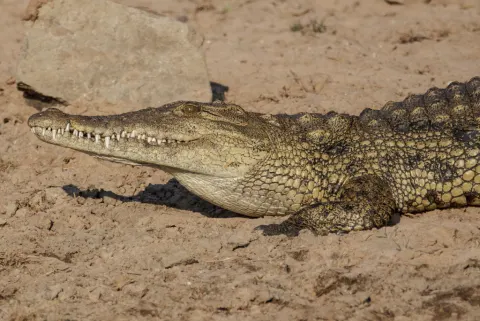
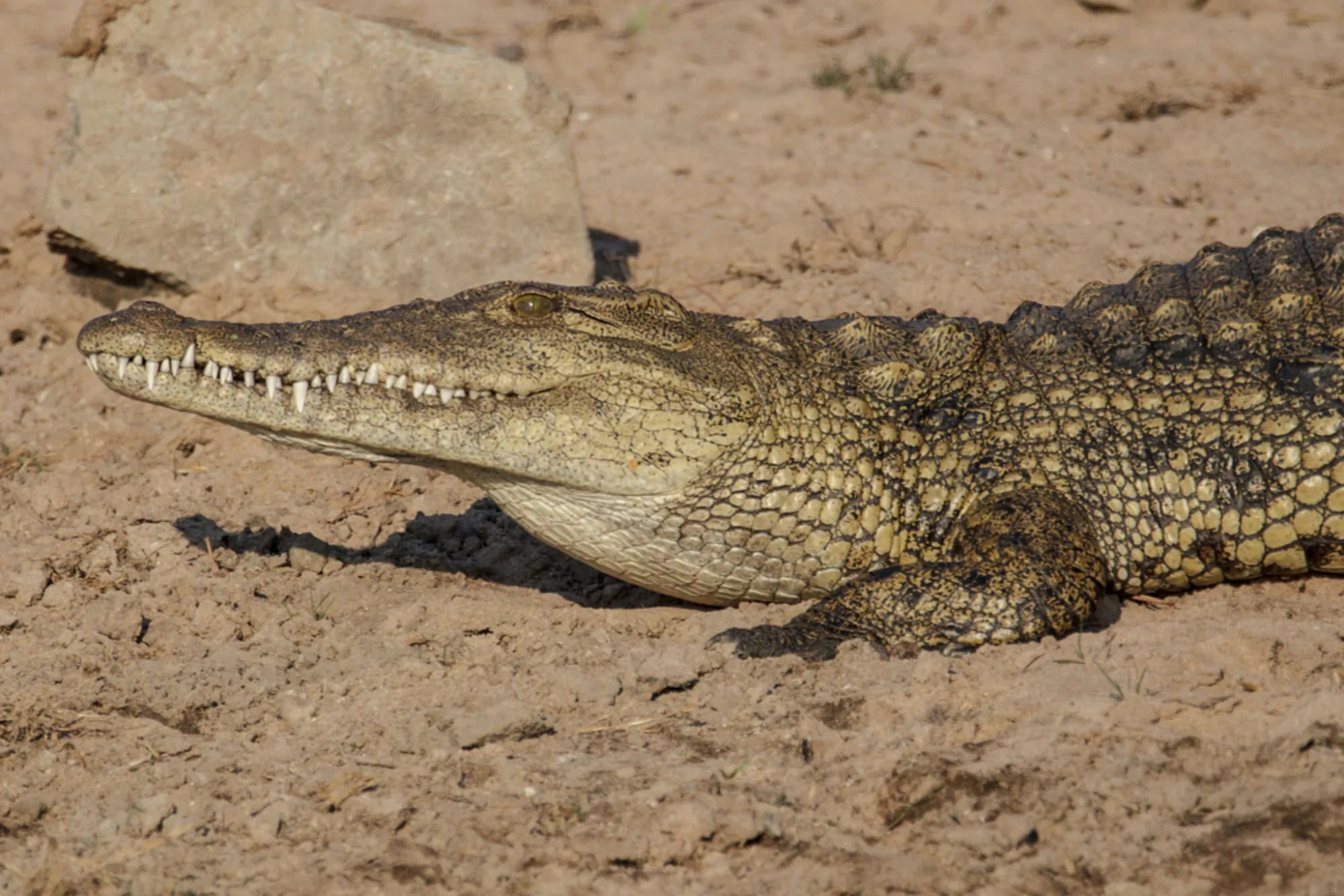
At the water's edge, the Nile Crocodile can be recognised by its long, powerful tail, short legs and heavily armoured, scaly skin. Adults are dark bronze above, with faded dark markings, although mud can hide their colour. Adult males generally measure 3.5 to 5 m, while females are usually about 30% smaller.
This freshwater crocodilian occurs across much of sub-Saharan Africa, chiefly in the east, south and centre. It lives in rivers, lakes, swamps and marshes, and sometimes enters brackish water or the sea. Kenya's Lake Turkana holds one of its largest undisturbed populations. In East Africa, it favours broad, open waters, including rivers, lakes, marshes and dams. In South Africa, winter offers a better chance of seeing crocodiles because they spend more time basking.
Nile crocodiles can lie motionless for hours in shallow water or while basking, yet remain alert to other animals nearby. They hunt by ambush, sometimes waiting for days or weeks before striking, and eat fish, reptiles, birds and mammals. They also scavenge carcasses and may share large food sources and basking places, with the largest old males taking priority. Both females and males guard the eggs, and the young receive protection for a time after hatching, though they must hunt for themselves. Regional populations have declined or disappeared in parts of the Maghreb. The species is also associated with the leather trade, and crocodiles can die after being mishandled by people and subjected to prolonged struggling and stress. It is dangerous to people, causing hundreds of human deaths each year.
Written from the English Wikipedia article Nile crocodile (CC BY-SA 4.0).
- Records
- 646
- Countries
- 22
- Atlas places
- 42
- Kruger National Park· South Africa
- Okavango Delta· Botswana
- Serengeti National Park· Tanzania
- iSimangaliso Wetland Park· South Africa
- Chobe National Park· Botswana
- Maasai Mara National Reserve· Kenya
- Tsavo East National Park· Kenya
- Bwabwata National Park· Namibia
- Murchison Falls National Park· Uganda
- South Luangwa National Park· Zambia
- Tsavo West National Park· Kenya
- Hluhluwe-iMfolozi Park· South Africa
- Kafue National Park· Zambia
- Nyerere National Park· Tanzania
- Akagera National Park· Rwanda
- Gonarezhou National Park· Zimbabwe
- Hwange National Park· Zimbabwe
- Lower Zambezi National Park· Zambia
- Mana Pools National Park· Zimbabwe
- Nairobi National Park· Kenya
- Ngorongoro Conservation Area· Tanzania
- Queen Elizabeth National Park· Uganda
- Samburu National Reserve· Kenya
- Zambezi National Park· Zimbabwe
- Meru National Park· Kenya
- Mikumi National Park· Tanzania
- Mudumu National Park· Namibia
- Nkasa Rupara National Park· Namibia
- Pilanesberg National Park· South Africa
- Ruaha National Park· Tanzania
- Kasanka National Park· Zambia
- Katavi National Park· Tanzania
- Kilimanjaro National Park· Tanzania
- Lake Manyara National Park· Tanzania
- Lake Mburo National Park· Uganda
- Madikwe Game Reserve· South Africa
- Makgadikgadi Pans National Park· Botswana
- Mapungubwe National Park· South Africa
- Matobo National Park· Zimbabwe
- Matusadona National Park· Zimbabwe
- Saadani National Park· Tanzania
- Udzungwa Mountains National Park· Tanzania
These are open occurrence records, so they show where people looked for and recorded the Nile Crocodile as much as where it lives. Cells are up to 25 km across, and every location is generalised to its cell.
Generalised encounter areas, not exact locations. Each shape is a grid cell coloured by how likely the species is there.
- Very likelyKenya25 km zone · medium confidence · 161 records · updated 80 days ago
- Very likelySouth Africa25 km zone · medium confidence · 141 records · updated 80 days ago
- Very likelyUganda25 km zone · medium confidence · 59 records · updated 80 days ago
- Very likelyTanzania25 km zone · medium confidence · 46 records · updated 80 days ago
- Very likelyBenin25 km zone · medium confidence · 42 records · updated 80 days ago
- Very likelyZambia25 km zone · medium confidence · 40 records · updated 80 days ago
- Very likelyBotswana25 km zone · medium confidence · 34 records · updated 80 days ago
- Very likelyNamibia25 km zone · medium confidence · 29 records · updated 80 days ago
- Very likelyMalawi25 km zone · medium confidence · 23 records · updated 80 days ago
- Very likelyZimbabwe25 km zone · medium confidence · 23 records · updated 80 days ago
Conservation status not assessed here yet, so every location is generalised to its grid cell.