Morelet's Crocodile
Crocodylus moreletii
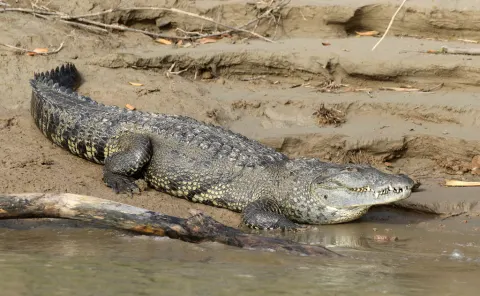
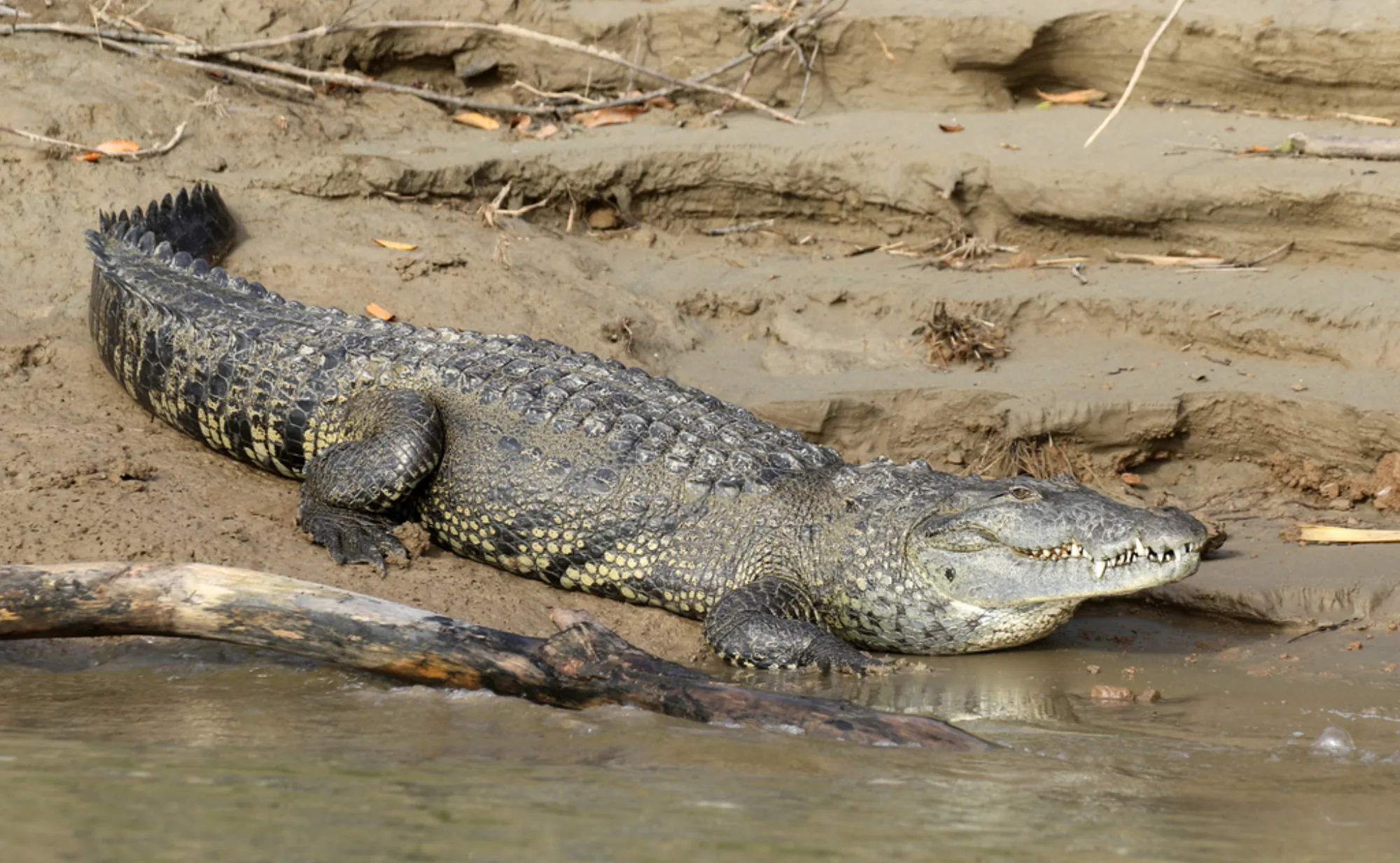
A broad snout and a greyish-brown body marked with dark bands and spots help identify the Morelet's Crocodile. Its long tail carries the same markings and helps propel it through water. Young crocodiles look different, with bright yellow colouring crossed by dark bands. Adults average about 2.1 m in total length, including the tail, and males are typically larger than females.
Across Mexico, Belize and Guatemala, the species occurs on the Atlantic side, favouring secluded freshwater areas. Look for it in inland swamps and marshes, as well as large rivers and lakes, where forest provides cover. It also occurs in coastal brackish water and on the grassy savannas of the Yucatán Peninsula. Flooding in the rainy season makes it easier for crocodiles to move into other areas, while adults dig burrows during the dry season. Young animals stay in dense cover for protection until they are old enough to fend for themselves.
An opportunistic hunter, it takes prey it can overpower within its territory. Young crocodiles eat mainly fish and insects, while adults feed on small mammals, birds, reptiles, fish and a range of invertebrates. Breeding generally occurs from April to June, with females laying 20 to 45 eggs in mound nests near water or on floating vegetation. Females guard the nests and carry their hatchlings to water, where both parents protect them. Habitat destruction and illegal hunting have significantly reduced populations, and hunters sought the crocodile's skin for leather in the 1940s and 1950s.
Written from the English Wikipedia article Morelet's crocodile (CC BY-SA 4.0).
- Records
- 616
- Countries
- 3
No atlas park has a record of the Morelet's Crocodile in or around it yet.
These are open occurrence records, so they show where people looked for and recorded the Morelet's Crocodile as much as where it lives. Cells are up to 25 km across, and every location is generalised to its cell.
Generalised encounter areas, not exact locations. Each shape is a grid cell coloured by how likely the species is there.
- Very likelyMexico25 km zone · medium confidence · 547 records · updated 80 days ago
- Very likelyBelize25 km zone · medium confidence · 37 records · updated 80 days ago
- Very likelyGuatemala25 km zone · medium confidence · 32 records · updated 80 days ago
Conservation status not assessed here yet, so every location is generalised to its grid cell.