Orinoco Crocodile
Crocodylus intermedius
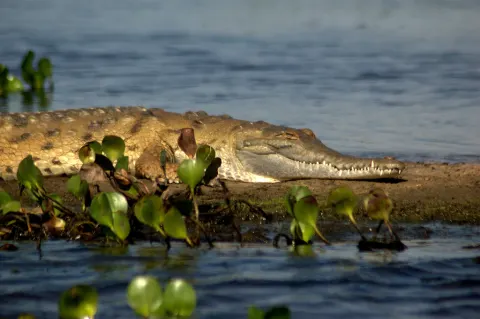
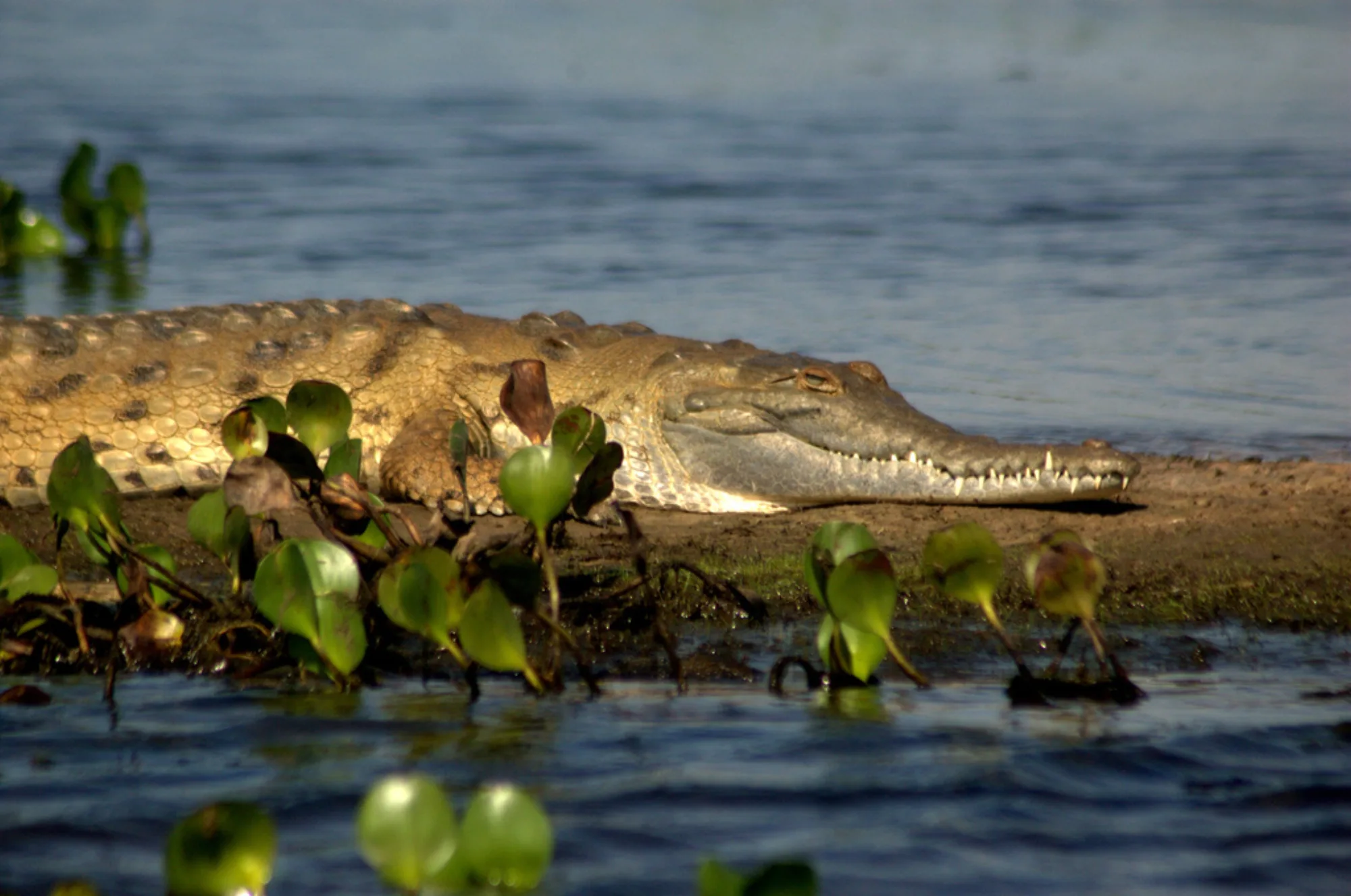
Along the seasonal freshwater rivers of the Llanos savanna, the Orinoco Crocodile inhabits the middle and lower Orinoco river basin in Venezuela and Colombia. It is a very large crocodile, with a relatively long, narrow snout and usually a pale tan hide. Its colour varies from almost entirely yellowish to dark brownish-gray, and its dark-brown markings form stronger bands in young animals than in adults. A large male today may reach 4.2 m and weigh up to 450 kg, while females are substantially smaller.
Large fish appear to make up most of its diet, although this predator also stalks prey on land and in water. Young crocodiles eat invertebrates and small fish; larger ones take fish, birds and land animals, sometimes including caimans. As water recedes in the dry season, the crocodiles withdraw into burrows they dig in riverbanks. Females usually lay about 40 eggs in a hole on a sandbank, then help their calling hatchlings out of the nest and carry them to the water. Mothers defend their young, sometimes for more than three years, although independence after about one year is more common.
Extensive hunting for skins brought the species close to extinction, and it has yet to recover. More recent threats include pollution, the capture of juveniles for the live animal trade and a proposed dam in the upper Orinoco region. Spectacled caimans can also outcompete it for fish, aided by their larger population and faster breeding. Eggs and young face predators including tegu lizards, while adults have no predators apart from humans.
Written from the English Wikipedia article Orinoco crocodile (CC BY-SA 4.0).
- Records
- 1
- Countries
- 2
No atlas park has a record of the Orinoco Crocodile in or around it yet.
These are open occurrence records, so they show where people looked for and recorded the Orinoco Crocodile as much as where it lives. Cells are up to 25 km across, and every location is generalised to its cell.
Generalised encounter areas, not exact locations. Each shape is a grid cell coloured by how likely the species is there.
- Very likelyColombia25 km zone · medium confidence · 1 record · updated 80 days ago
- UncommonVenezuela25 km zone · low confidence · 0 records · updated 80 days ago
Conservation status not assessed here yet, so every location is generalised to its grid cell.