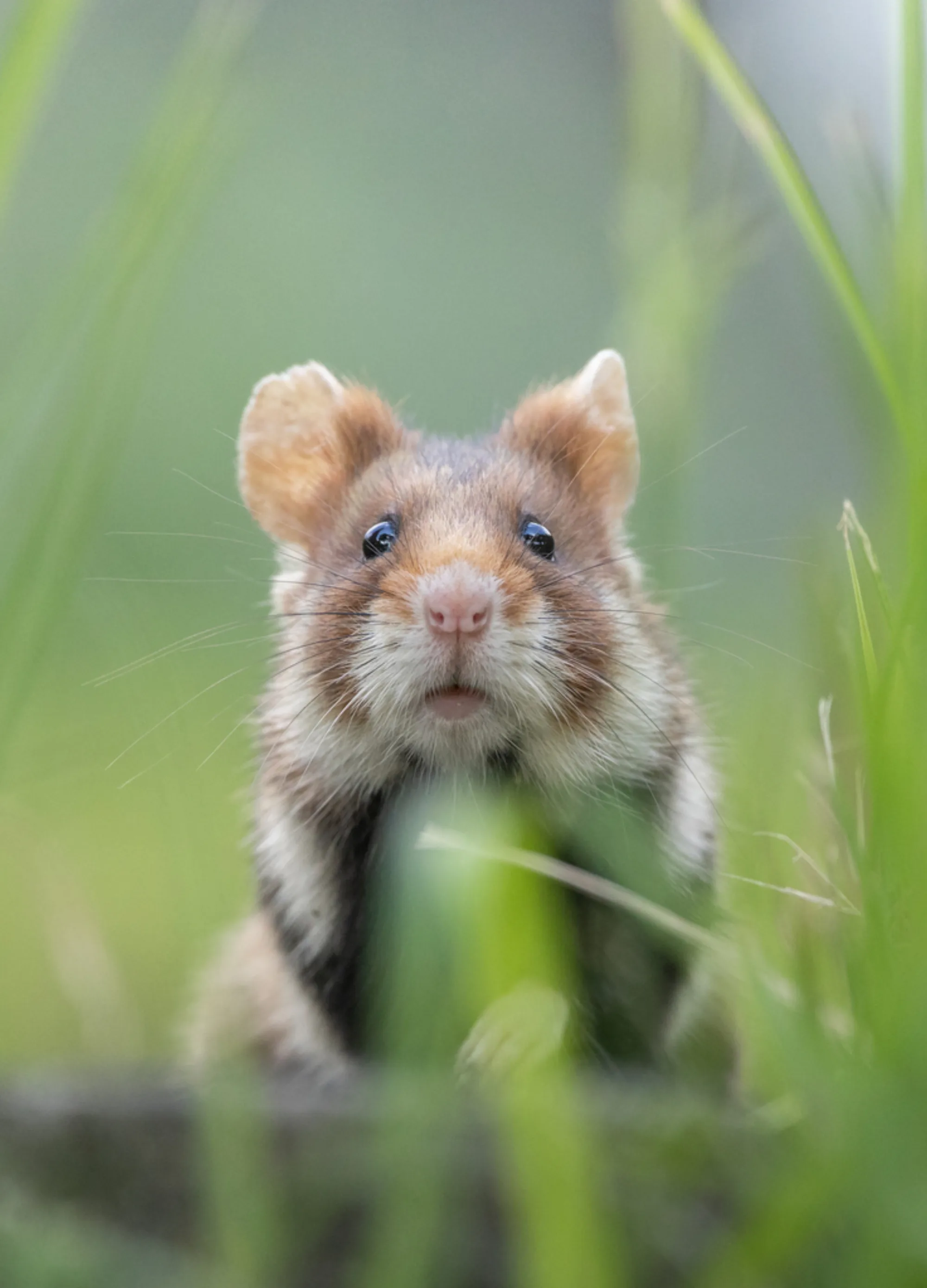
Common Hamster
Cricetus cricetus
Stocky and short-legged, the Common Hamster is the largest living hamster, reaching 20 to 30 centimetres in length. Its brown back contrasts with a black belly and white or cream markings on the nose, paws, cheeks and neck, as well as behind the forelimbs. It has a blunt snout, a relatively short tail and expandable cheek pouches for carrying food.
Its range stretches across Eurasia from Belgium and eastern France to Russia and northwest Xinjiang in China, and south to Bulgaria. Look for it in lowland areas, usually below 500 metres, where dry steppe and forest steppe give way in places to crop fields. A significant population lives in Vienna Central Cemetery. Often active at night or around dawn and dusk, it sometimes ventures out during the day. Usually solitary, it lives in complex burrows with separate chambers for storing food and tunnels used for defecation. Seeds, legumes, root vegetables and grasses make up much of its diet, supplemented by earthworms, snails and insects. It carries food underground in its cheek pouches and wakes every five to seven days during its October to March hibernation to feed from its stores.
When threatened, the hamster rises on its hind legs, shows its black underside and makes loud noises. Breeding usually runs from April or May until August, with females generally producing two litters, sometimes three, each containing 3 to 12 young. Populations have declined drastically, with intensive agriculture, habitat destruction, development and persecution among the main threats. Roads can divide populations, while pollution, including light pollution, has also been linked to the decline.
Written from the English Wikipedia article European hamster (CC BY-SA 4.0).
- Records
- 3,271
- Countries
- 8
No atlas park has a record of the Common Hamster in or around it yet.
These are open occurrence records, so they show where people looked for and recorded the Common Hamster as much as where it lives. Cells are up to 25 km across, and every location is generalised to its cell.
Generalised encounter areas, not exact locations. Each shape is a grid cell coloured by how likely the species is there.
- Very likelyGermany25 km zone · medium confidence · 2830 records · updated 80 days ago
- Very likelyUkraine25 km zone · high confidence · 161 records · updated 80 days ago
- Very likelyAustria25 km zone · medium confidence · 154 records · updated 80 days ago
- Very likelyRussia25 km zone · medium confidence · 39 records · updated 80 days ago
- LikelyFrance25 km zone · medium confidence · 72 records · updated 80 days ago
- LikelyCzechia25 km zone · medium confidence · 13 records · updated 80 days ago
- PossiblePoland25 km zone · medium confidence · 2 records · updated 80 days ago
- RareCroatia25 km zone · low confidence · 0 records · updated 80 days ago
Conservation status not assessed here yet, so every location is generalised to its grid cell.