Northern Giant Pouched Rat
Cricetomys gambianus
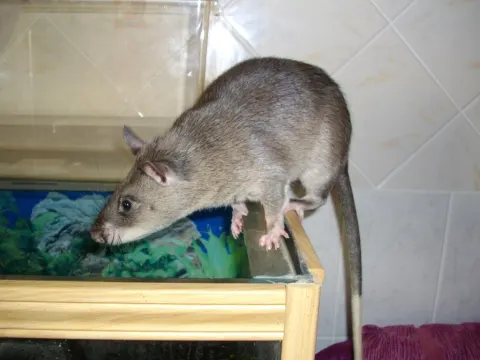
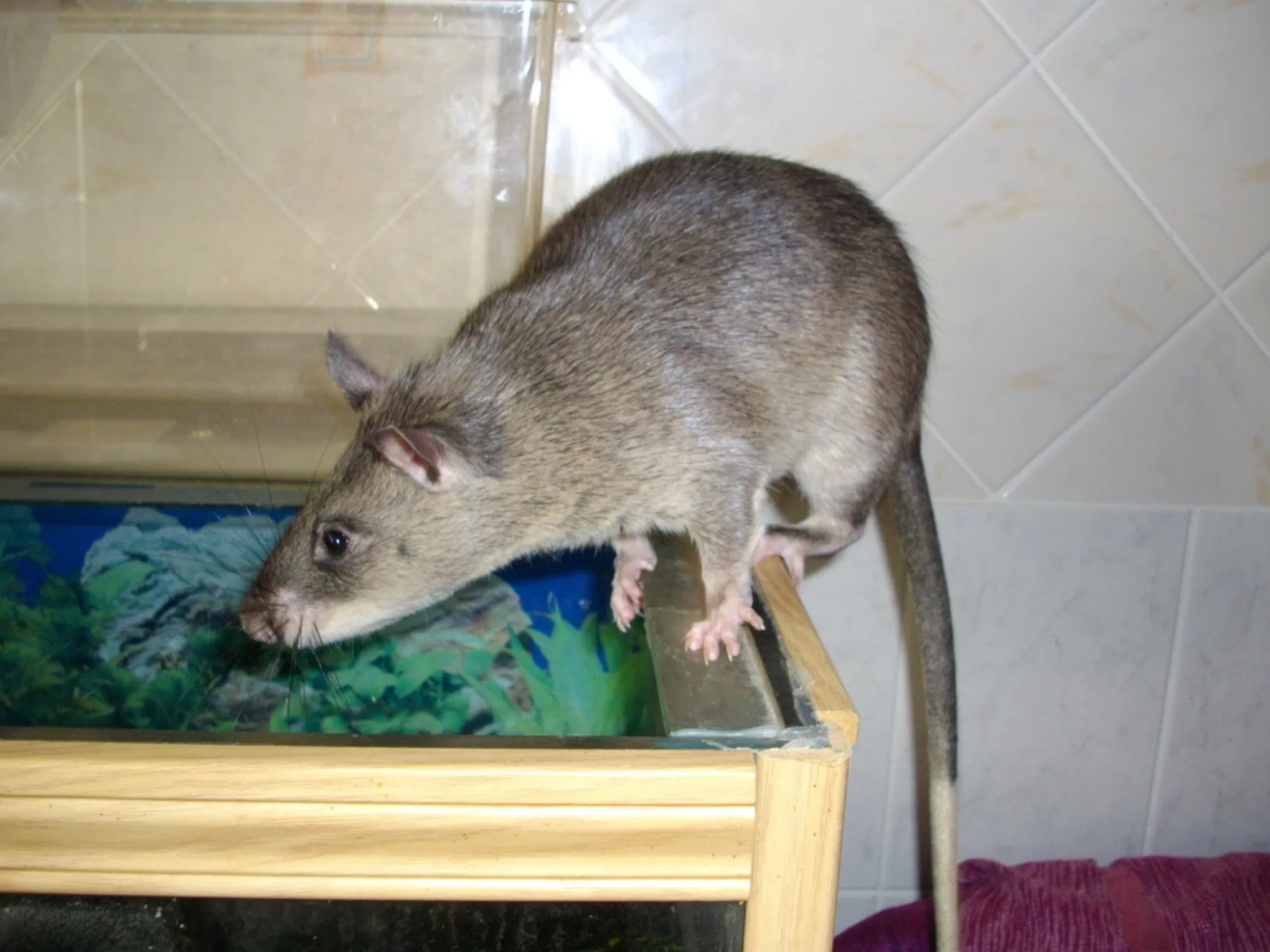
After dark, the Northern Giant Pouched Rat relies on smell and hearing to navigate, as its eyesight is very poor. This large African rodent can reach about 0.9 m from nose to tail, with the tail accounting for half its length. Look for the dark rings around its eyes and the large pouches in its cheeks. Its usual weight is 1.0 to 1.4 kg.
Its sub-Saharan African range extends between Senegal and Kenya, and between Angola and Mozambique, though the species is absent across large parts of the Democratic Republic of the Congo. Secluded populations also occur in southern Zimbabwe and South Africa, and the species lives from sea level up to 2,000 m. In its native range, it usually inhabits forests and thickets, and is also commonly found in termite mounds. Urban sightings are rare. These rats live in colonies of up to 20, though males defend territories and can be aggressive towards one another.
The rat eats both plant and animal food, including vegetables, insects, crabs and snails, with palm fruits and kernels apparently favoured. It carries nuts in its cheek pouches to store underground, sometimes filling them so heavily that entering its burrow becomes difficult. Inside, a long passage leads to side alleys and chambers for sleeping and storage. When occupied, the burrow is closed from within. As many as four litters can be born in nine months, each containing as many as six young. In Florida, where escaped animals established a population on Grassy Key, wildlife officials have attempted to eradicate them.
Written from the English Wikipedia article Gambian pouched rat (CC BY-SA 4.0).
- Records
- 1,470
- Countries
- 9
No atlas park has a record of the Northern Giant Pouched Rat in or around it yet.
These are open occurrence records, so they show where people looked for and recorded the Northern Giant Pouched Rat as much as where it lives. Cells are up to 25 km across, and every location is generalised to its cell.
Generalised encounter areas, not exact locations. Each shape is a grid cell coloured by how likely the species is there.
- Very likelyKenya25 km zone · high confidence · 1248 records · updated 80 days ago
- Very likelyBenin25 km zone · high confidence · 190 records · updated 80 days ago
- Very likelyCôte d’Ivoire25 km zone · medium confidence · 12 records · updated 80 days ago
- LikelySierra Leone25 km zone · medium confidence · 5 records · updated 80 days ago
- LikelyTogo25 km zone · medium confidence · 5 records · updated 80 days ago
- PossibleRwanda25 km zone · medium confidence · 6 records · updated 80 days ago
- UncommonSouth Sudan25 km zone · medium confidence · 3 records · updated 80 days ago
- UncommonGambia25 km zone · medium confidence · 1 record · updated 80 days ago
- RareNigeria25 km zone · low confidence · 0 records · updated 80 days ago
Conservation status not assessed here yet, so every location is generalised to its grid cell.