Corn Crake
Crex crex
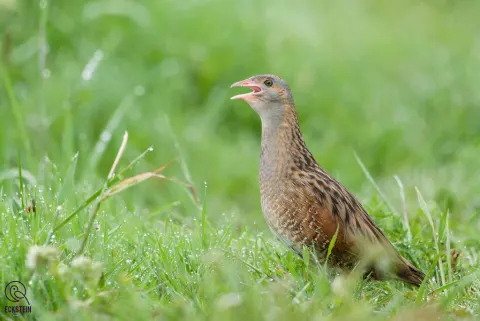
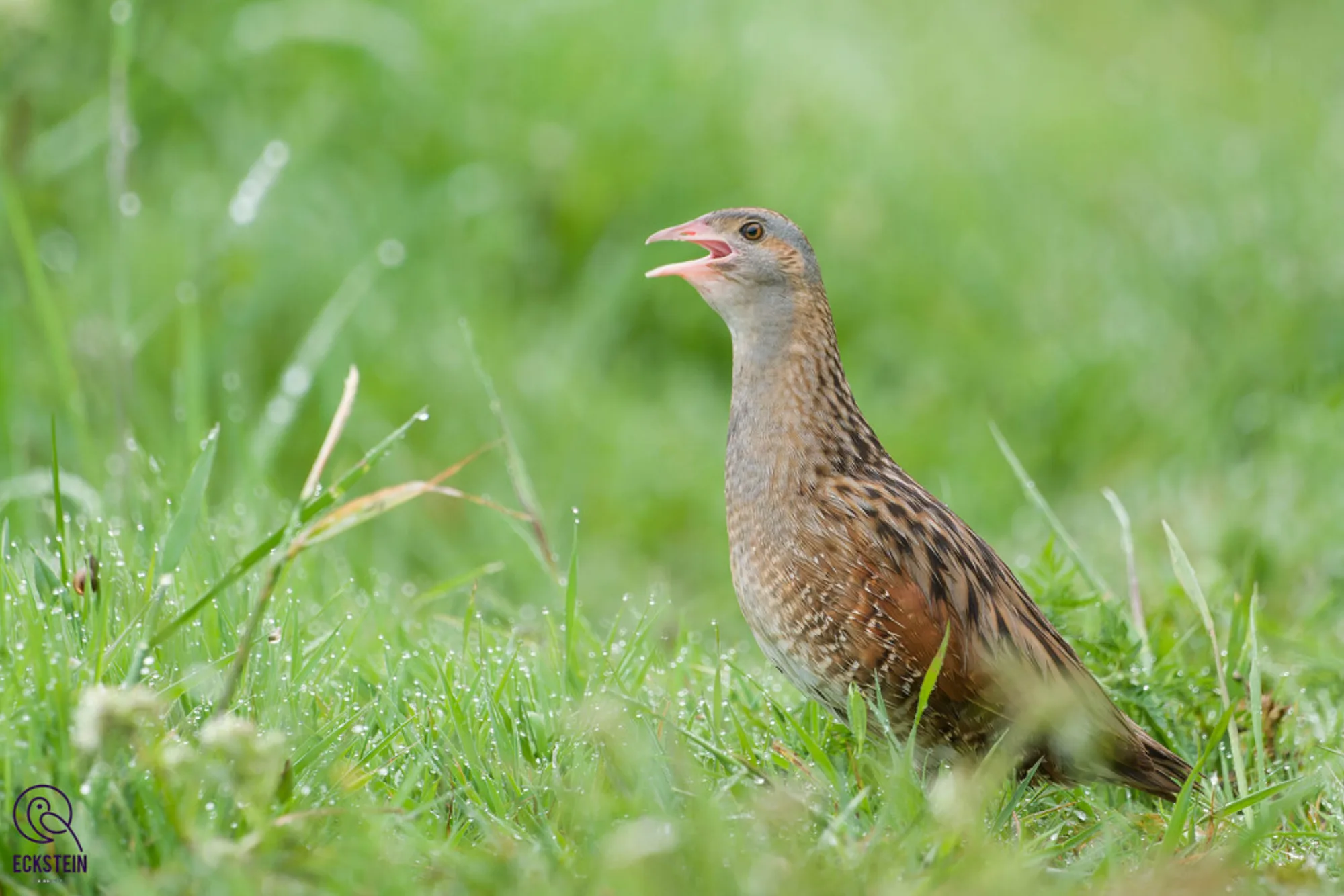
Hidden in grass, the Corn Crake is often easier to hear than to see. This medium-sized rail has dark brown-black upperparts streaked with buff or grey, chestnut wings and blue-grey underparts, with rust and white barring along its sides. In flight, look for the chestnut wing pattern and dangling legs. On the breeding grounds, the male gives a loud, grating krek krek, often through the night and sometimes during the day; in Africa, the bird is silent.
Corn Crakes breed from Ireland across Europe to central Siberia, with a substantial population in western China, and spend the northern winter mainly in Africa. They favour cool, moist hay meadows, especially traditional farmland with little cutting or fertiliser, although they also use other treeless grasslands and some crops. In Africa they occupy dry grassland and savanna, as well as fallow fields and crop edges. The bird is busiest towards the beginning and end of the day, can run swiftly through grass and usually hunts under cover. It eats mainly invertebrates, including worms, slugs and insects, along with small frogs and mammals, grass seed and cereal grain. A grass nest lies concealed in a hollow in the ground, where the female lays 6 to 14 eggs. The chicks hatch after 19 to 20 days and depart the nest within their first two days.
Early mowing destroys nests and chicks, and machinery can cut large areas so quickly that birds lose alternative places to breed. Drained and fertilised fields, conversion of grassland to arable land, and abandonment of farmland also reduce suitable habitat. Predators include cats, foxes and large birds, while some migrants are caught in nets set for quail in Egypt.
Written from the English Wikipedia article Corn crake (CC BY-SA 4.0).
- Records
- 114,952
- Countries
- 69
- Atlas places
- 13
- Serengeti National Park· Tanzania
- Kruger National Park· South Africa
- Maasai Mara National Reserve· Kenya
- Tsavo East National Park· Kenya
- Tsavo West National Park· Kenya
- Arusha National Park· Tanzania
- Fernando de Noronha Marine National Park· Brazil
- Gonarezhou National Park· Zimbabwe
- Ngorongoro Conservation Area· Tanzania
- Okavango Delta· Botswana
- Samburu National Reserve· Kenya
- South Luangwa National Park· Zambia
- Tarangire National Park· Tanzania
These are open occurrence records, so they show where people looked for and recorded the Corn Crake as much as where it lives. Cells are up to 25 km across, and every location is generalised to its cell.
Generalised encounter areas, not exact locations. Each shape is a grid cell coloured by how likely the species is there.
- Very likelyUnited Kingdom25 km zone · high confidence · 88442 records · updated 86 days ago
- Very likelyNorway25 km zone · high confidence · 7401 records · updated 86 days ago
- Very likelyFinland25 km zone · high confidence · 3488 records · updated 86 days ago
- Very likelyFrance25 km zone · high confidence · 2443 records · updated 86 days ago
- Very likelyDenmark25 km zone · high confidence · 2276 records · updated 86 days ago
- Very likelySweden25 km zone · high confidence · 2048 records · updated 86 days ago
- Very likelyPoland25 km zone · high confidence · 1453 records · updated 86 days ago
- Very likelyEstonia25 km zone · high confidence · 885 records · updated 86 days ago
- Very likelyRussia25 km zone · high confidence · 824 records · updated 86 days ago
- Very likelyAustria25 km zone · high confidence · 575 records · updated 86 days ago
Conservation status not assessed here yet, so every location is generalised to its grid cell.