Japanese Quail
Coturnix japonica
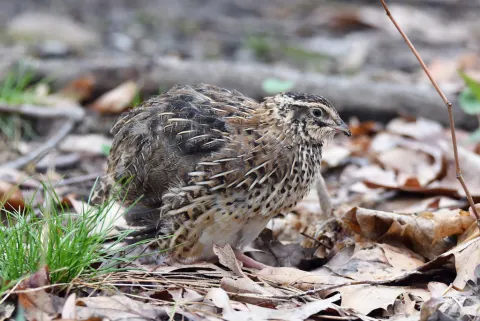
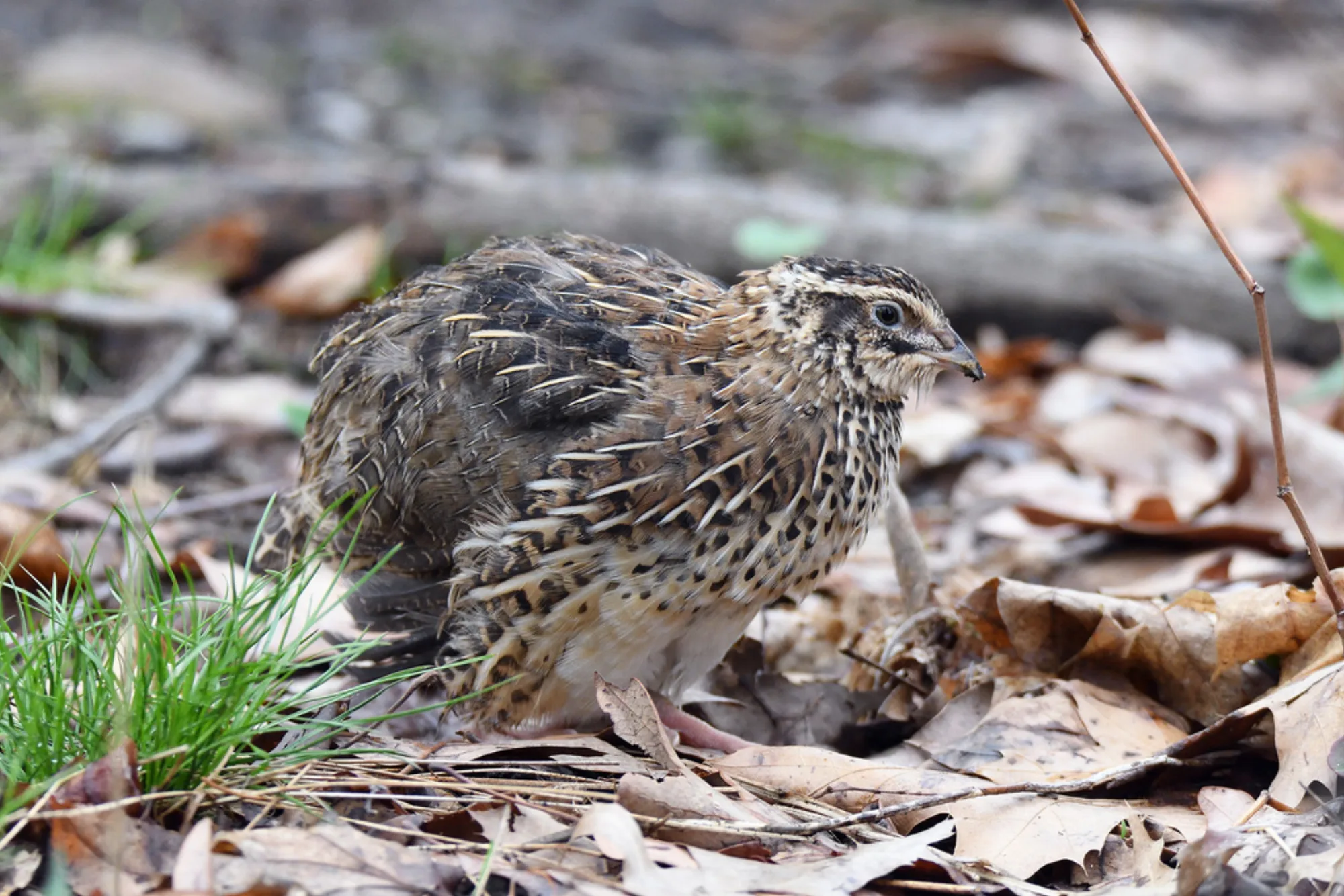
Brown plumage helps the Japanese Quail blend into the vegetation where it spends much of its time. This ground-living East Asian quail has different markings on males and females: the female's pale breast is dotted with dark spots, while the male's breast is an even reddish brown. Males also have reddish-brown cheeks, whereas females have cream-coloured cheeks. In the breeding season, a male has distinctive rufous feathers on its throat, which give way to pale feathers outside that season. Adults in the wild weigh 90 to 100 grams.
The species occurs across parts of East Asia and Russia, including Korea, Japan and China. Most migrate south for winter, reaching southern China and countries including Laos, Cambodia and Vietnam, although some populations remain in Japan. Breeding areas include the Korean Peninsula and northern Japan, as well as southeastern Siberia and Manchuria. Look for suitable habitat in grassy fields, riverside bushes and fields planted with oats, rice or barley. The bird also favours open steppes, meadows and mountain slopes near water, but tends to keep within dense vegetation for cover from predators.
Japanese Quail eat grass seeds, insects, larvae and other small invertebrates. They feed and drink mainly at the start and end of the day, though they also do both at other times. Dust bathing is a frequent part of their day: they loosen soil, toss dust with their wings and shake it through their feathers. Breeding activity peaks in summer, and eggs are generally laid in the hours before dusk. Females do most of the incubation and care for the newly hatched young; incubation lasts an average of 16.5 days.
Written from the English Wikipedia article Japanese quail (CC BY-SA 4.0).
- Records
- 4,601
- Countries
- 13
No atlas park has a record of the Japanese Quail in or around it yet.
These are open occurrence records, so they show where people looked for and recorded the Japanese Quail as much as where it lives. Cells are up to 25 km across, and every location is generalised to its cell.
Generalised encounter areas, not exact locations. Each shape is a grid cell coloured by how likely the species is there.
- Very likelyChina25 km zone · high confidence · 3120 records · updated 80 days ago
- Very likelyRussia25 km zone · high confidence · 452 records · updated 80 days ago
- Very likelyMongolia25 km zone · medium confidence · 402 records · updated 80 days ago
- Very likelyHong Kong SAR China25 km zone · high confidence · 167 records · updated 80 days ago
- Very likelyTaiwan25 km zone · high confidence · 163 records · updated 80 days ago
- Very likelyUnited States25 km zone · medium confidence · 146 records · updated 80 days ago
- Very likelySouth Korea25 km zone · medium confidence · 94 records · updated 80 days ago
- LikelyJapan25 km zone · medium confidence · 31 records · updated 80 days ago
- LikelyNorway25 km zone · medium confidence · 9 records · updated 80 days ago
- PossibleBhutan25 km zone · medium confidence · 6 records · updated 80 days ago
Conservation status not assessed here yet, so every location is generalised to its grid cell.