Common Quail
Coturnix coturnix
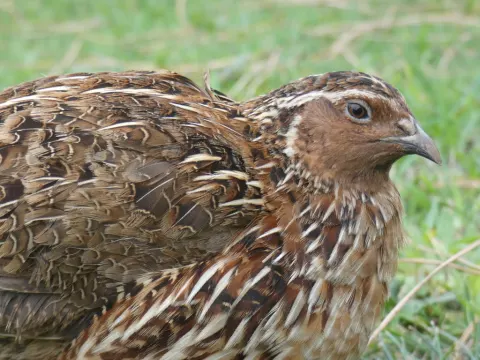
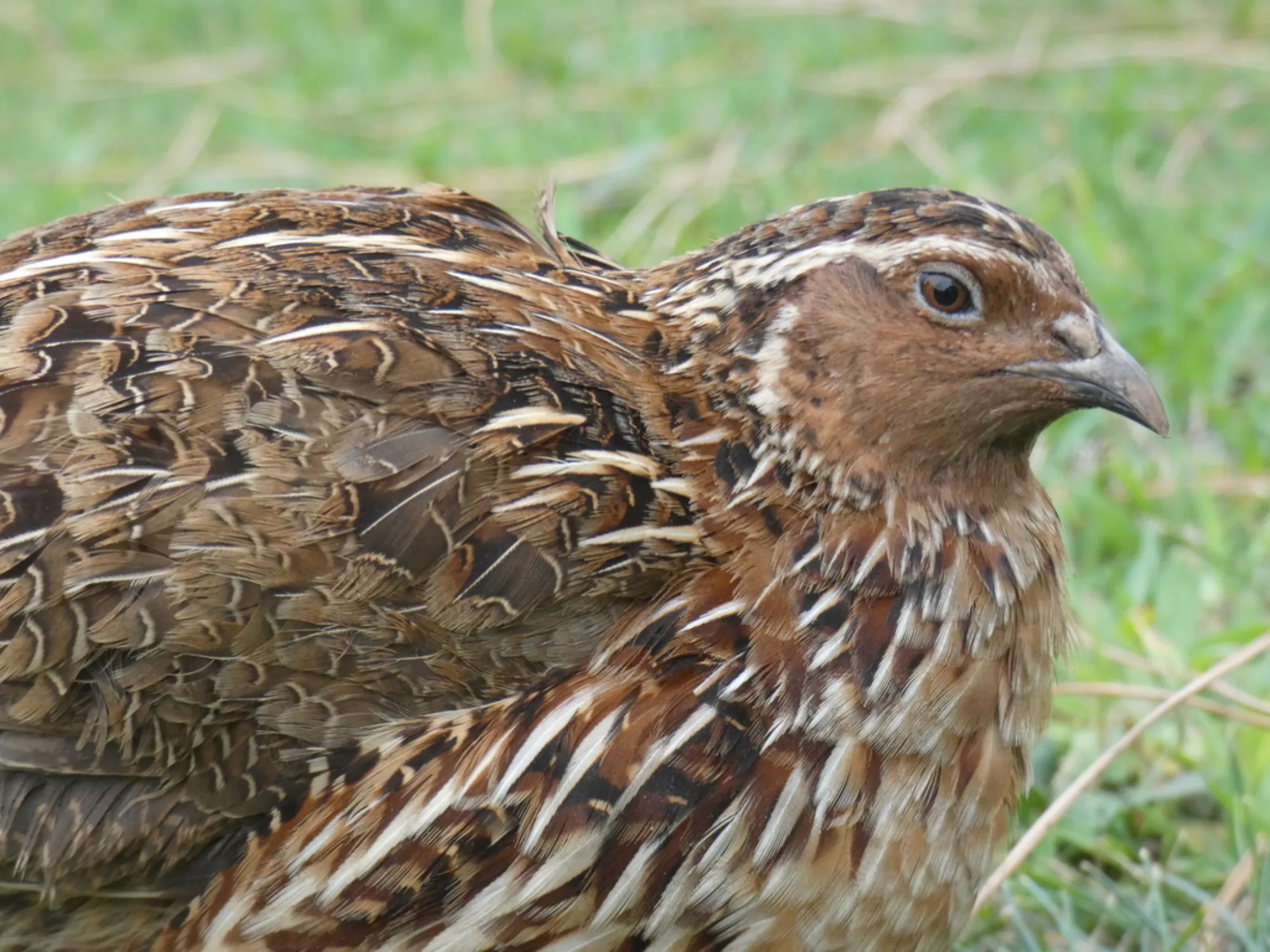
More often heard than seen, the Common Quail is a compact game bird belonging to the pheasant family, and it nests on the ground. Its compact body is streaked brown, with a white stripe above the eye; males also have a white chin. It measures 16 to 18 cm long, with a wingspan of 32 to 35 cm. A male's repeated “wet-my-lips” song can give away its presence, especially in the morning and evening, though it sometimes calls at night. Even when disturbed into flight, it stays low and quickly returns to cover.
Found widely across Europe and North Africa, the species migrates between breeding grounds in the Palearctic and wintering areas in Africa and southern India. Hidden among crops, it prefers to creep away rather than fly. It feeds on the ground, taking weed seeds, cereal gleanings, insects and their larvae. In northern Europe, laying begins in mid-May and can continue until the end of August when birds lay again. The female makes a shallow ground scrape, lines it sparsely with vegetation and lays between 8 and 13 eggs. She incubates them alone; after 17 to 20 days the chicks hatch together, soon leave the nest and can feed themselves. The female cares for the young while they are small, and they remain in the family group for 30 to 50 days.
Hunting is a major pressure during passage through the Mediterranean, with very large numbers caught in nets along Egypt's Mediterranean coast. The species is also declining in parts of its range, including Ireland.
Written from the English Wikipedia article Common quail (CC BY-SA 4.0).
- Records
- 83,483
- Countries
- 23
- Atlas places
- 2
These are open occurrence records, so they show where people looked for and recorded the Common Quail as much as where it lives. Cells are up to 25 km across, and every location is generalised to its cell.
Generalised encounter areas, not exact locations. Each shape is a grid cell coloured by how likely the species is there.
- Very likelyPortugal25 km zone · high confidence · 26806 records · updated 80 days ago
- Very likelyFrance25 km zone · high confidence · 14853 records · updated 80 days ago
- Very likelySpain25 km zone · high confidence · 14723 records · updated 80 days ago
- Very likelyNorway25 km zone · high confidence · 9667 records · updated 80 days ago
- Very likelyBelgium25 km zone · high confidence · 5743 records · updated 80 days ago
- Very likelyIsrael25 km zone · high confidence · 3049 records · updated 80 days ago
- Very likelySouth Africa25 km zone · high confidence · 2719 records · updated 80 days ago
- Very likelyItaly25 km zone · high confidence · 1964 records · updated 80 days ago
- Very likelyUnited Arab Emirates25 km zone · high confidence · 641 records · updated 80 days ago
- Very likelyHungary25 km zone · high confidence · 491 records · updated 80 days ago
Conservation status not assessed here yet, so every location is generalised to its grid cell.