Dolphin
Coryphaena hippurus
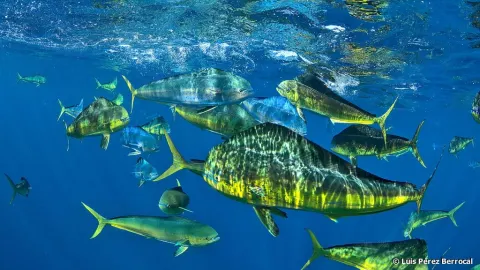
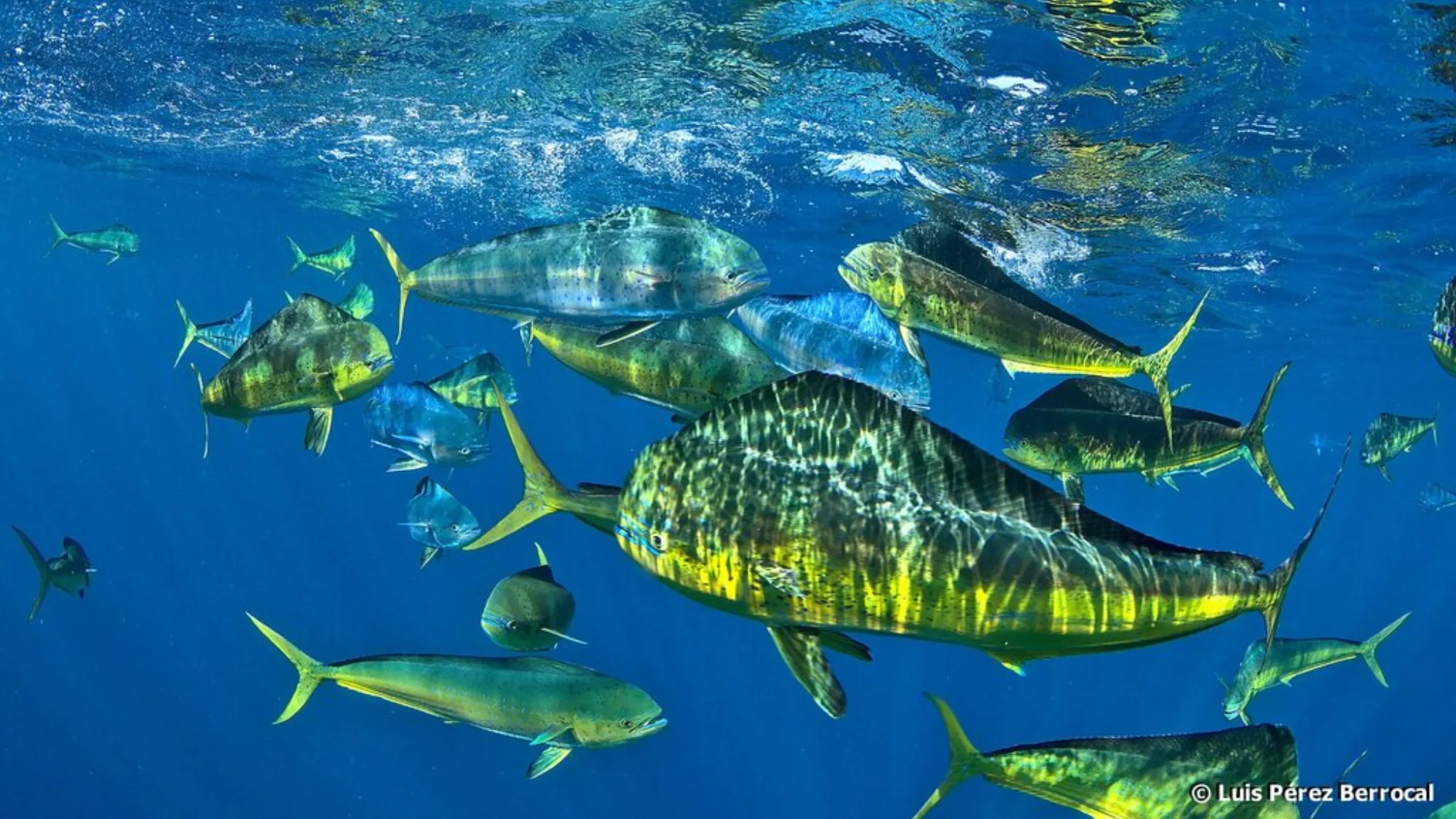
Known also as mahi-mahi or dorado, the Dolphin (Coryphaena hippurus) is a fish of the open ocean, usually found close to the surface. Its flattened body carries a long fin along the back, stretching from its head almost to its tail. Gold covers its sides, while blue and green colour the sides and back; its pectoral fins are iridescent blue. Mature males develop a prominent forehead, while females have a rounded head and are usually smaller. Fish caught typically weigh 7 to 13 kg and measure a metre long, though larger individuals occur.
The Dolphin lives in offshore tropical, subtropical and temperate waters around the world. Commonly found near Hawaii and Costa Rica, it also occurs in the Gulf of Mexico and the Indian Ocean, as well as from the Caribbean to Southeast Asia. Look for it near floating wood, palm fronds, sargasso weed lines or fish buoys, where it often swims alongside other fish. Fishing guides also watch for frigatebirds, which search for food around floating debris and sargasso. A swift hunter, the Dolphin eats small fish, crabs, other crustaceans and squid, as well as a wide variety of other prey, including young tuna and other mahi-mahi. It can swim at speeds of up to 92.6 km/h when pursuing prey.
Spawning takes place in warm ocean currents through much of the year, and young fish commonly shelter among floating Sargassum weeds. Males and females mature in their first year, and females may spawn two to three times a year. The fish is sought by both sport and commercial fishers; it was once mostly caught incidentally in tuna and swordfish longline fisheries and is now targeted commercially in its own right.
Written from the English Wikipedia article Mahi-mahi (CC BY-SA 4.0).
- Records
- 23,597
- Countries
- 6
No atlas park has a record of the Dolphin in or around it yet.
These are open occurrence records, so they show where people looked for and recorded the Dolphin as much as where it lives. Cells are up to 25 km across, and every location is generalised to its cell.
Generalised encounter areas, not exact locations. Each shape is a grid cell coloured by how likely the species is there.
- Very likelyUnited States25 km zone · high confidence · 21025 records · updated 80 days ago
- Very likelyBahamas25 km zone · high confidence · 1347 records · updated 80 days ago
- Very likelyCuba25 km zone · high confidence · 946 records · updated 80 days ago
- Very likelyAustralia25 km zone · high confidence · 219 records · updated 80 days ago
- Very likelyU.S. Virgin Islands25 km zone · high confidence · 60 records · updated 80 days ago
Conservation status not assessed here yet, so every location is generalised to its grid cell.