Panda Corydoras
Corydoras panda
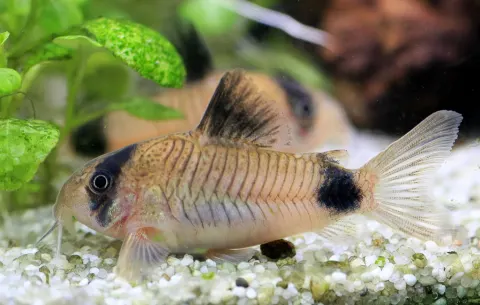
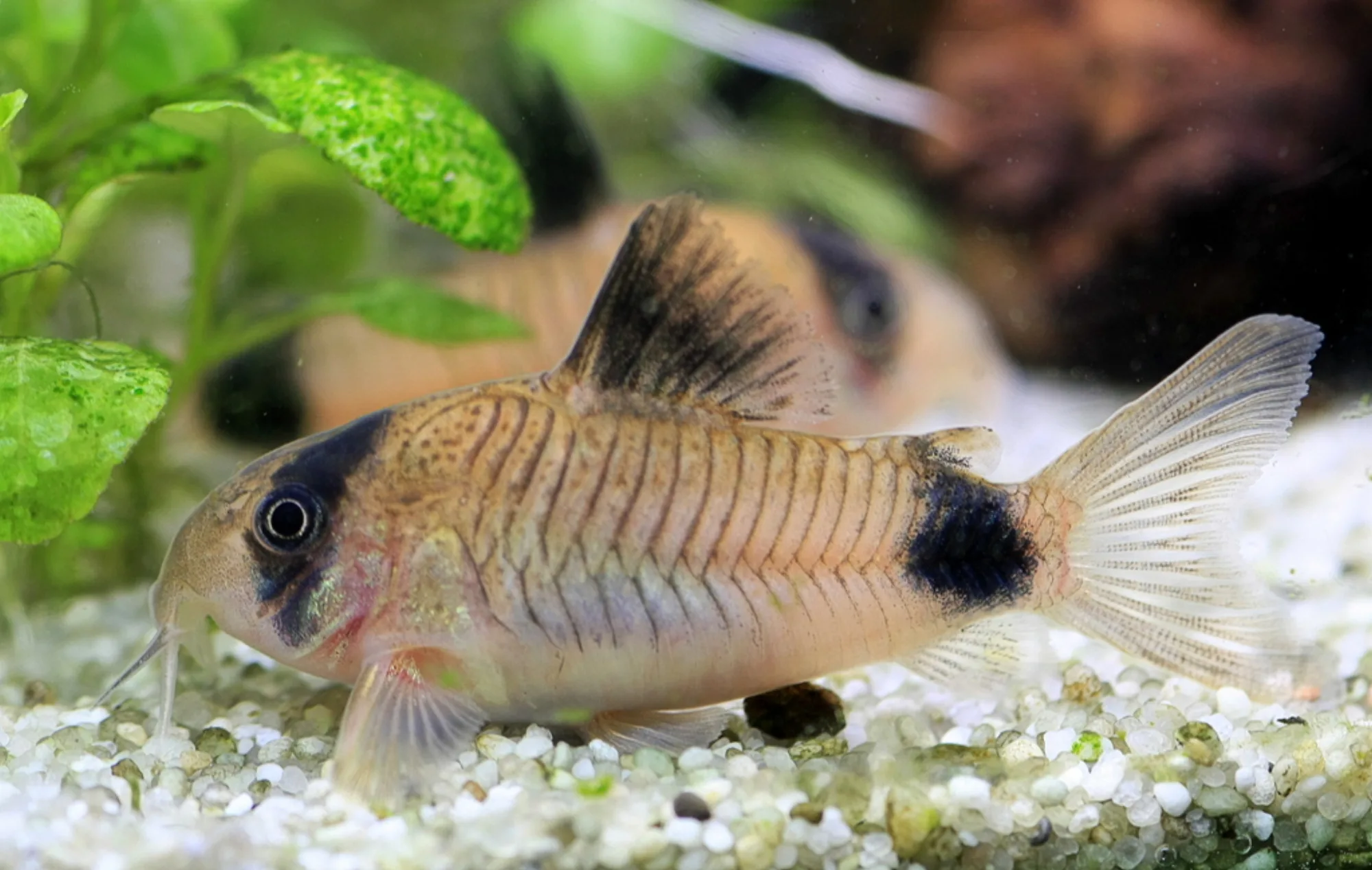
This small, armoured catfish is native to the river systems of Peru and Ecuador. It is named for the distinctive black markings around its eyes, which resemble the patches of a giant panda. These dark features contrast with an off-white or pinkish-orange body that may show a green iridescence under the right light. A prominent black blotch covers most of the dorsal fin, and a dark band encircles the base of the tail. Adult females are the larger sex, reaching a standard length of 55 millimetres.
Panda Corydoras live in clear, well-oxygenated rivers that flow relatively quickly. Because these waters are fed by snowmelt from the Andes, the fish are adapted to cooler temperatures than many other tropical species, surviving in water as low as 12 °C. They prefer habitats with soft sand or fine gravel substrates and plenty of aquatic plants. In these environments, they are highly social and gregarious, showing a strong need to live in groups with their own kind.
Feeding primarily on animal matter, these fish search for food such as worms and small crustaceans. They are lively and active, often grouping together in currents. In the wild, the arrival of the rainy season and the influx of clean, new water triggers breeding. However, they are sensitive to their environment. The fish are intolerant of poor water quality or dirty substrates, and the young are particularly vulnerable to heat stress if water temperatures rise above 26 °C.
Written from the English Wikipedia article Hoplisoma panda (CC BY-SA 4.0).
- Atlas places
- 0
These are open occurrence records, so they show where people looked for and recorded the Panda Corydoras as much as where it lives. Cells are up to 25 km across, and every location is generalised to its cell.
No encounter zones yet
Where and when you can expect to see Panda Corydoras is calculated from observation density. No zones have been computed for this species yet.
Conservation status not assessed here yet, so every location is generalised to its grid cell.