House Crow
Corvus splendens
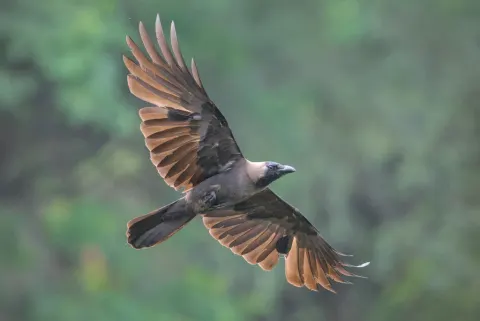
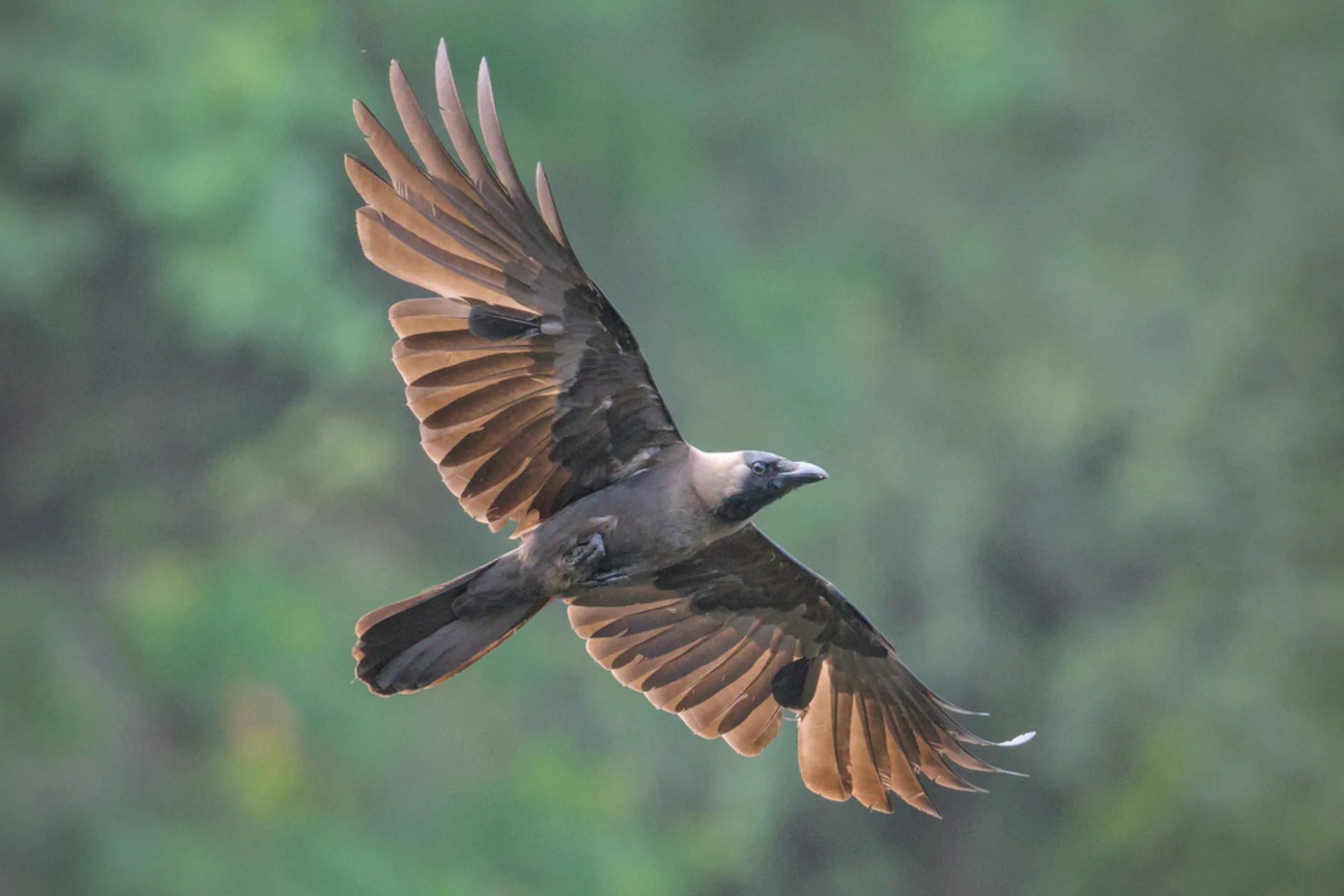
At 40 cm long, the House Crow is a slim member of the crow family, with a harsh call often rendered as “kaaw-kaaw”. Its forehead, crown, throat and upper breast are glossy black, while the neck and breast are lighter grey-brown. Black wings, tail and legs complete the picture, although bill thickness and plumage colour vary between regions. Birds in Myanmar are especially dark and lack the grey collar found in some other forms.
Native across much of southern Asia, the species has reached other parts of the world with help from ships. It lives alongside people in settlements of all sizes, and no populations are known to live independently of humans. Look for it around marketplaces and rubbish dumps, where it searches for scraps, or roosting communally near homes and busy streets. Before settling into roost trees, birds gather on rooftops, television aerials and trees, sometimes feeding or preening. They take most of their food from the ground, but also feed in trees when opportunities arise. Their varied diet includes refuse, small reptiles and mammals, insects, eggs, nestlings, grain and fruit. They have even been seen swooping down to snatch baby squirrels.
For breeding, House Crows favour large trees with broad crowns, though they occasionally nest on telephone towers. A typical stick nest holds 3 to 5 eggs, and several nests may occupy the same tree. In India and Peninsular Malaysia, breeding peaks from April to July; in South Asia, Asian koels parasitise their nests. People have suppressed populations in some places, and introduced birds were eradicated on Socotra Island to prevent harm to its endemic species.
Written from the English Wikipedia article House crow (CC BY-SA 4.0).
- Records
- 1,056,664
- Countries
- 54
- Atlas places
- 14
- Bandipur National Park· India
- Namib-Naukluft· Namibia
- Table Mountain National Park· South Africa
- Annapurna Conservation Area· Nepal
- Chitwan National Park· Nepal
- Dorob National Park· Namibia
- Eravikulam National Park· India
- Jozani Chwaka Bay National Park· Tanzania
- Kanha National Park· India
- Langtang National Park· Nepal
- Periyar National Park· India
- Tsau ǁKhaeb (Sperrgebiet) National Park· Namibia
- Walvis Bay· Namibia
- Yala National Park· Sri Lanka
These are open occurrence records, so they show where people looked for and recorded the House Crow as much as where it lives. Cells are up to 25 km across, and every location is generalised to its cell.
Generalised encounter areas, not exact locations. Each shape is a grid cell coloured by how likely the species is there.
- Very likelyIndia25 km zone · high confidence · 886592 records · updated 86 days ago
- Very likelySingapore25 km zone · high confidence · 29233 records · updated 86 days ago
- Very likelySri Lanka25 km zone · high confidence · 29185 records · updated 86 days ago
- Very likelyNepal25 km zone · high confidence · 23882 records · updated 86 days ago
- Very likelyUnited Arab Emirates25 km zone · high confidence · 16731 records · updated 86 days ago
- Very likelyJordan25 km zone · high confidence · 14113 records · updated 86 days ago
- Very likelyBangladesh25 km zone · high confidence · 12329 records · updated 86 days ago
- Very likelyMalaysia25 km zone · high confidence · 6255 records · updated 86 days ago
- Very likelyPakistan25 km zone · high confidence · 5578 records · updated 86 days ago
- Very likelyOman25 km zone · high confidence · 5232 records · updated 86 days ago
Conservation status not assessed here yet, so every location is generalised to its grid cell.