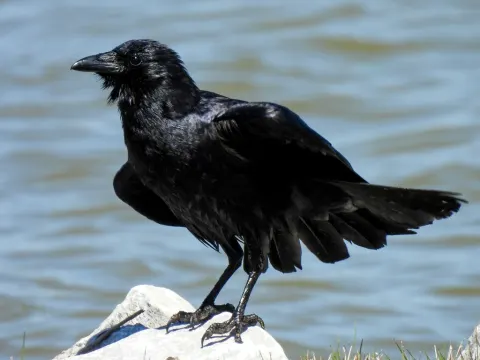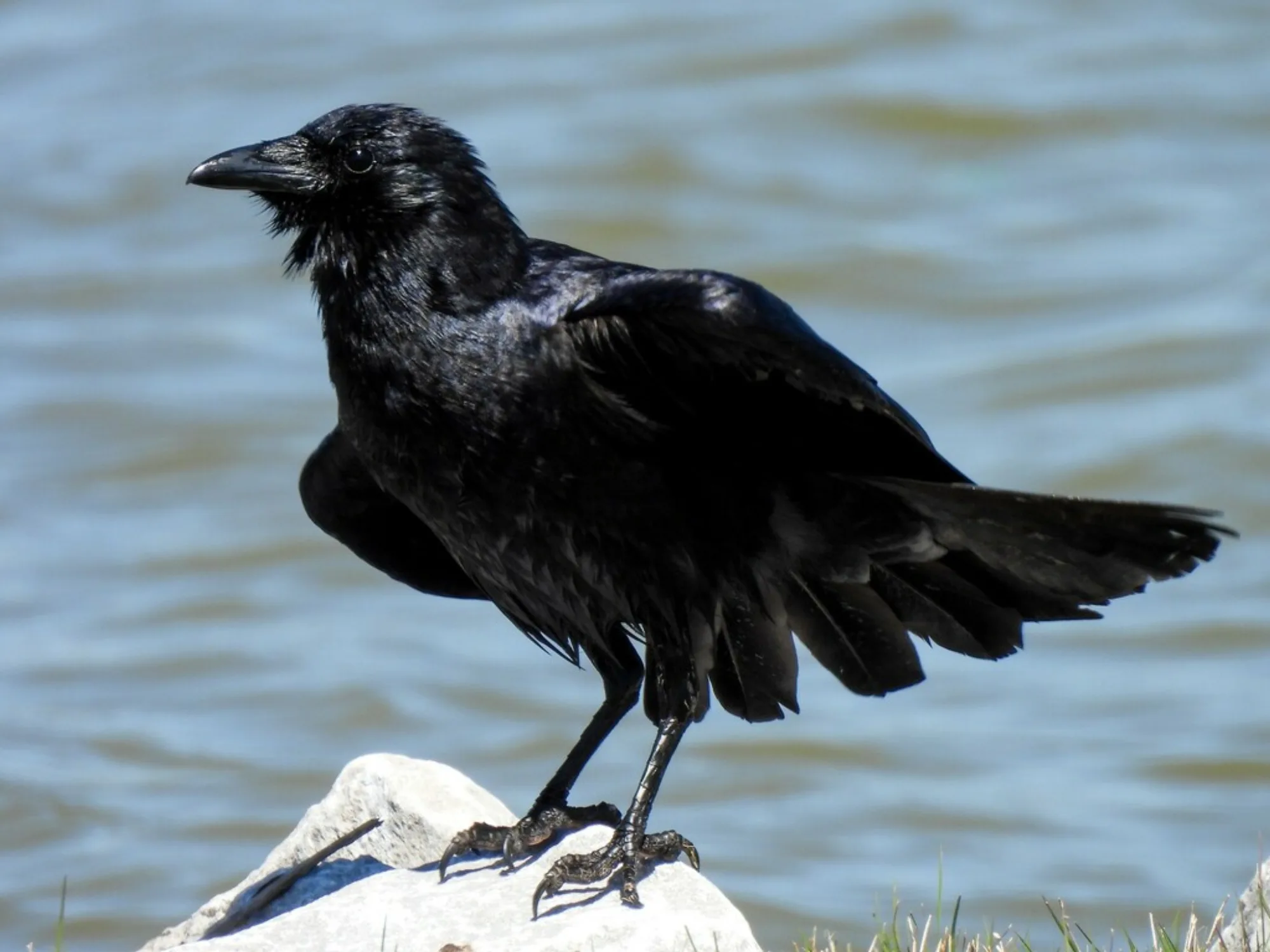
Fish Crow
Corvus ossifragus
Along the waterways of the eastern and southeastern United States, the Fish Crow is a medium-large crow with smooth, black plumage. Blue or blue-green light catches its upper feathers, while the black feathers underneath have a greener tint. It is smaller than the American crow, with a generally slimmer bill, but telling the two apart by sight can be difficult, especially when they are not side by side. Listen for a nasal “ark-ark-ark” or “nyuh unh”, and watch for a bird hunching and fluffing its throat feathers as it calls.
The species ranges from Maine south to Key West on the eastern seaboard, and follows the Gulf of Mexico's northern coast westwards. It visits beaches and coastal marshes, as well as rivers, lakes and marshes inland and the land around them, and has spread along river systems. Since 2012 it has expanded into Canada, where breeding populations occur along Lake Ontario. Fish Crows usually gather food from the ground or shallow water, sometimes hovering and plucking it from the water with their feet. Their varied diet includes crabs, shrimps, fish, bird eggs and nestlings, small reptiles, fruit, peanuts, grains and available human scraps.
Nests are usually high in trees, sometimes near other Fish Crow nests in small, loose colonies. Depending on the trees available, pairs place them near the tops of evergreens, deciduous trees, palms or mangroves. A fresh nest is built for each breeding attempt, and the usual clutch is four or five pale blue-green eggs marked with olive-brown blotches. West Nile virus affects Fish Crows, although reported survival rates reach up to 45%.
Written from the English Wikipedia article Fish crow (CC BY-SA 4.0).
- Records
- 2,102,774
- Countries
- 1
- Atlas places
- 3
These are open occurrence records, so they show where people looked for and recorded the Fish Crow as much as where it lives. Cells are up to 25 km across, and every location is generalised to its cell.
Generalised encounter areas, not exact locations. Each shape is a grid cell coloured by how likely the species is there.
- Very likelyUnited States25 km zone · high confidence · 2102774 records · updated 80 days ago
Conservation status not assessed here yet, so every location is generalised to its grid cell.