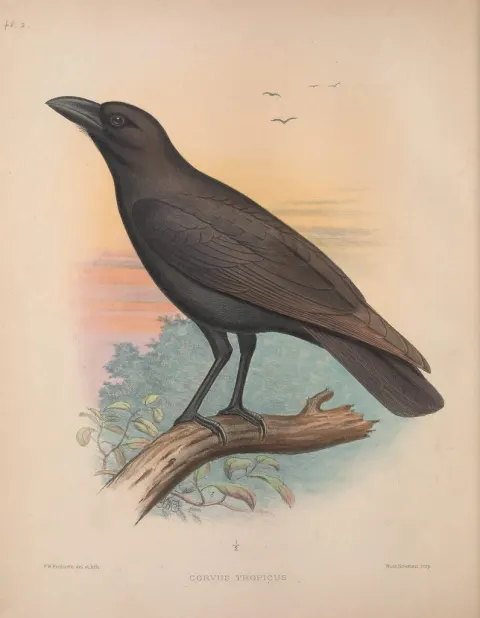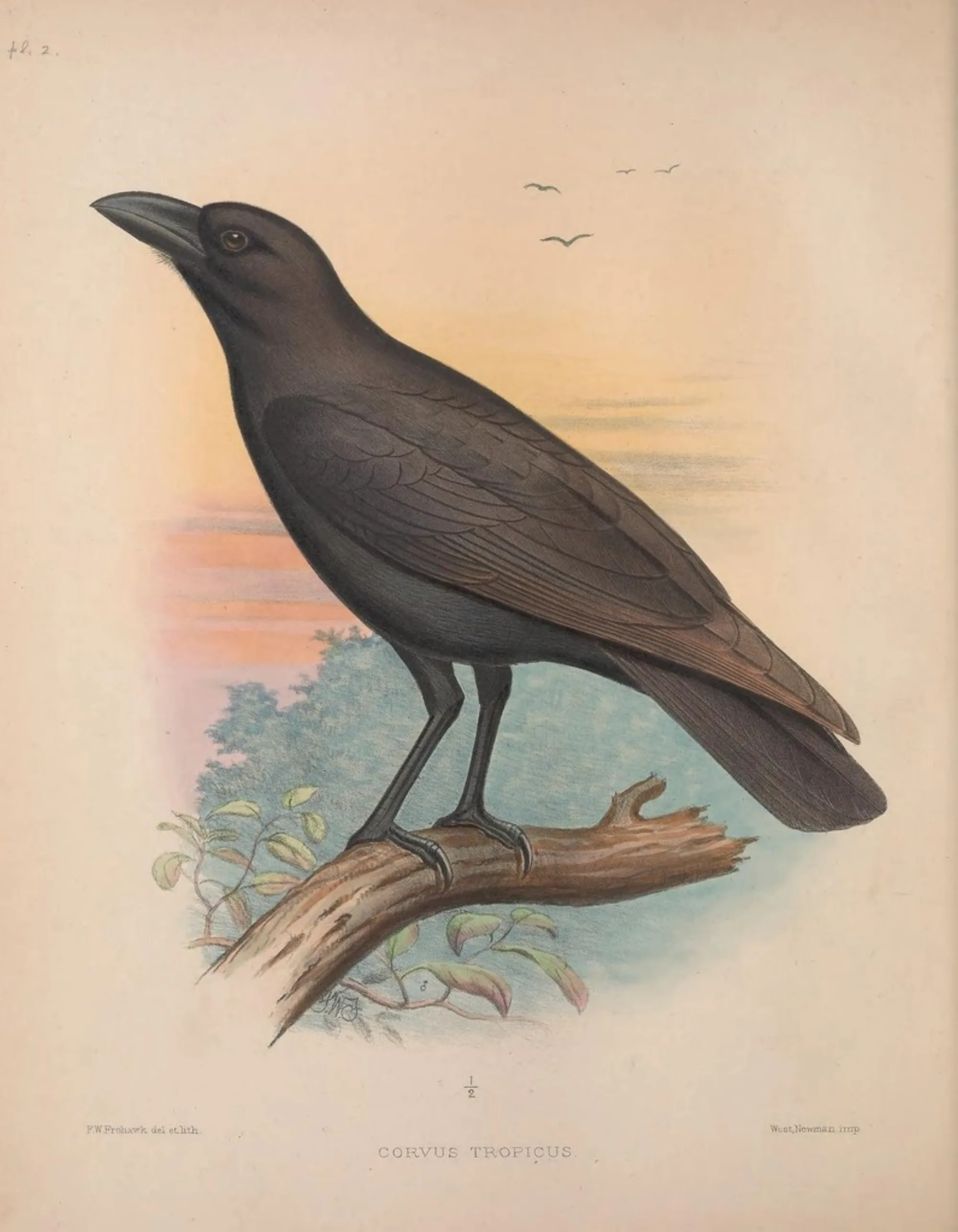
Hawaiian Crow
Corvus hawaiiensis
Soft brownish-black feathers, a thick black bill and a shaggy-looking throat help distinguish the Hawaiian Crow, or ʻalalā. Measuring 48 to 50 cm long, it has rounded wings and is a strong flier. Its varied voice includes a two-toned caw, a catlike screech and a burbling song.
The crow disappeared from the wild on Hawaii, but reintroductions are underway; five birds were released on Maui in December 2024. Before its disappearance, it lived in dry and mesic forests on the western and southeastern slopes of Mauna Loa and Hualālai. Ōhiʻa lehua and koa were important trees there, while dense undergrowth offered cover from Hawaiian hawks. A resourceful feeder, the crow searches trunks, branches and leaves for invertebrates, stripping bark and moss to expose insects. It also eats fruit, flowers, and the eggs and nestlings of other birds; captive crows can use sticks to extract food from holes in logs. Breeding runs from March to July, with both parents building a nest from branches and grasses. Young birds depend on their parents for eight months and remain with the family until the next breeding season.
Habitat loss, introduced predators and introduced diseases are thought to have contributed to the crow's decline. Logging, ranching and grazing damaged higher-elevation forests, while rats, mongooses and feral cats prey on eggs and young birds. Hawaiian hawks have killed birds released into the wild, and toxoplasmosis has also caused deaths during reintroduction efforts. The small population faces further pressure from inbreeding, which can reduce the chances that offspring survive to recruitment.
Written from the English Wikipedia article Hawaiian crow (CC BY-SA 4.0).
- Records
- 9
- Countries
- 1
No atlas park has a record of the Hawaiian Crow in or around it yet.
These are open occurrence records, so they show where people looked for and recorded the Hawaiian Crow as much as where it lives. Cells are up to 25 km across, and every location is generalised to its cell.
Generalised encounter areas, not exact locations. Each shape is a grid cell coloured by how likely the species is there.
- Very likelyUnited States25 km zone · medium confidence · 9 records · updated 80 days ago
Conservation status not assessed here yet, so every location is generalised to its grid cell.