Rook
Corvus frugilegus
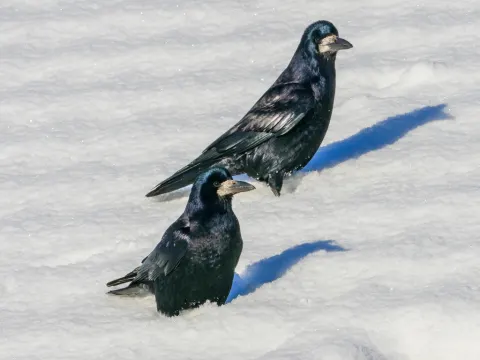
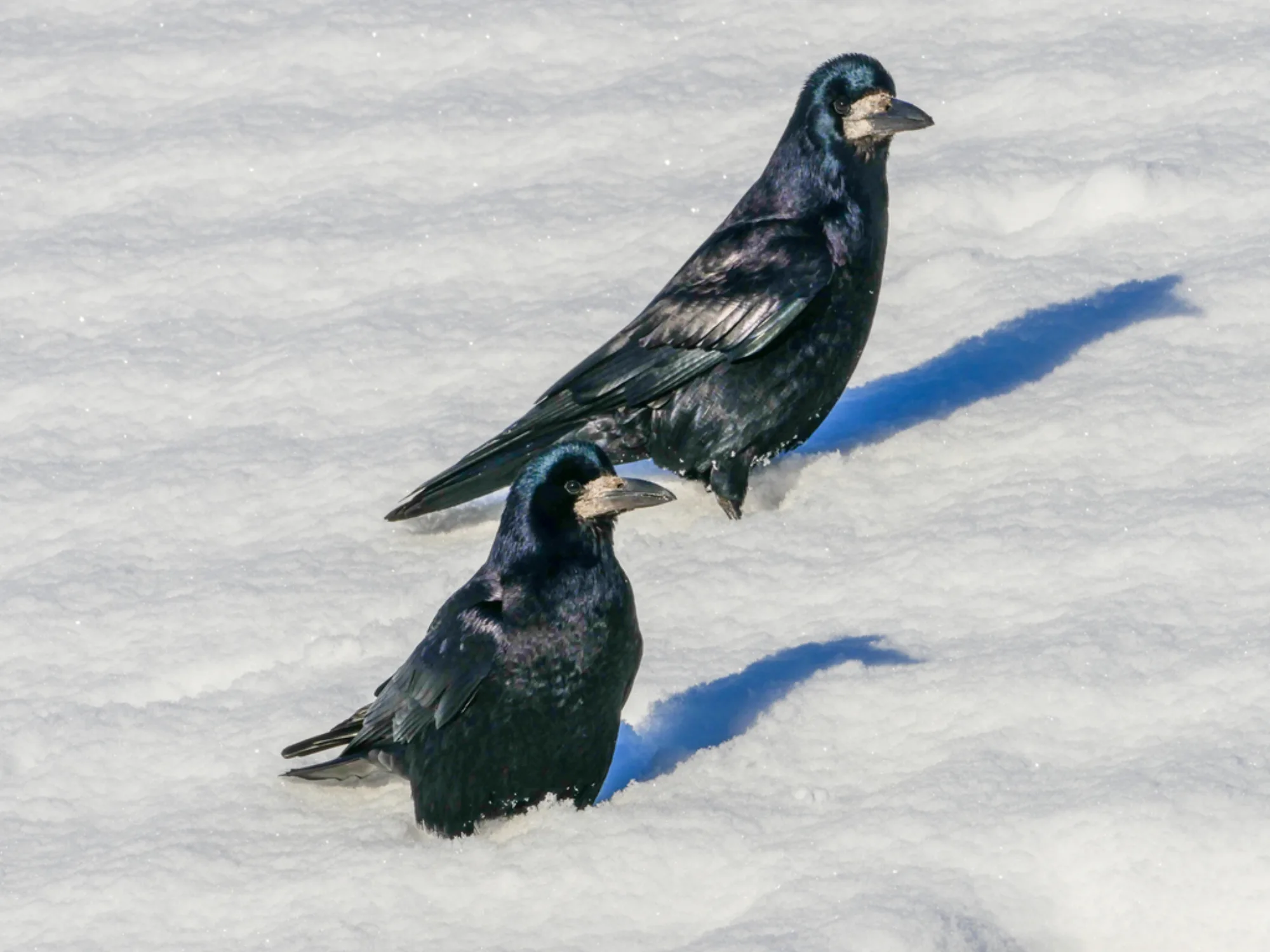
Often seen in company, the Rook is a large black member of the crow family, with feathers that can shine blue or bluish-purple in bright sunlight. Adults have a distinctive bare, whitish patch around the base of the bill and in front of the eye. Young birds lack this patch at first, looking rather like young crows, but have a thinner beak. The call is a variable caw, heard both from perched birds and from those in flight.
Rooks occur across a broad stretch of the Palearctic, reaching eastern Siberia from western Europe and Scandinavia. Look for them in open farmland, where they feed on pasture and arable ground and have tall trees available for nesting. They often nest near farms, villages and open towns, but generally avoid heavily built-up areas and forests. Most stay in their range year-round, although birds in the far north may move south to escape severe winter conditions. In autumn, flocks gather before roosting, sometimes with jackdaws, and may wheel through the air in synchronised displays.
On the ground, rooks stride or hop as they probe the soil for food. Their varied diet includes earthworms and insect larvae, along with cereals, fruit, seeds and other plant material; they also scavenge scraps in tourist areas. Pairs remain together for life and breed in spring, building nests in colonies known as rookeries, usually high in large trees. Both parents help feed the young, which leave the nest by the 32nd or 33rd day and continue to receive food afterwards. Changes in agricultural land use, seed dressings, pesticides and shooting are among the threats they face.
Written from the English Wikipedia article Rook (bird) (CC BY-SA 4.0).
- Records
- 557,408
- Countries
- 65
- Atlas places
- 1
These are open occurrence records, so they show where people looked for and recorded the Rook as much as where it lives. Cells are up to 25 km across, and every location is generalised to its cell.
Generalised encounter areas, not exact locations. Each shape is a grid cell coloured by how likely the species is there.
- Very likelyUnited Kingdom25 km zone · high confidence · 318817 records · updated 86 days ago
- Very likelyNorway25 km zone · high confidence · 31948 records · updated 86 days ago
- Very likelyIreland25 km zone · high confidence · 24156 records · updated 86 days ago
- Very likelyBelgium25 km zone · high confidence · 22740 records · updated 86 days ago
- Very likelyFrance25 km zone · high confidence · 18342 records · updated 86 days ago
- Very likelyDenmark25 km zone · high confidence · 12718 records · updated 86 days ago
- Very likelySerbia25 km zone · high confidence · 12142 records · updated 86 days ago
- Very likelyCzechia25 km zone · high confidence · 11096 records · updated 86 days ago
- Very likelyIsle of Man25 km zone · high confidence · 9982 records · updated 86 days ago
- Very likelyPoland25 km zone · high confidence · 8515 records · updated 86 days ago
Conservation status not assessed here yet, so every location is generalised to its grid cell.