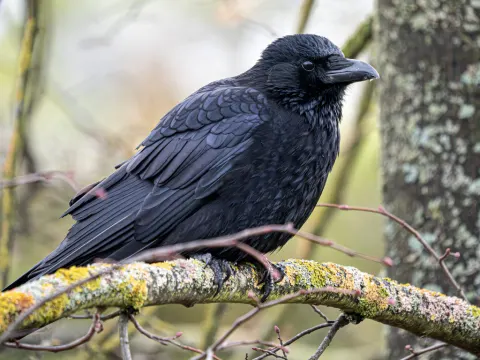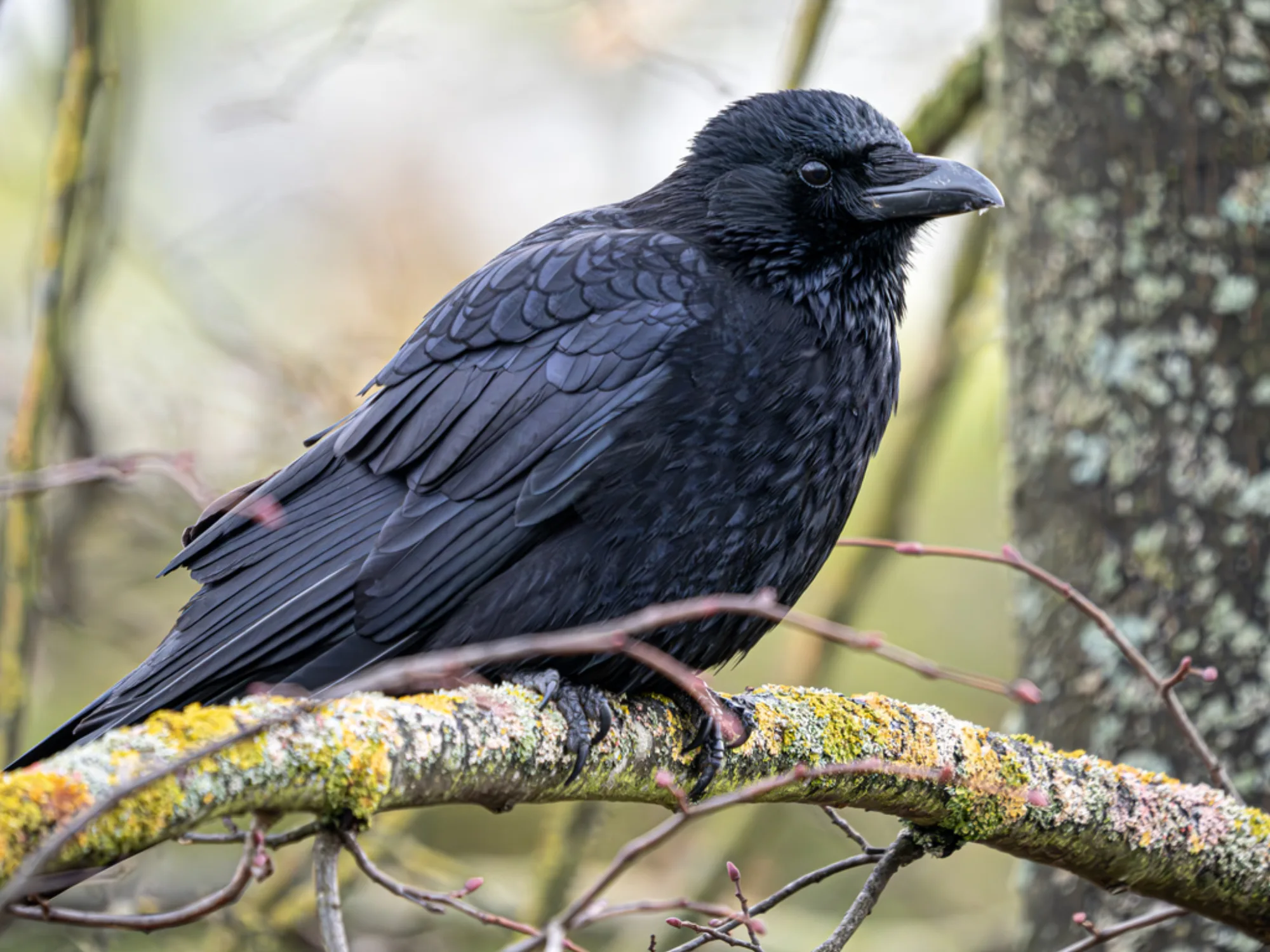
Carrion Crow
Corvus corone
Black from bill to feet, the Carrion Crow has plumage that can catch a green or purple sheen. It measures around 48 to 52 cm in length, smaller than the common raven, and its black plumage distinguishes it from the hooded crow. Young birds have brownish feathers and blue eyes, which darken as they mature. Listen for a deep, croaking call: a crow may deliver three or four calls from a building or treetop, pausing briefly between series.
Its native range includes western Europe and the eastern part of the Palearctic; it also lives in Japan's mountains, forests and cities. Travellers may encounter it around human activity as well as on moors, in woodland, on sea cliffs and on farmland. Usually solitary, it can be sociable at winter roosts and may feed alongside rooks. Carrion crows eat carrion, but their varied diet includes insects, worms, fruit, seeds, small mammals, fish and discarded human food. They also hunt, sometimes working together, and may harass birds of prey or foxes for their kills. Crows can recognise human and crow faces and distinguish numbers up to 30.
A pair usually places its bulky stick nest high in a tree, though cliff ledges, old buildings and pylons also provide sites. The female incubates three or four eggs for 18 to 20 days while the male brings her food. Young birds leave the nest at around 29 to 30 days, and offspring from the previous year may help feed the new brood. Carrion crows have few natural predators, but powerful birds of prey, including goshawks, peregrine falcons and golden eagles, hunt them.
Written from the English Wikipedia article Carrion crow (CC BY-SA 4.0).
- Records
- 1,619,604
- Countries
- 49
- Atlas places
- 1
These are open occurrence records, so they show where people looked for and recorded the Carrion Crow as much as where it lives. Cells are up to 25 km across, and every location is generalised to its cell.
Generalised encounter areas, not exact locations. Each shape is a grid cell coloured by how likely the species is there.
- Very likelyUnited Kingdom25 km zone · high confidence · 929475 records · updated 86 days ago
- Very likelyBelgium25 km zone · high confidence · 219812 records · updated 86 days ago
- Very likelyFrance25 km zone · high confidence · 156803 records · updated 86 days ago
- Very likelySpain25 km zone · high confidence · 72750 records · updated 86 days ago
- Very likelyGermany25 km zone · high confidence · 45774 records · updated 86 days ago
- Very likelyPortugal25 km zone · high confidence · 45312 records · updated 86 days ago
- Very likelyNetherlands25 km zone · high confidence · 32126 records · updated 86 days ago
- Very likelySwitzerland25 km zone · high confidence · 31495 records · updated 86 days ago
- Very likelyJapan25 km zone · high confidence · 24576 records · updated 86 days ago
- Very likelyNorway25 km zone · high confidence · 13094 records · updated 86 days ago
Conservation status not assessed here yet, so every location is generalised to its grid cell.