Hooded Crow
Corvus cornix
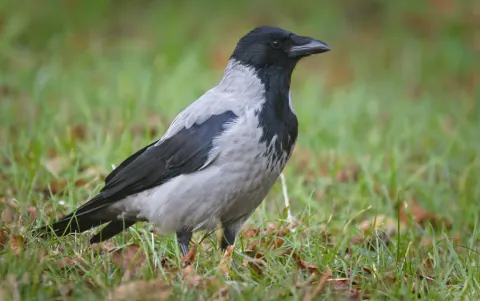
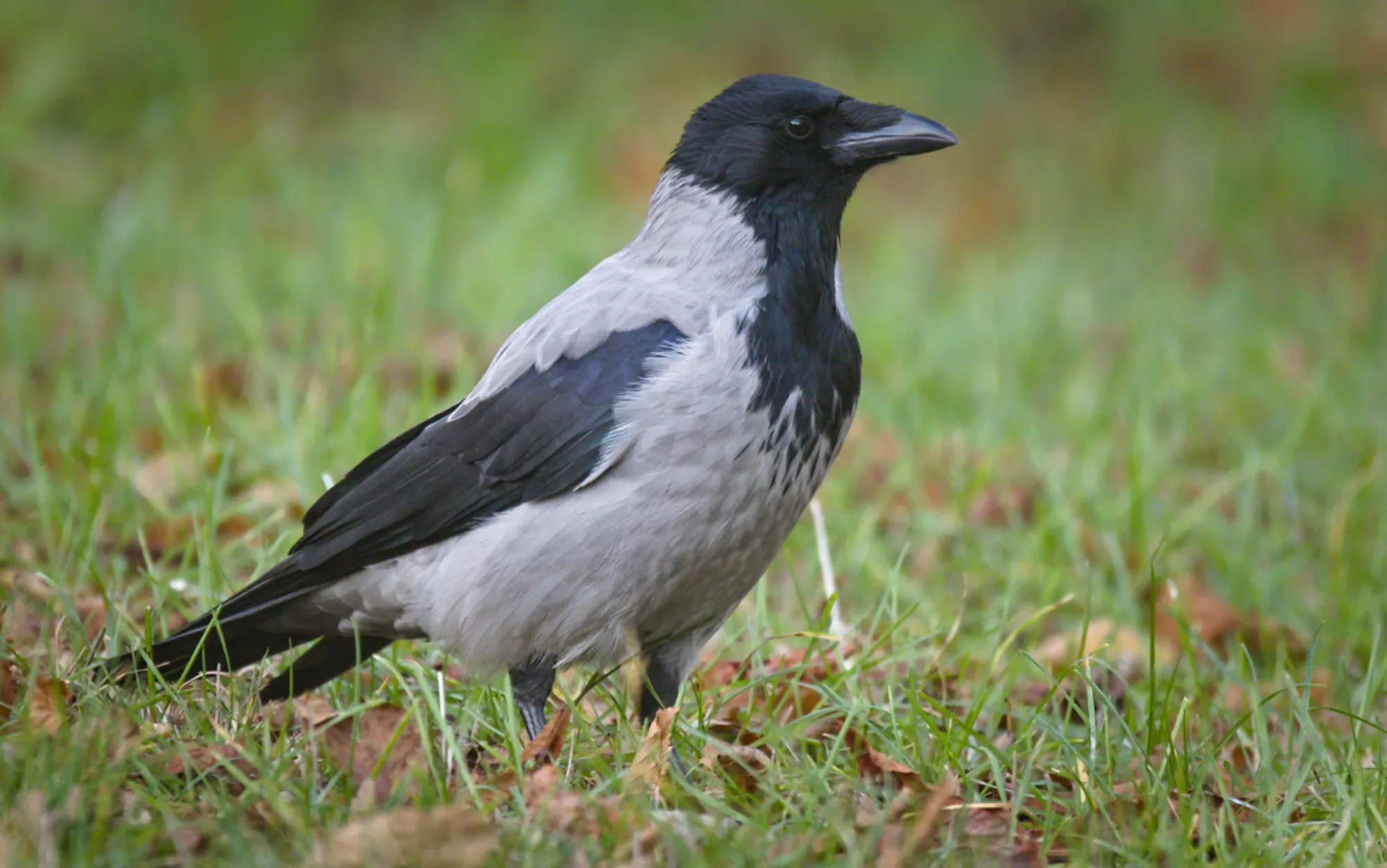
Ash-grey plumage and a black head, throat, wings and tail make the Hooded Crow easy to distinguish from the all-black carrion crow. Its bill and legs are black, and its flight is usually slow, heavy and straight. Adults measure 48 to 52 cm in length, while juveniles have duller feathers and bluish or greyish eyes. The bird ranges across northern, eastern and southeastern Europe and parts of the Middle East, with forms also found from western Siberia to Iran. In the British Isles, it breeds throughout Ireland, on the Isle of Man and Scottish Islands, and across northern and western parts of Scotland. Look for it along coasts, where it searches cliffs for unattended bird eggs, or around trees, old buildings and pylons, all places it may use for nesting.
An opportunistic omnivore and scavenger, the crow eats small mammals, smaller birds, carrion and scraps. It breaks open crabs and molluscs by dropping them, and enters puffin burrows to take eggs. Food may be hidden for later under bushes, in flower pots or in rain gutters, although other crows sometimes watch and search the cache afterwards. Hooded crows can also use sticks to reach food lodged in cracks and small holes. Their bulky nests are made from sticks, sometimes with seaweed, bones or wire added, and may even be placed on or near the ground. Nesting begins later in colder regions, and the young leave the nest after 32 to 36 days. Farmers and grouse estates regularly kill hooded crows, while the great spotted cuckoo sometimes uses their nests as a host.
Written from the English Wikipedia article Hooded crow (CC BY-SA 4.0).
- Records
- 1,108,921
- Countries
- 70
- Atlas places
- 1
These are open occurrence records, so they show where people looked for and recorded the Hooded Crow as much as where it lives. Cells are up to 25 km across, and every location is generalised to its cell.
Generalised encounter areas, not exact locations. Each shape is a grid cell coloured by how likely the species is there.
- Very likelyNorway25 km zone · high confidence · 547521 records · updated 86 days ago
- Very likelyIsrael25 km zone · high confidence · 69931 records · updated 86 days ago
- Very likelyPalestinian Territories25 km zone · high confidence · 35716 records · updated 86 days ago
- Very likelyFinland25 km zone · high confidence · 34086 records · updated 86 days ago
- Very likelySerbia25 km zone · high confidence · 33245 records · updated 86 days ago
- Very likelyIreland25 km zone · high confidence · 32034 records · updated 86 days ago
- Very likelySweden25 km zone · high confidence · 25668 records · updated 86 days ago
- Very likelyRussia25 km zone · high confidence · 24351 records · updated 86 days ago
- Very likelyTürkiye25 km zone · high confidence · 23444 records · updated 86 days ago
- Very likelyDenmark25 km zone · high confidence · 22163 records · updated 86 days ago
Conservation status not assessed here yet, so every location is generalised to its grid cell.