Common Raven
Corvus corax
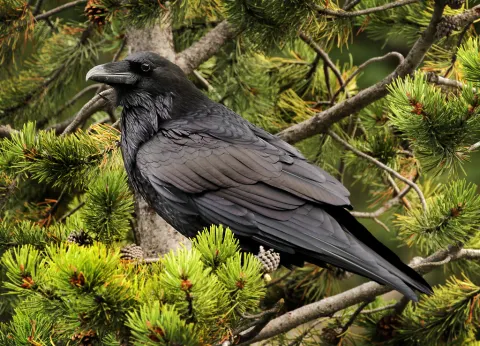
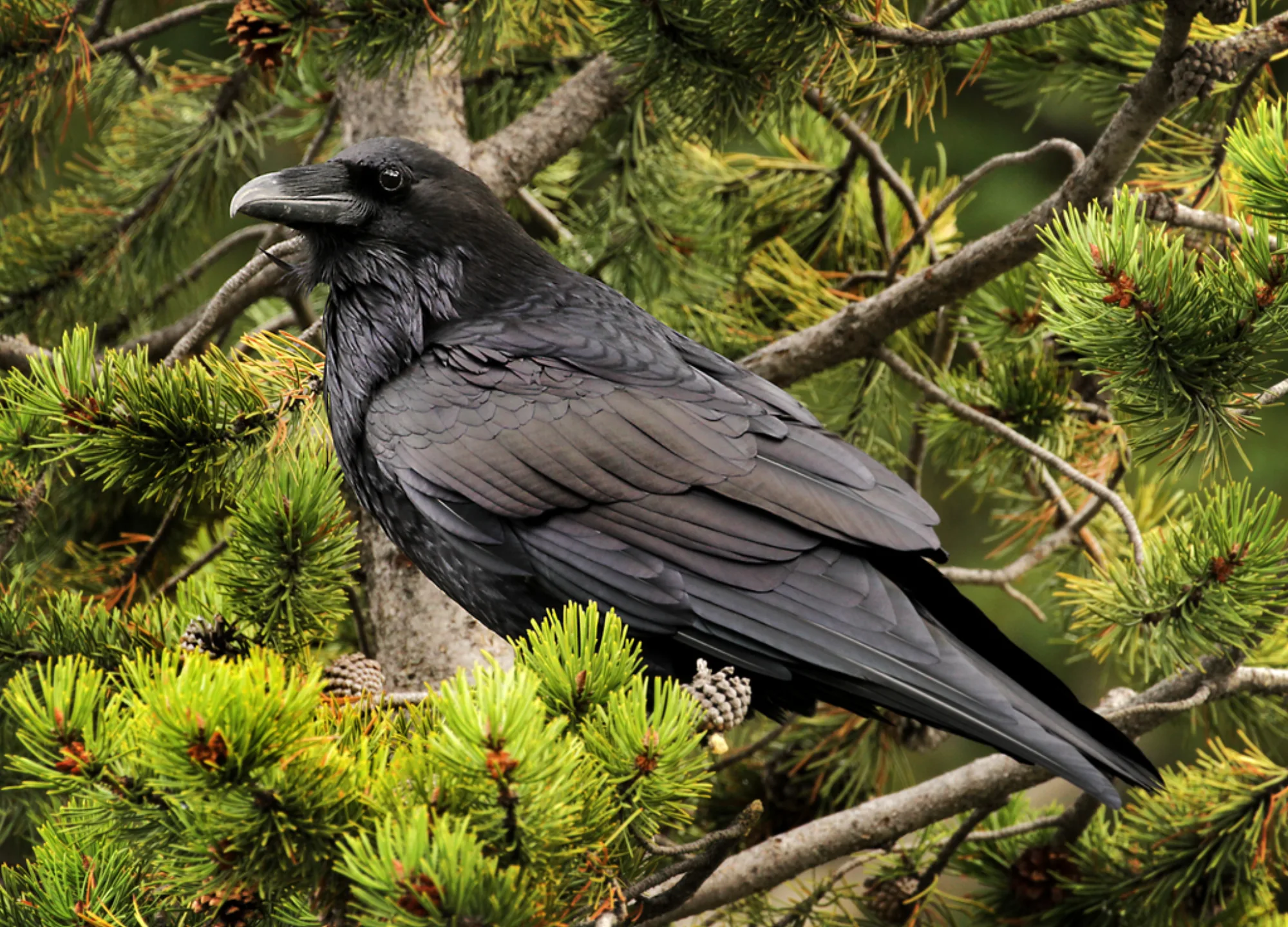
A large, all-black bird with a heavy bill and shaggy throat feathers, the Common Raven (Corvus corax) can be told from related crows by its greater size and longer, wedge-shaped tail. In flight, it soars steadily with comparatively little flapping. Listen, too, for its deep, resonant croak, although other raven species can sound similar where their ranges overlap.
Ravens live across the Northern Hemisphere, from Arctic and temperate habitats in Eurasia and North America to North African deserts and Pacific islands. They generally remain within their range throughout the year. Look for them around wooded areas with open land nearby, or along coasts, where they often nest on sea cliffs. In the United Kingdom, they favour mountains and coasts, but also use parks with tall trees. Young birds may gather in flocks, while adults usually travel in pairs and defend a territory together.
Opportunistic feeders, ravens eat carrion, insects, grain, berries, small animals and food waste. They store surplus food, sometimes hiding it from other ravens, and may also steal from caches. A pair builds a deep bowl of sticks and twigs, usually on a cliff ledge or in a large tree. Both parents feed the young, which leave the nest at 35 to 49 days and stay with them for another six months. Ravens have few natural predators, but martens, large owls and sometimes eagles take eggs and chicks. Despite improved legal protection in the United Kingdom, gamekeepers continue to persecute ravens illegally in many areas.
Written from the English Wikipedia article Common raven (CC BY-SA 4.0).
- Records
- 3,267,295
- Countries
- 84
- Atlas places
- 13
- Olympic National Park· United States
- Algonquin Provincial Park· Canada
- Annapurna Conservation Area· Nepal
- Langtang National Park· Nepal
- Acadia National Park· United States
- Banff National Park· Canada
- Grand Canyon National Park· United States
- Hemis National Park· India
- Joshua Tree National Park· United States
- Redwood National and State Parks· United States
- Rocky Mountain National Park· United States
- Sagarmatha National Park· Nepal
- Yosemite National Park· United States
These are open occurrence records, so they show where people looked for and recorded the Common Raven as much as where it lives. Cells are up to 25 km across, and every location is generalised to its cell.
Generalised encounter areas, not exact locations. Each shape is a grid cell coloured by how likely the species is there.
- Very likelyUnited States25 km zone · high confidence · 2292773 records · updated 86 days ago
- Very likelyCanada25 km zone · high confidence · 731976 records · updated 86 days ago
- Very likelyNorway25 km zone · high confidence · 36378 records · updated 86 days ago
- Very likelyFinland25 km zone · high confidence · 19002 records · updated 86 days ago
- Very likelyIceland25 km zone · high confidence · 18101 records · updated today
- Very likelySpain25 km zone · high confidence · 15424 records · updated today
- Very likelyUnited Kingdom25 km zone · high confidence · 13977 records · updated today
- Very likelyMexico25 km zone · high confidence · 12181 records · updated today
- Very likelyFrance25 km zone · high confidence · 11325 records · updated today
- Very likelyPortugal25 km zone · high confidence · 8662 records · updated today
Conservation status not assessed here yet, so every location is generalised to its grid cell.