Smooth Snake
Coronella austriaca
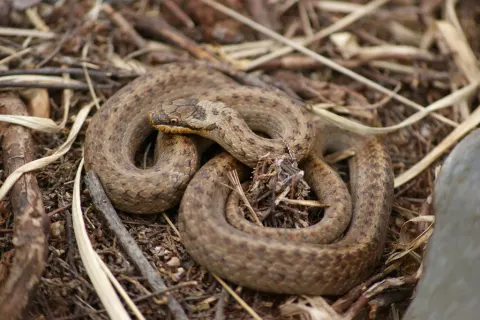
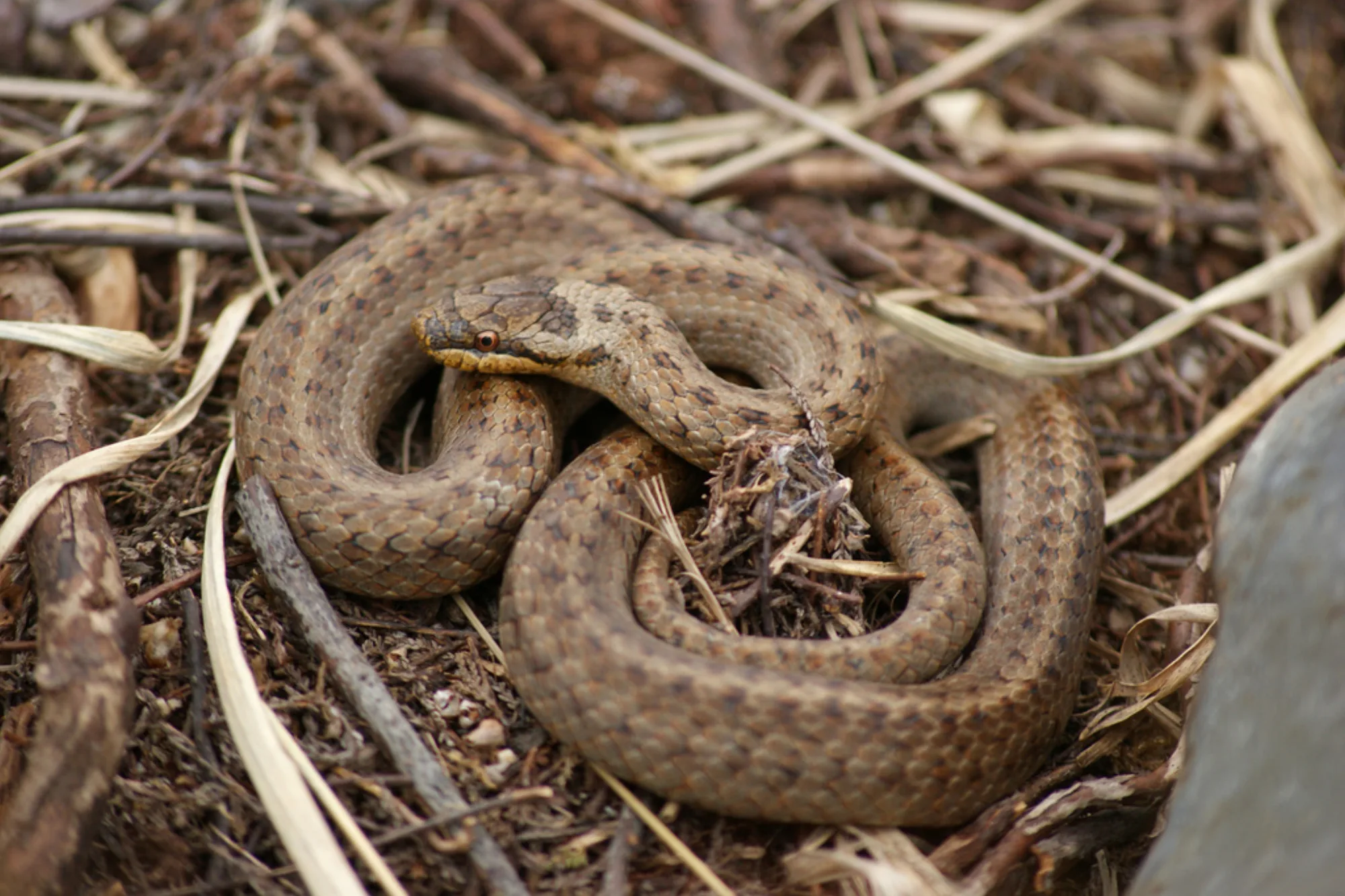
Across northern and central Europe, the Smooth Snake ranges east as far as northern Iran, with populations also found from Turkey through the Caucasus. It is a small snake, averaging about 60 cm to 75 cm in total length, including the tail. Its background colour can be brown, grey or reddish, with two rows of small, often indistinct dark spots down the back. The spots sometimes join near the neck to form bars, while fainter spots and shadowy stripes run along the sides. A dark mark, often shaped like a crown, sits on top of the head, and a thick dark stripe passes through each eye. Its flat scales give it the smooth texture behind its name.
Its European range includes southern England, France, the Low Countries, parts of Scandinavia, the western Balkans and Greece. It is also found in Italy and Sicily, although it is absent from Corsica and Sardinia. In Finland it occurs only in Åland, where it is uncommon, while in Britain it is restricted to heathland. The snake eats small animals, especially other reptiles, and uses constriction to subdue larger prey without killing it by that method. Secretions from a venom gland help it overcome prey and can neutralise small animals. Young hatch from eggs inside the mother and are born live. Beyond Europe, its range includes Azerbaijan, Georgia and Armenia, and its dark head stripe reaches a little way past the neck.
Written from the English Wikipedia article Smooth snake (CC BY-SA 4.0).
- Records
- 9,089
- Countries
- 13
No atlas park has a record of the Smooth Snake in or around it yet.
These are open occurrence records, so they show where people looked for and recorded the Smooth Snake as much as where it lives. Cells are up to 25 km across, and every location is generalised to its cell.
Generalised encounter areas, not exact locations. Each shape is a grid cell coloured by how likely the species is there.
- Very likelyFrance25 km zone · medium confidence · 4893 records · updated 80 days ago
- Very likelyNorway25 km zone · high confidence · 2698 records · updated 80 days ago
- Very likelyNetherlands25 km zone · medium confidence · 357 records · updated 80 days ago
- Very likelyAustria25 km zone · medium confidence · 300 records · updated 80 days ago
- Very likelyLuxembourg25 km zone · high confidence · 232 records · updated 80 days ago
- Very likelyUkraine25 km zone · medium confidence · 154 records · updated 80 days ago
- Very likelyPoland25 km zone · medium confidence · 136 records · updated 80 days ago
- Very likelySwitzerland25 km zone · medium confidence · 87 records · updated 80 days ago
- Very likelyGermany25 km zone · medium confidence · 82 records · updated 80 days ago
- Very likelyUnited Kingdom25 km zone · medium confidence · 80 records · updated 80 days ago
Conservation status not assessed here yet, so every location is generalised to its grid cell.