Lake Whitefish
Coregonus clupeaformis
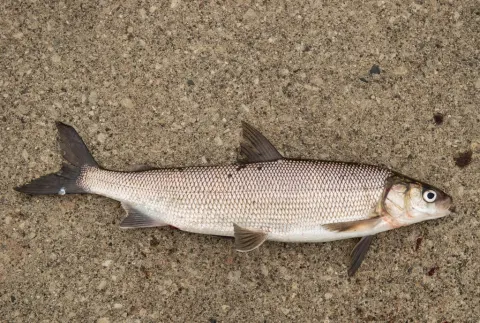
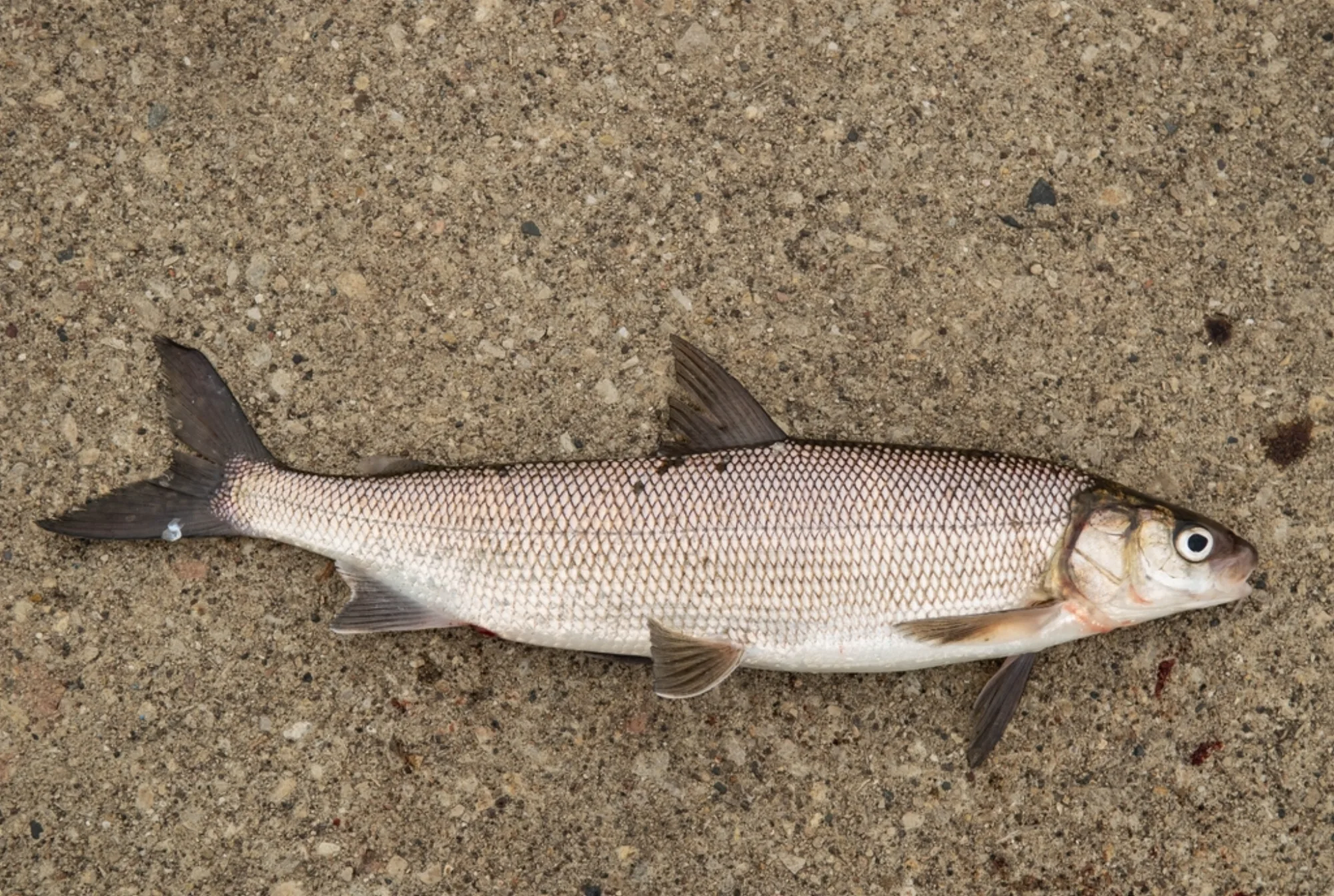
Lake Whitefish inhabit cool waters across Canada and the northern United States, including every Great Lake. Their range reaches from Alaska through western Canada and eastward to Maine's Atlantic coastal drainage, extending north from New Brunswick to Labrador. They live in many inland lakes and are also known to enter brackish water. A small head compared with a long body gives this freshwater fish its alternative name, humpback. Look for a silvery to white fish with olive, pale-green or brown colouring along the back, white lower fins and a dark edge to the tail. Its snout projects over the lower jaw, and it can grow to 79 cm, although 51 cm is a common length.
Lake Whitefish take food from the lake bed, the water and the surface. Young fish feed on plankton, switching as they grow to bottom-dwelling animals such as snails, insect larvae and small clams. Some populations in inland lakes rise from deep, cool water during late June and July to feed on emerging mayflies and midges. In autumn, mature fish move into shallow water to lay eggs over rubble and gravel; spawning takes place at night from September through January. The eggs hatch the following spring, and the young receive no parental care. In northwestern Canada, a large spawning migration moves upstream along the Athabasca River into the Athabasca Delta in late summer.
Burbot, lake trout and northern pike prey on Lake Whitefish, and people catch them commercially and for sport. The invasive sea lamprey is a major threat. In Lakes Michigan and Huron, invasive quagga mussels also threaten young whitefish by filtering out the zooplankton they rely on for food.
Written from the English Wikipedia article Lake whitefish (CC BY-SA 4.0).
- Records
- 6,409
- Countries
- 2
- Atlas places
- 4
These are open occurrence records, so they show where people looked for and recorded the Lake Whitefish as much as where it lives. Cells are up to 25 km across, and every location is generalised to its cell.
Generalised encounter areas, not exact locations. Each shape is a grid cell coloured by how likely the species is there.
- Very likelyUnited States25 km zone · high confidence · 5561 records · updated 80 days ago
- Very likelyCanada25 km zone · high confidence · 848 records · updated 80 days ago
Conservation status not assessed here yet, so every location is generalised to its grid cell.