European Roller
Coracias garrulus
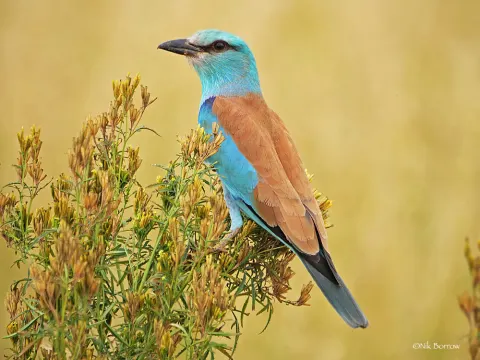
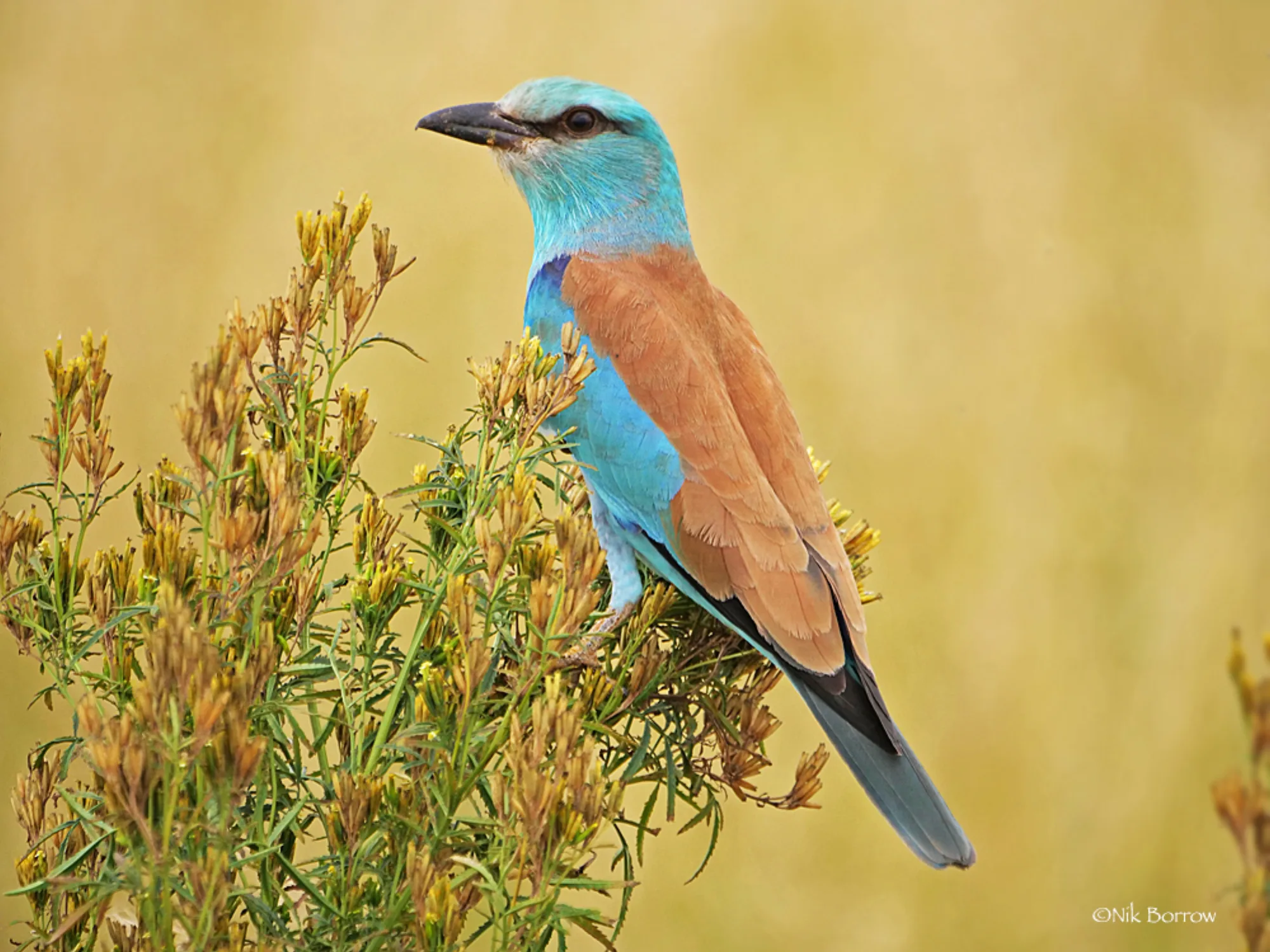
A flash of blue against an orange-brown back can reveal a European Roller perched in open country. This stocky bird measures 29 to 32 cm long, with a wingspan of 52 to 58 cm. In its strong, direct flight, blue contrasts with the blue-black tips of its flight feathers. Males and females look alike, while young birds have duller colouring. Listen, too, for a harsh, crow-like call, or a noisy series of calls when the bird is alarmed.
European Rollers breed across parts of northern Africa, southern and east-central Europe, and Asia as far east as western China. They favour warm, dry, open country with scattered trees, usually in the lowlands. Oak and pine woodland with clearings provides prime breeding habitat, though farms and orchards are also used. These long-distance migrants winter south of the Sahara, often in dry wooded savanna and bushy plains. Birds from south-west Europe travel to Angola, Namibia and Botswana, while those from eastern Europe spend the winter farther east in Zambia, Zimbabwe and Botswana.
Look for a roller sitting prominently on a tree, post or overhead wire, watching for insects and small animals. Beetles dominate the adult diet, while chicks mainly eat insects such as grasshoppers and bush crickets. Pairs usually nest in tree holes, though they sometimes use cavities in rocks or buildings. Both parents care for the young, which leave the nest after 26 to 27 days. Hunting during migration around the Mediterranean and killing for food in Oman threaten the species. Agricultural changes remove trees and hedges used for nesting and hunting, while pesticides reduce its insect food.
Written from the English Wikipedia article European roller (CC BY-SA 4.0).
- Records
- 95,423
- Countries
- 89
- Atlas places
- 24
- Kruger National Park· South Africa
- Ngorongoro Conservation Area· Tanzania
- Serengeti National Park· Tanzania
- iSimangaliso Wetland Park· South Africa
- Tsavo East National Park· Kenya
- Tsavo West National Park· Kenya
- Zambezi National Park· Zimbabwe
- Akagera National Park· Rwanda
- Chobe National Park· Botswana
- Etosha National Park· Namibia
- Hluhluwe-iMfolozi Park· South Africa
- Hwange National Park· Zimbabwe
- Okavango Delta· Botswana
- Queen Elizabeth National Park· Uganda
- Tarangire National Park· Tanzania
- Bwabwata National Park· Namibia
- Central Kalahari Game Reserve· Botswana
- Gonarezhou National Park· Zimbabwe
- Kafue National Park· Zambia
- Liuwa Plain National Park· Zambia
- Mapungubwe National Park· South Africa
- Murchison Falls National Park· Uganda
- Nairobi National Park· Kenya
- Udawalawe National Park· Sri Lanka
These are open occurrence records, so they show where people looked for and recorded the European Roller as much as where it lives. Cells are up to 25 km across, and every location is generalised to its cell.
Generalised encounter areas, not exact locations. Each shape is a grid cell coloured by how likely the species is there.
- Very likelyFrance25 km zone · high confidence · 28237 records · updated 86 days ago
- Very likelySouth Africa25 km zone · high confidence · 18368 records · updated 86 days ago
- Very likelySpain25 km zone · high confidence · 9096 records · updated 86 days ago
- Very likelyIndia25 km zone · high confidence · 5419 records · updated 86 days ago
- Very likelyGeorgia25 km zone · high confidence · 3128 records · updated 86 days ago
- Very likelyPortugal25 km zone · high confidence · 2260 records · updated 86 days ago
- Very likelyTanzania25 km zone · high confidence · 2203 records · updated 86 days ago
- Very likelyUnited Arab Emirates25 km zone · high confidence · 2055 records · updated 86 days ago
- Very likelyTürkiye25 km zone · high confidence · 1944 records · updated 86 days ago
- Very likelyIsrael25 km zone · high confidence · 1793 records · updated 86 days ago
Conservation status not assessed here yet, so every location is generalised to its grid cell.