Oriental Magpie-Robin
Copsychus saularis
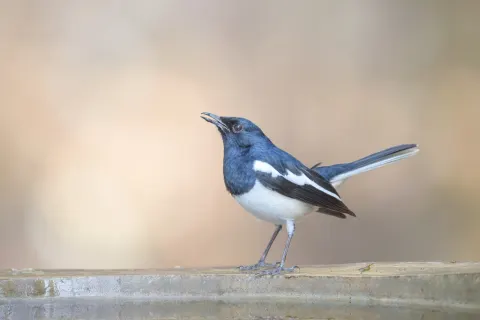
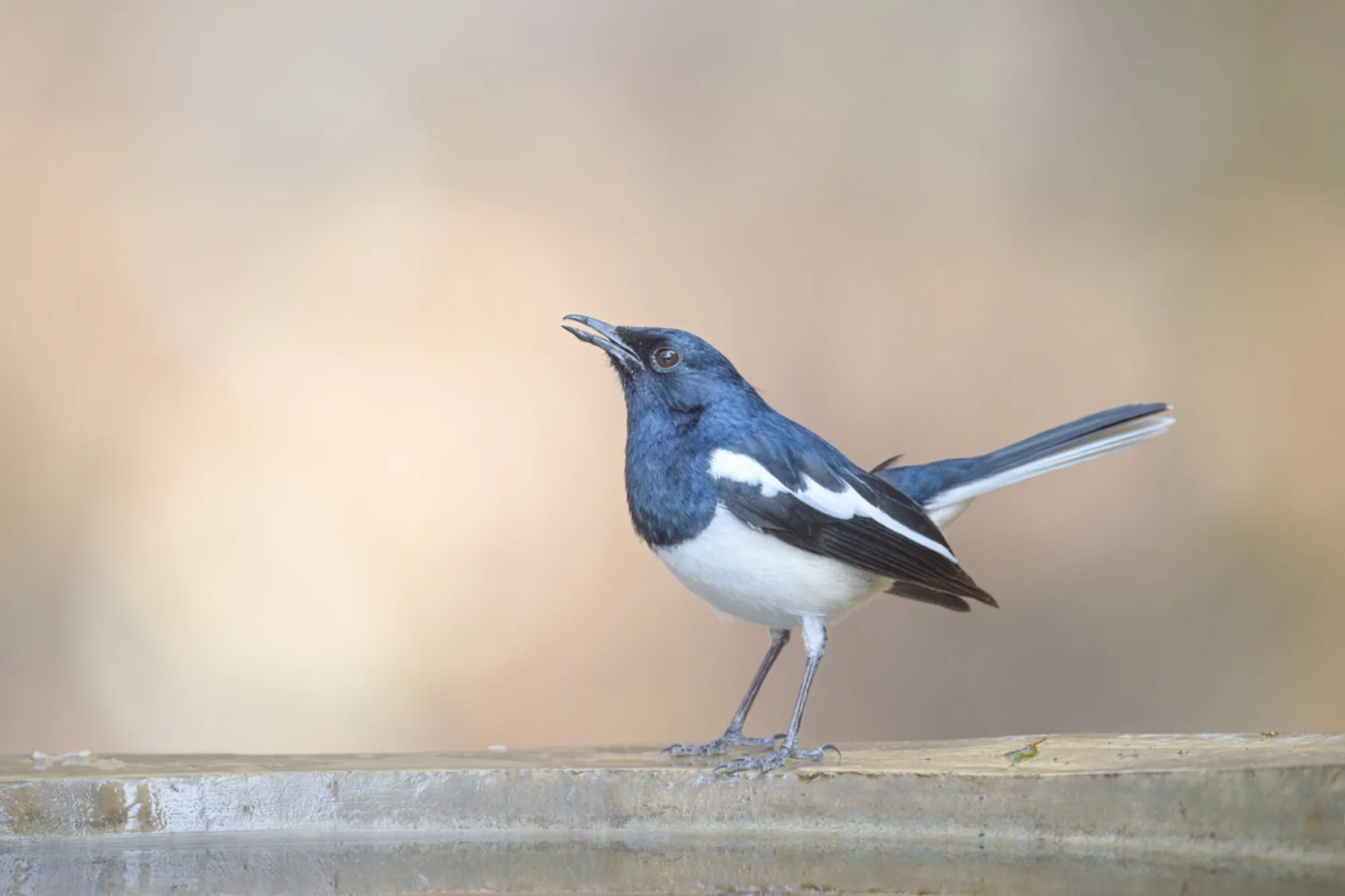
A long, cocked tail is a useful clue when an Oriental Magpie-Robin hops across the ground or searches through leaf litter. This small bird measures 19 centimetres from bill to tail. The male has a black head, throat and back, with a white shoulder patch, white underparts and white sides to the tail. Females are generally greyish black above and greyish white below, while young birds have scaly brown heads and upperparts. Female plumage varies across the bird's range, and some females in Sri Lanka and southern India are nearly as dark as males.
Across much of the Indian subcontinent and in Southeast Asia, the species lives in open woodland, cultivated land, forests and urban gardens. It often lives close to human habitations and is commonly seen near the ground, though males sing loudly from treetops and other high perches during the breeding season. Their songs can include imitations of other birds' calls, and neighbouring birds may have different song dialects. Insects and other invertebrates make up most of the diet, but magpie-robins occasionally eat geckos or fish and take flower nectar. Often active late in the evening, they sometimes bathe in rainwater gathered on leaves.
In India, the main breeding period runs from March to July, while in Southeast Asia it lasts from January to June. Nests are tucked into tree hollows, wall or building niches, and nest boxes, with grass lining the cavity. Females do most of the nest building and more of the feeding of young, while males defend their territories and nests. The birds have declined in some areas, affected by habitat changes and poaching for the pet bird trade, and are still sold as pets in parts of Asia.
Written from the English Wikipedia article Oriental magpie-robin (CC BY-SA 4.0).
- Records
- 729,335
- Countries
- 21
- Atlas places
- 20
- Bandipur National Park· India
- Kanha National Park· India
- Nagarhole National Park· India
- Eravikulam National Park· India
- Jim Corbett National Park· India
- Periyar National Park· India
- Ranthambore National Park· India
- Annapurna Conservation Area· Nepal
- Baluran National Park· Indonesia
- Bandhavgarh National Park· India
- Chitwan National Park· Nepal
- Danum Valley Conservation Area· Malaysia
- Kaziranga National Park· India
- Langtang National Park· Nepal
- Royal Belum State Park· Malaysia
- Sundarbans National Park· India
- Tadoba Andhari Tiger Reserve· India
- Udawalawe National Park· Sri Lanka
- West Bali National Park· Indonesia
- Yala National Park· Sri Lanka
These are open occurrence records, so they show where people looked for and recorded the Oriental Magpie-Robin as much as where it lives. Cells are up to 25 km across, and every location is generalised to its cell.
Generalised encounter areas, not exact locations. Each shape is a grid cell coloured by how likely the species is there.
- Very likelyIndia25 km zone · high confidence · 487450 records · updated 86 days ago
- Very likelyChina25 km zone · high confidence · 64332 records · updated 86 days ago
- Very likelyThailand25 km zone · high confidence · 42945 records · updated 86 days ago
- Very likelyTaiwan25 km zone · high confidence · 40234 records · updated 86 days ago
- Very likelySri Lanka25 km zone · high confidence · 19917 records · updated 86 days ago
- Very likelyNepal25 km zone · high confidence · 15418 records · updated 86 days ago
- Very likelySingapore25 km zone · high confidence · 13697 records · updated 86 days ago
- Very likelyHong Kong SAR China25 km zone · high confidence · 11525 records · updated 86 days ago
- Very likelyBangladesh25 km zone · high confidence · 9363 records · updated 86 days ago
- Very likelyCambodia25 km zone · high confidence · 7160 records · updated 86 days ago
Conservation status not assessed here yet, so every location is generalised to its grid cell.