Giant Slippery Frog
Conraua goliath
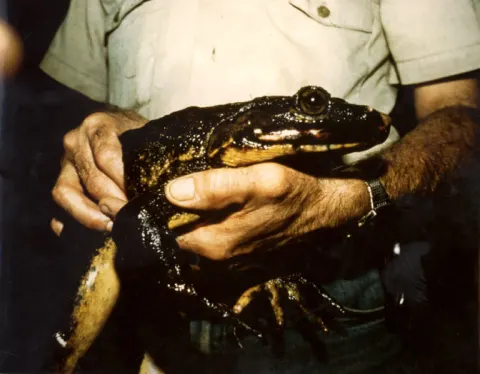
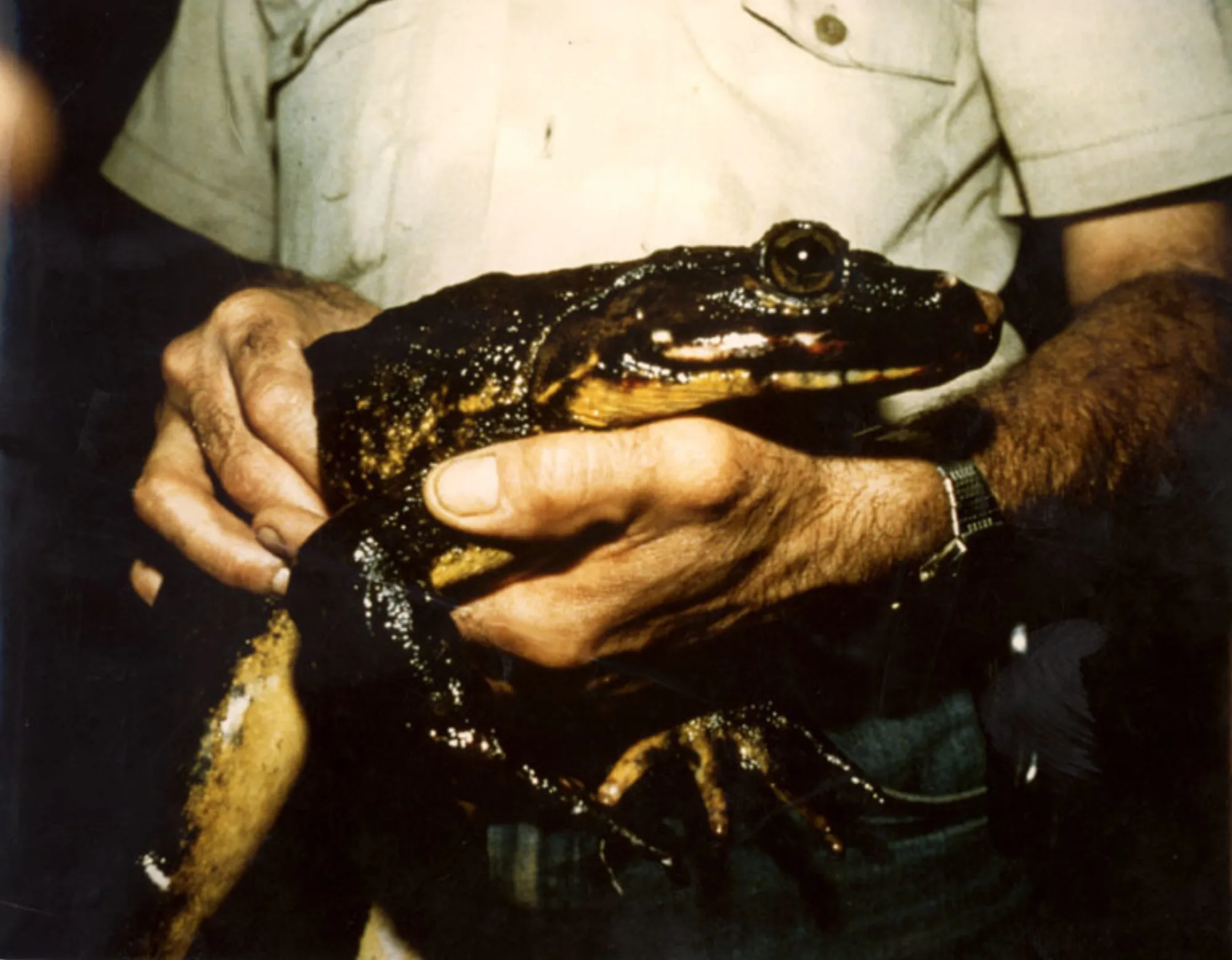
Near waterfalls and fast-flowing rivers in Cameroon and Equatorial Guinea lives the Giant Slippery Frog, the largest living frog. Its range is small, largely confined to a fringe of dense equatorial forest near the coast, with rivers running through the area. Look for a green sienna back, granular skin and yellow or orange colouring underneath and on the lower limbs. Its toes are fully webbed, and with their legs stretched out, the biggest frogs measure just over 80 cm from end to end. Males and females look very similar, and frogs may rest on rocks during the day.
Goliath frogs hunt both on land and in water, typically waiting to catch prey by stealth or surprise. Their varied diet includes insects, crustaceans, gastropods and other small animals, with food choices differing between weight groups. Breeding takes place in or near rivers, where the frogs make semi-circular nests by clearing or enlarging pools, or by digging new ones. They sometimes move large stones while digging, and adults have been observed guarding nests at night. Egg masses can contain several hundred to a few thousand eggs and are often attached to aquatic vegetation. Tadpoles take between 85 and 95 days to develop, and their nests may be reused by successive groups.
Hunting for food is the primary threat to the species, while habitat loss and degradation also affect it. Frogs have been exported extensively for zoos and the pet trade, and deforestation and parasites add to the pressures they face. In its native range, people catch them with nets, sometimes using lanterns to attract their attention.
Written from the English Wikipedia article Goliath frog (CC BY-SA 4.0).
- Records
- 39
- Countries
- 1
No atlas park has a record of the Giant Slippery Frog in or around it yet.
These are open occurrence records, so they show where people looked for and recorded the Giant Slippery Frog as much as where it lives. Cells are up to 25 km across, and every location is generalised to its cell.
Generalised encounter areas, not exact locations. Each shape is a grid cell coloured by how likely the species is there.
- Very likelyCameroon25 km zone · medium confidence · 39 records · updated 80 days ago
Conservation status not assessed here yet, so every location is generalised to its grid cell.