Black Wildebeest
Connochaetes gnou
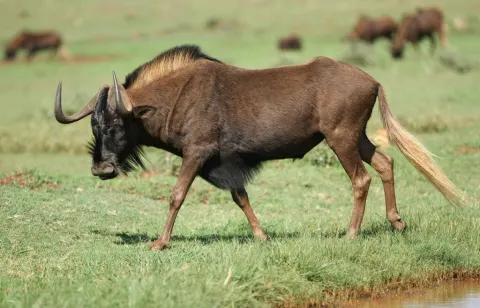
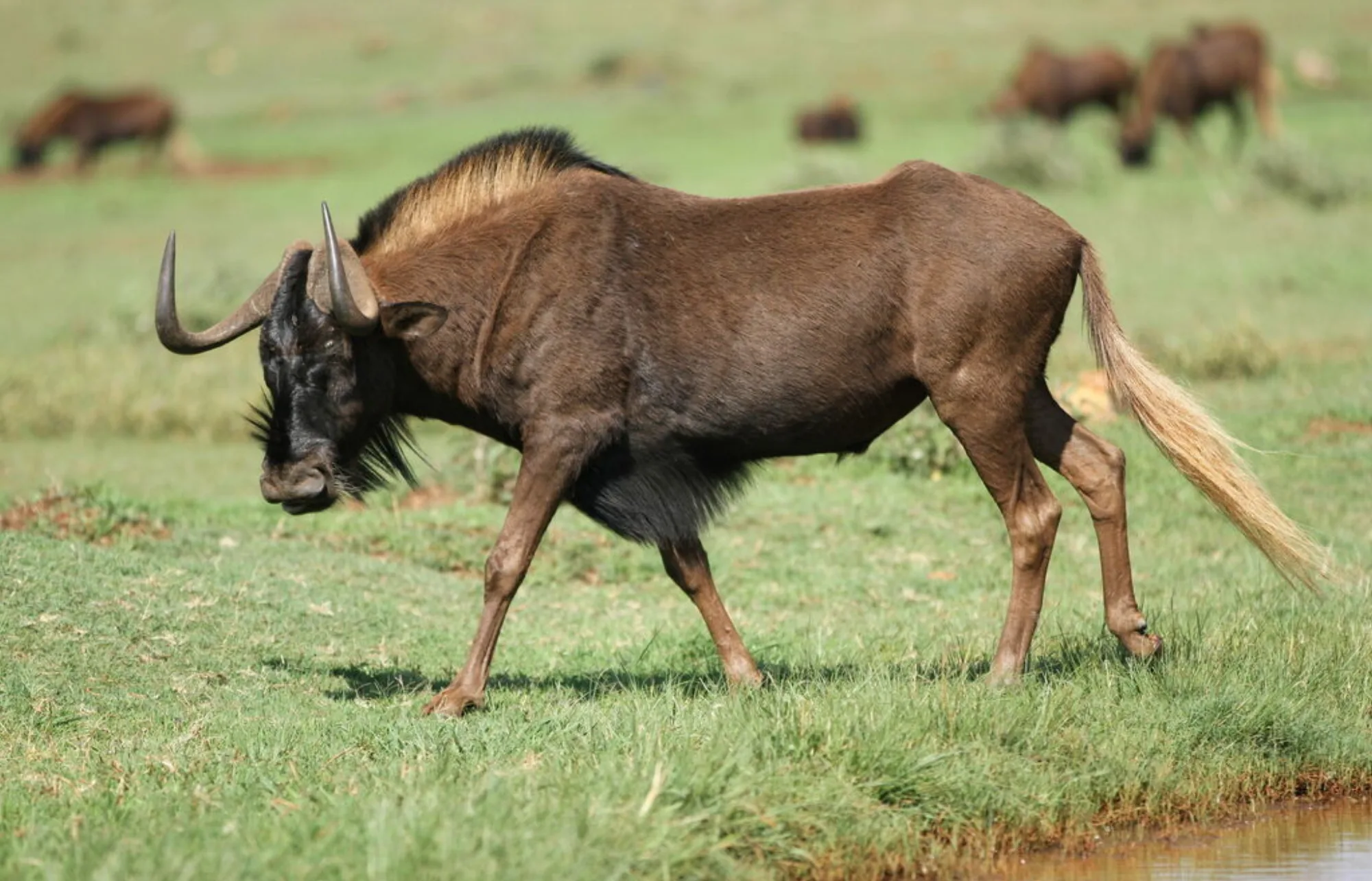
A long, bright white tail gives the Black Wildebeest its other name, the white-tailed gnu. Its coat ranges from dark brown to black, with a standing mane and long dark hair beneath the belly and between the forelegs. Both sexes have forward-curving horns, although those of females are shorter and narrower. Calves have shaggy, fawn-coloured coats, while adults become shaggier in winter.
Native to southern Africa, this wildebeest lives on grasslands, open plains and karoo shrublands, from mountainous country to lower hills. It has been reintroduced in Lesotho and Eswatini, and introduced to Namibia and Kenya. Today, almost all live in reserves or on farms, where their movements are limited. Look for them in the early morning or late afternoon, when they are most active; they generally rest during the heat of the day. A herd approached by a person may snort, run a short distance and stop to look back, repeating the pattern if approached again. Female herds contain adults and their young, while other groups consist of bachelor males or territorial bulls. They mainly graze, favouring short karoo grasses, but also eat herbs and shrubs when grass is scarce. Water is essential, although they do not need to drink every day.
Breeding takes place between February and April, and a single calf is usually born after about 8.5 months. A calf stays beside its mother for a year, until she gives birth again. Hunting for hides and meat nearly wiped out natural populations in the 19th century, and the species remains largely confined to farms and protected reserves. Hybridisation with the blue wildebeest is considered a potential threat, while outbreaks of anthrax have also proved deadly.
Written from the English Wikipedia article Black wildebeest (CC BY-SA 4.0).
- Records
- 63
- Countries
- 2
- Atlas places
- 5
These are open occurrence records, so they show where people looked for and recorded the Black Wildebeest as much as where it lives. Cells are up to 25 km across, and every location is generalised to its cell.
Generalised encounter areas, not exact locations. Each shape is a grid cell coloured by how likely the species is there.
- Very likelySouth Africa25 km zone · medium confidence · 60 records · updated 80 days ago
- LikelyNamibia25 km zone · medium confidence · 3 records · updated 80 days ago
Conservation status not assessed here yet, so every location is generalised to its grid cell.