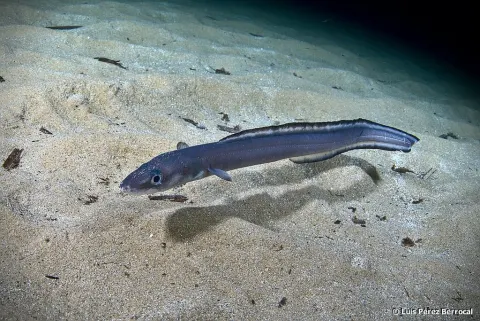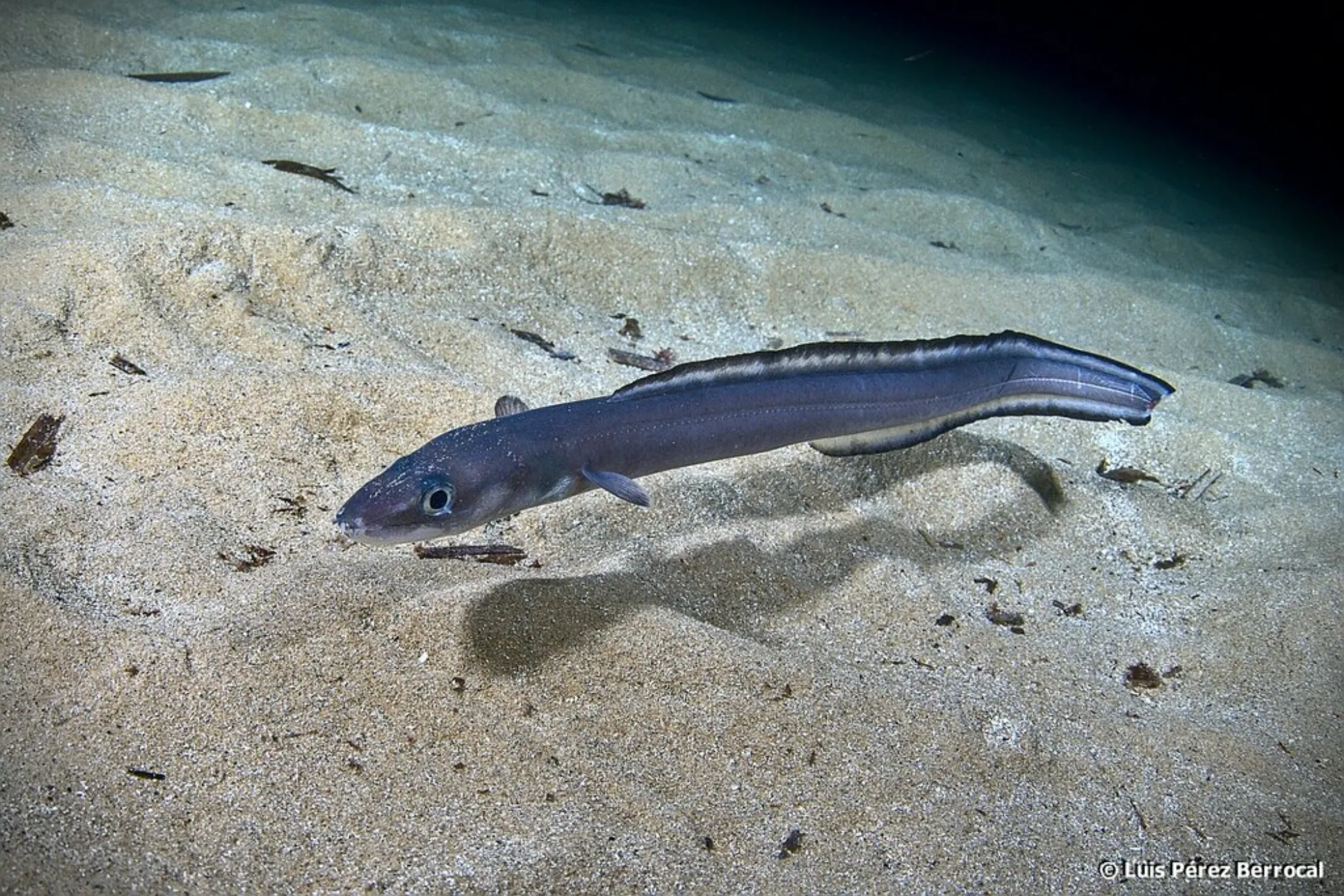
Conger Eel
Conger conger
Long, scaleless and usually grey, the Conger Eel has a white belly and a line of small white spots along its side. Its colour can also be blackish, and its head has a rounded, prominent snout. Adults average 1.5 m in length, with the largest known reaching around 3 m. Its range extends from Norway and Iceland south to Senegal in the eastern Atlantic, and includes the Mediterranean and Black Sea. It can sometimes be seen in shallow water by the shore, though adults generally move into deeper water. Young congers favour rough, rocky ground near the coast; in the northern Adriatic, they also inhabit rocky reefs known as tegnùe.
Congers usually shelter in holes among rocks, sometimes sharing one with a moray eel. They emerge at night to hunt, feeding mainly on fish, cephalopods and crustaceans, and may also scavenge dead or rotting fish. Large congers can pose a danger to divers. Between 5 and 15 years of age, congers undergo physical changes before migrating to spawning areas in the Mediterranean and Atlantic. Females produce several million eggs, and both sexes die after spawning. The larvae then swim back towards shallower water, where they live until maturity. Congers' habit of seeking crevices on the seafloor can bring them into contact with submerged munitions and the toxins leaking from corroded casings. A 2012 study found more mercury and arsenic in congers living near a submerged munitions dump than elsewhere, and some had severe skin lesions and nematode infestations.
Written from the English Wikipedia article European conger (CC BY-SA 4.0).
- Records
- 4,785
- Countries
- 9
No atlas park has a record of the Conger Eel in or around it yet.
These are open occurrence records, so they show where people looked for and recorded the Conger Eel as much as where it lives. Cells are up to 25 km across, and every location is generalised to its cell.
Generalised encounter areas, not exact locations. Each shape is a grid cell coloured by how likely the species is there.
- Very likelyFrance25 km zone · medium confidence · 2875 records · updated 80 days ago
- Very likelyUnited Kingdom25 km zone · medium confidence · 943 records · updated 80 days ago
- Very likelyIreland25 km zone · medium confidence · 407 records · updated 80 days ago
- Very likelyPortugal25 km zone · medium confidence · 367 records · updated 80 days ago
- Very likelySpain25 km zone · medium confidence · 111 records · updated 80 days ago
- Very likelyIsle of Man25 km zone · medium confidence · 45 records · updated 80 days ago
- LikelyNorway25 km zone · medium confidence · 21 records · updated 80 days ago
- LikelyItaly25 km zone · medium confidence · 7 records · updated 80 days ago
- PossibleCroatia25 km zone · medium confidence · 9 records · updated 80 days ago
Conservation status not assessed here yet, so every location is generalised to its grid cell.