Star-nosed Mole
Condylura cristata
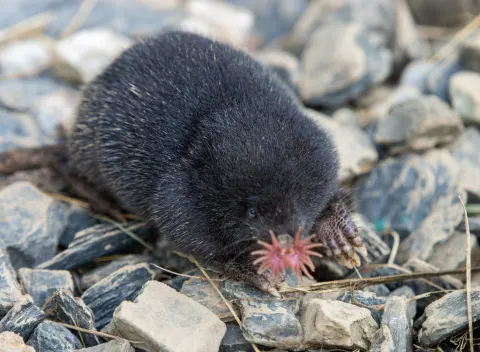
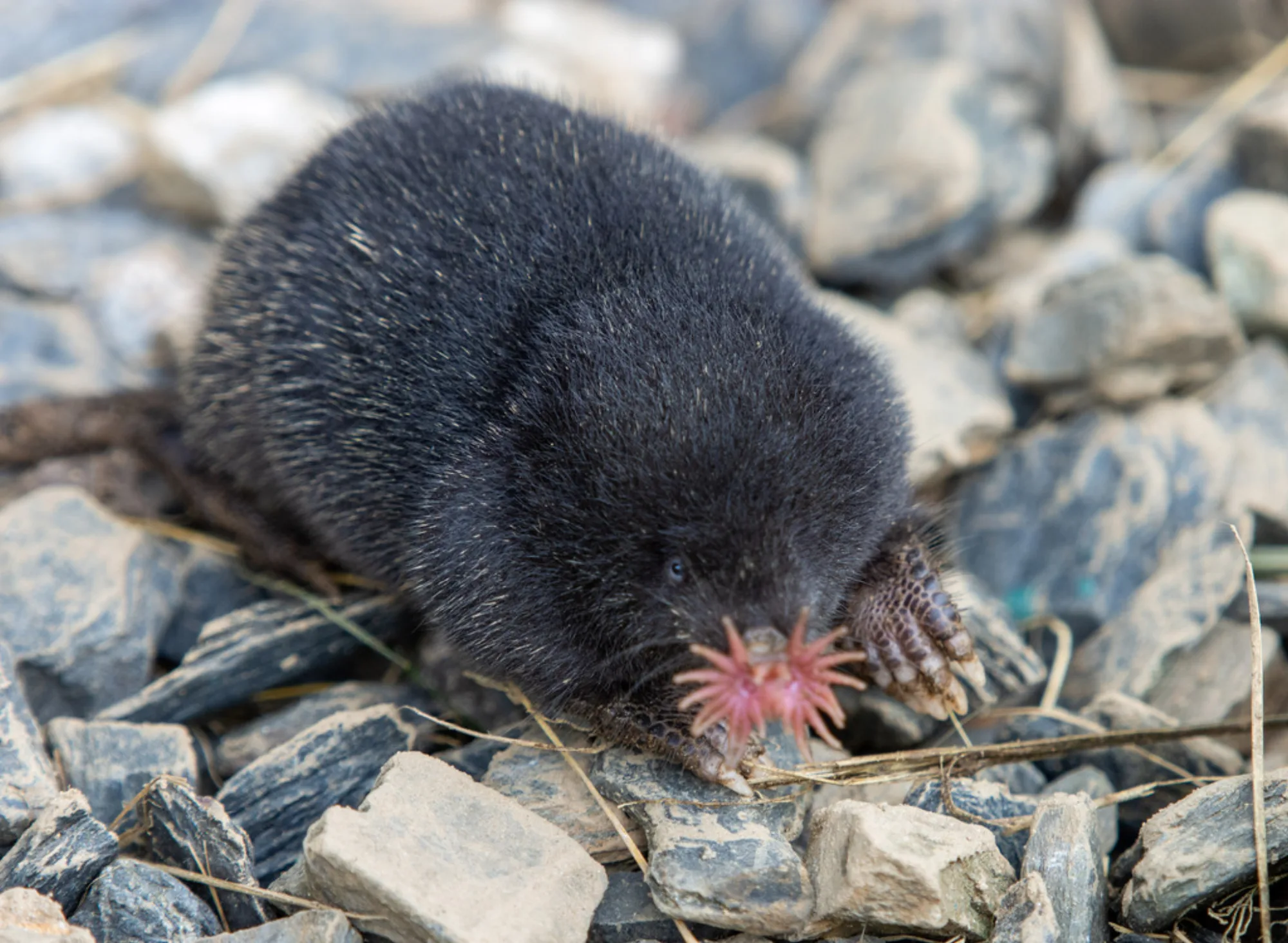
With a nose shaped like a star, the Star-nosed Mole (Condylura cristata) is a small, semiaquatic mammal about the size of a hamster. Its distinctive nose has 22 fleshy, finger-like projections that move constantly as it explores. Functionally blind, it uses this sensitive structure to feel its surroundings and find food.
The mole occurs in northeastern North America, chiefly in moist lowlands. It favours marshes and wet ground with poor drainage, although it has also been found in dry meadows away from water. In the Great Smoky Mountains, records reach 1,676 m. A capable swimmer, it searches for food on stream and pond bottoms as well as in shallow tunnels, which often open underwater. It can smell beneath the surface by blowing bubbles onto objects or scent trails, then drawing them back into its nose. Active by day and night, it continues to forage in winter, tunnelling through snow and swimming beneath ice. Its food includes aquatic and land insects, worms, molluscs and aquatic crustaceans, along with small fish and amphibians. In under 2 seconds, it can find and consume 8 individual prey items.
Breeding takes place in late winter or early spring, with a litter usually born in late spring or early summer. A female typically has four or five young, and may have a second litter if the first does not survive. The young become independent after about 30 days and reach maturity after 10 months. Predators include owls, foxes, weasels, mink, large fish and domestic cats.
Written from the English Wikipedia article Star-nosed mole (CC BY-SA 4.0).
- Records
- 87
- Countries
- 2
- Atlas places
- 2
These are open occurrence records, so they show where people looked for and recorded the Star-nosed Mole as much as where it lives. Cells are up to 25 km across, and every location is generalised to its cell.
Generalised encounter areas, not exact locations. Each shape is a grid cell coloured by how likely the species is there.
- Very likelyCanada25 km zone · medium confidence · 53 records · updated 80 days ago
- Very likelyUnited States25 km zone · medium confidence · 34 records · updated 80 days ago
Conservation status not assessed here yet, so every location is generalised to its grid cell.