Common Wood Pigeon
Columba palumbus
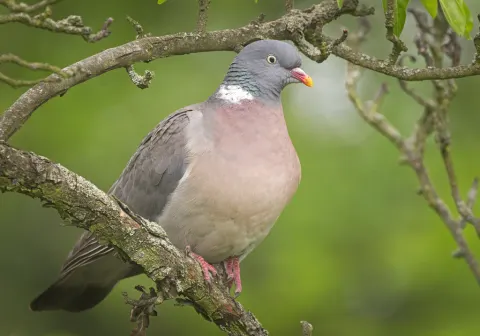
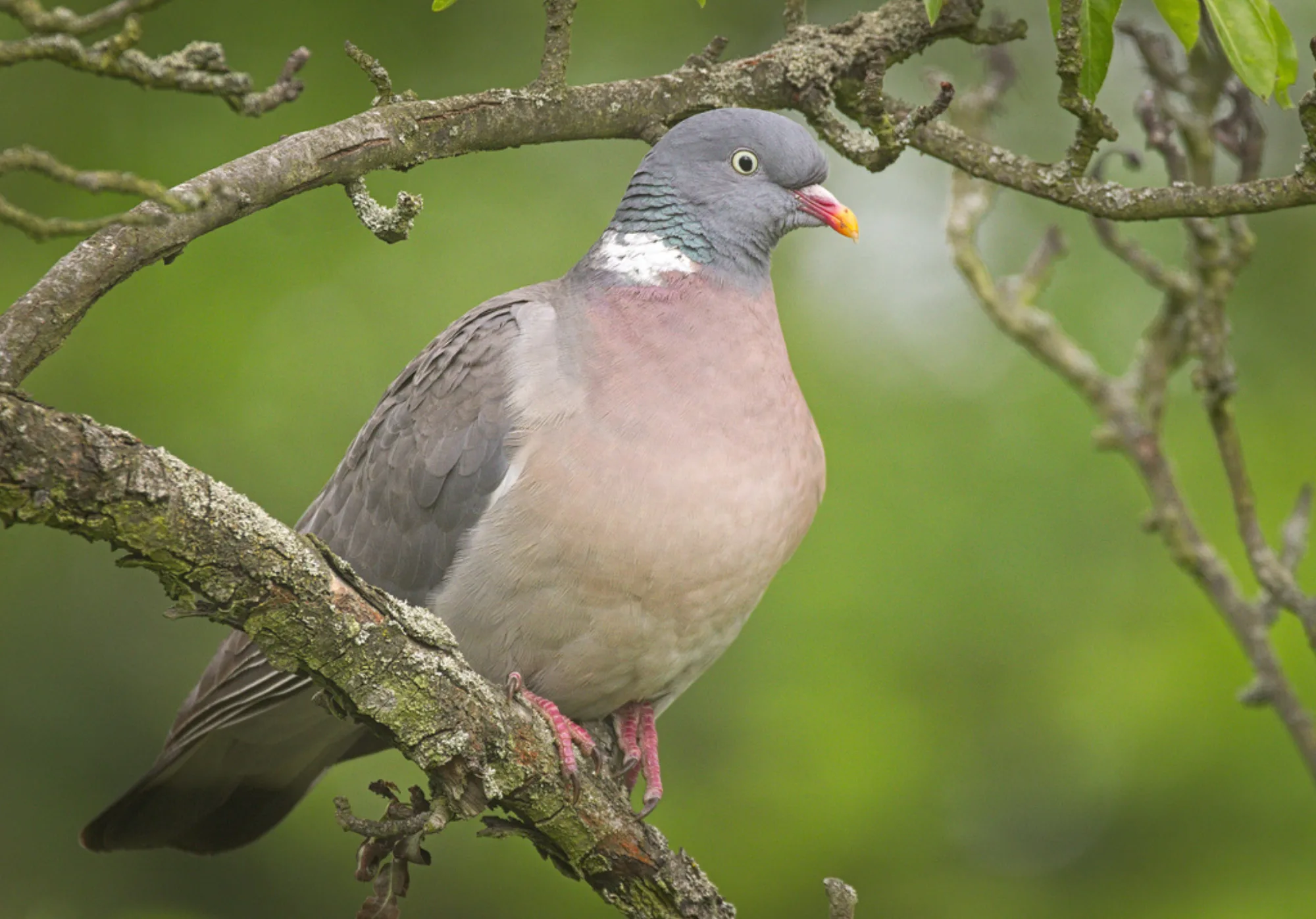
A loud clatter on take-off may be the first sign of a Common Wood Pigeon, although its repeated cooing call is often heard before the bird is seen. Large for a pigeon, it measures 38 to 44.5 cm and has mainly grey plumage, a pinkish breast and white on its neck and wings. Adults have green and white neck patches and pale yellow eyes, while juveniles look lighter grey and lack the white neck patches.
Native to the western Palearctic, the species is resident and often abundant in southern and western Europe. It migrates from colder regions of northern and eastern Europe and western Asia. In Great Britain, look for wood pigeons in parks and gardens, as well as in towns and cities. They perch on trees and buildings to survey their surroundings, and often gather in very large flocks outside the breeding season. Rural birds are wary, but those in urban areas can become exceptionally tame. Their food is mainly plant matter, including young shoots, seedlings, grain, fruit and berries, with ants, larvae and small worms sometimes on the menu. They need open water for drinking and bathing.
Wood pigeons breed in trees in woodland, parks and gardens, often favouring trees near roads and rivers. A simple nest of sticks holds two white eggs, which hatch after 17 to 19 days. Breeding can take place throughout the year when food is plentiful, though it usually peaks between April and October. Crows, jays, magpies, stoats, invasive brown rats and grey squirrels can attack nests. Birds of prey and domestic cats also take wood pigeons, while hunting is widespread across much of the bird's range.
Written from the English Wikipedia article Common wood pigeon (CC BY-SA 4.0).
- Records
- 2,317,093
- Countries
- 77
- Atlas places
- 3
These are open occurrence records, so they show where people looked for and recorded the Common Wood Pigeon as much as where it lives. Cells are up to 25 km across, and every location is generalised to its cell.
Generalised encounter areas, not exact locations. Each shape is a grid cell coloured by how likely the species is there.
- Very likelyUnited Kingdom25 km zone · high confidence · 1004439 records · updated 86 days ago
- Very likelyBelgium25 km zone · high confidence · 308876 records · updated 86 days ago
- Very likelyNorway25 km zone · high confidence · 231114 records · updated 86 days ago
- Very likelySpain25 km zone · high confidence · 195135 records · updated 86 days ago
- Very likelyFrance25 km zone · high confidence · 167932 records · updated 86 days ago
- Very likelyNetherlands25 km zone · high confidence · 53248 records · updated 86 days ago
- Very likelyPortugal25 km zone · high confidence · 49000 records · updated 86 days ago
- Very likelyCzechia25 km zone · high confidence · 31873 records · updated 86 days ago
- Very likelyGermany25 km zone · high confidence · 30951 records · updated 86 days ago
- Very likelyFinland25 km zone · high confidence · 28958 records · updated 86 days ago
Conservation status not assessed here yet, so every location is generalised to its grid cell.