Stock Dove
Columba oenas
Look for the Stock Dove in open woodland or along a coast where cliffs offer places to nest. This member of the pigeon and dove family ranges widely across the western Palearctic, from central Scandinavia south to northwest Africa. Birds in western and southern populations stay year-round, while those farther northeast migrate to escape colder winters.
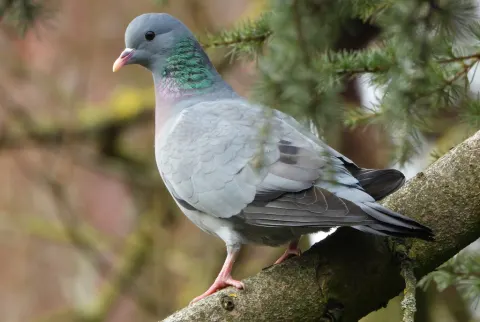
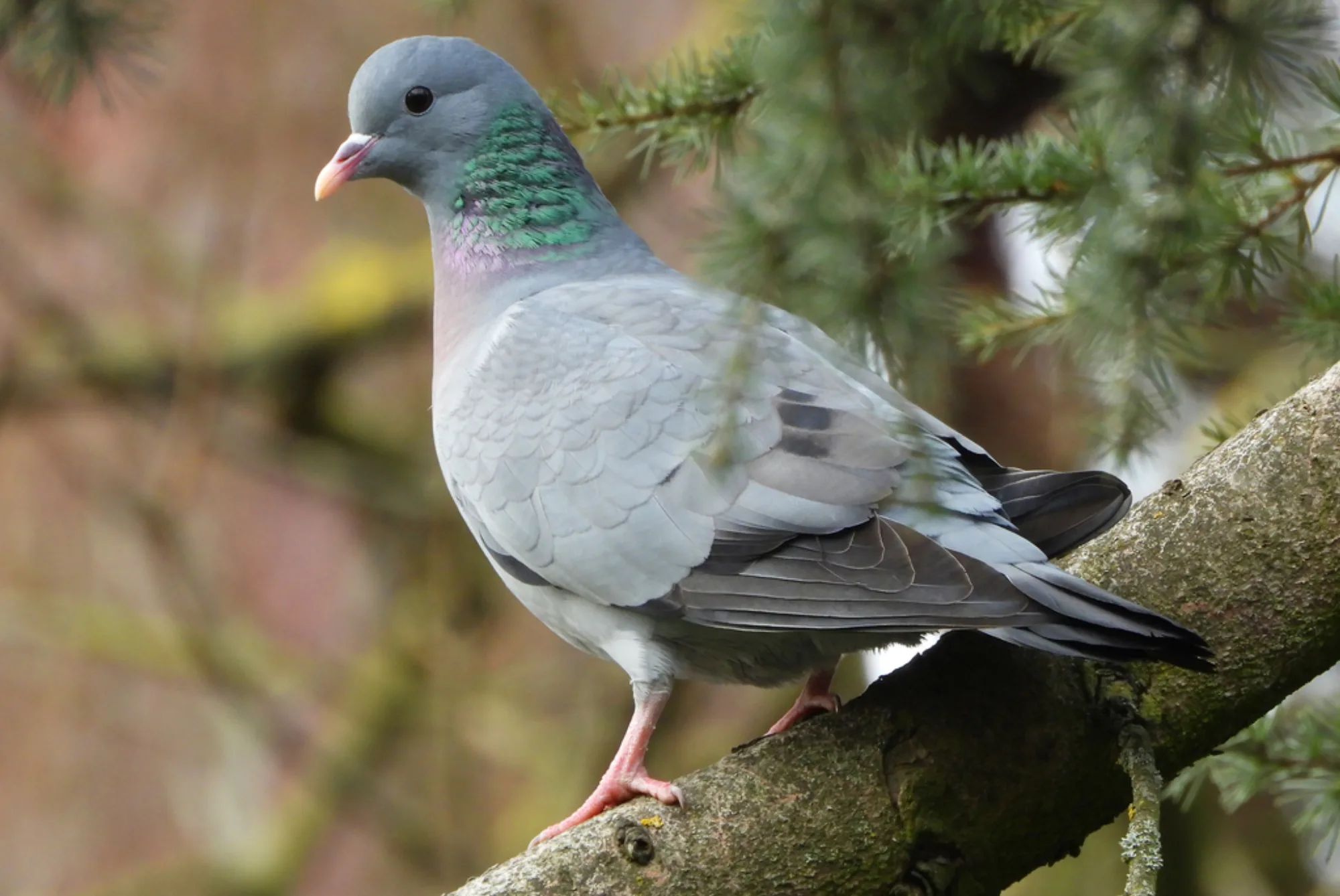
At 28 to 34 cm long, it has blue-grey plumage, a pinkish-purple wash on the breast and an iridescent neck patch that shifts from green to purple with the light. Its dark eyes and pink bill with a yellow tip add to the picture, although young birds lack the gleaming neck patch. In flight, look for dark grey underwings and a dark edge along the back of each wing. Its short, deep call has a grunting quality, distinct from the cooing of a common wood pigeon. Stock Doves are sociable, often joining wood pigeons and usually gathering in flocks ranging from a few birds to a few tens.
They forage on the ground, eating mostly plants, including young shoots and seedlings, as well as grain, insects and snails. In some places, acorns and pine seeds make up most of their diet. A pair usually nests in a hole in an old tree, though rabbit burrows, cliff cracks and nest boxes can also be used. Stock Doves favour nesting close together and generally lay two eggs per clutch. Deforestation has affected their nesting habitat, while plantations offer fewer holes than old forests, leaving the birds scarcer there.
Written from the English Wikipedia article Stock dove (CC BY-SA 4.0).
- Records
- 433,469
- Countries
- 14
No atlas park has a record of the Stock Dove in or around it yet.
These are open occurrence records, so they show where people looked for and recorded the Stock Dove as much as where it lives. Cells are up to 25 km across, and every location is generalised to its cell.
Generalised encounter areas, not exact locations. Each shape is a grid cell coloured by how likely the species is there.
- Very likelyUnited Kingdom25 km zone · high confidence · 265186 records · updated 80 days ago
- Very likelyBelgium25 km zone · high confidence · 53659 records · updated 80 days ago
- Very likelyNorway25 km zone · high confidence · 26596 records · updated 80 days ago
- Very likelyNetherlands25 km zone · high confidence · 22730 records · updated 80 days ago
- Very likelyFinland25 km zone · high confidence · 20908 records · updated 80 days ago
- Very likelyFrance25 km zone · high confidence · 16763 records · updated 80 days ago
- Very likelySpain25 km zone · high confidence · 15664 records · updated 80 days ago
- Very likelySweden25 km zone · high confidence · 4375 records · updated 80 days ago
- Very likelyGermany25 km zone · high confidence · 2712 records · updated 80 days ago
- Very likelySwitzerland25 km zone · high confidence · 2273 records · updated 80 days ago
Conservation status not assessed here yet, so every location is generalised to its grid cell.